
Arowana Care Guide - Furry Critter Network

Arowana

Quick Facts

🔬 Scientific Name
Osteoglossum bicirrhosum
⭐ Care Level
Advanced
😊 Temperament
Semi-Aggressive
📏 Adult Size
36-48 inches
⏱️ Lifespan
15-20 years
🐟 Tank Size Minimum
250 gallons
🌡️ Temperature Range
75-82°F
⚗️ Ph Range
6.0-7.5
🍽️ Diet Type
Carnivore
🌍 Origin
South America (Amazon Basin)

Arowana - Names & Recognition

The Arowana, scientifically known as Osteoglossum bicirrhosum, belongs to the ancient family Osteoglossidae, commonly referred to as the bony-tongued fishes. This family represents one of the oldest lineages of freshwater fish, with fossil records dating back over 150 million years to the Jurassic period. The species name 'bicirrhosum' refers to the two barbels located on the lower jaw, which serve as sensory organs for detecting prey at the water's surface.

In the aquarium trade, this species is most commonly known as the Silver Arowana due to its distinctive metallic silver coloration. Other regional names include Arawana, Water Monkey (referring to their impressive leaping ability), and Dragon Fish, a name shared with several Asian Arowana species. In their native South America, they are called Aruanã in Brazil and Arahuana in various indigenous languages, both terms from which the common English name derives.

The Silver Arowana should not be confused with the more expensive and heavily regulated Asian Arowanas of the genus Scleropages, which include the prized Super Red, Golden, and Green varieties. While sharing similar body plans and the dragon fish moniker, Asian Arowanas are separate species with different care requirements and legal restrictions. The Silver Arowana remains the most accessible and commonly kept species in the hobby, offering the iconic arowana appearance without the extreme costs or CITES restrictions associated with their Asian cousins.

Arowana Physical Description

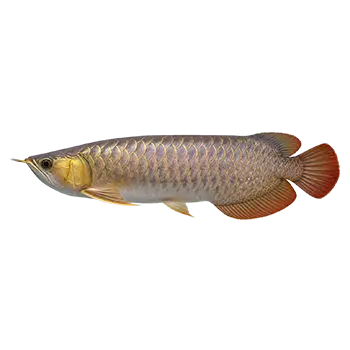
The Arowana possesses one of the most distinctive and primitive body plans among freshwater fish. Adults typically reach 36 to 48 inches in captivity, with exceptional specimens occasionally exceeding 4 feet in their natural habitat. Their elongated, laterally compressed body is covered in large, metallic scales that reflect light beautifully, creating an almost mirror-like appearance under proper aquarium lighting.

The coloration of Silver Arowanas is predominantly silvery-white with a subtle iridescent sheen that shifts between silver, green, and blue depending on lighting conditions. Juveniles display a more pronounced yellowish tint with darker bars that fade as the fish matures. The scales are arranged in perfect horizontal rows, each one edged with darker pigmentation that creates a chainmail-like pattern across the body. The dorsal and anal fins are set far back on the body, nearly meeting the caudal fin, creating a continuous fin surface that aids in their powerful swimming and jumping ability.

One of the most striking features is the upturned mouth, perfectly adapted for surface feeding. The lower jaw extends beyond the upper, housing two prominent barbels that serve as sensory organs for detecting vibrations and movement on the water's surface. These barbels are particularly sensitive and help the Arowana locate prey in murky waters or low-light conditions. The eyes are large and positioned high on the head, providing excellent upward vision for spotting prey above the waterline.

Sexual dimorphism in Silver Arowanas is subtle and typically only apparent in mature specimens. Males tend to develop a more slender body shape and a slightly longer anal fin, while females appear fuller-bodied, especially when carrying eggs. During breeding season, males develop a modified jaw structure to accommodate mouthbrooding duties. However, reliable sexing usually requires observing breeding behavior or expert examination.

Temperament
Arowanas are semi-aggressive predators that will consume any fish small enough to fit in their mouth. They can be territorial with similar-sized tank mates and may become aggressive during feeding. Best kept with robust, similarly-sized fish or as a solo specimen.
Care Level
This species demands advanced fishkeeping experience due to their massive size, specific water requirements, and dietary needs. They are sensitive to water quality degradation and require pristine conditions with powerful filtration systems to thrive.
Diet
Arowanas are obligate carnivores accepting a variety of meaty foods including pellets, frozen foods, and live prey. They readily take quality floating pellets once trained but benefit from dietary variety including shrimp, fish, and insects.
Water Conditions
These fish require consistently warm, clean water with stable parameters. They are sensitive to ammonia and nitrite, requiring robust filtration and regular water changes. Soft to moderately hard, slightly acidic water replicates their natural habitat.
Tank Size
Arowanas require exceptionally large aquariums of 250 gallons minimum for adults, though 300+ gallons is preferred. Tank length is critical as these fish need room to turn; a minimum of 8 feet in length is recommended for full-grown specimens.
Compatibility
Limited compatibility with other species due to their predatory nature and size. Best kept with large, robust tank mates like large catfish, stingrays, or similarly-sized cichlids. Small fish will be consumed without hesitation.
Activity Level
Arowanas are moderately active surface dwellers that patrol their territory with graceful, serpentine movements. They become highly animated during feeding and may jump enthusiastically. Activity increases when hungry or during water changes.
Hardiness
When properly acclimated and maintained in suitable conditions, Arowanas are reasonably hardy fish. However, they are susceptible to drop eye, infections, and scale damage if conditions deteriorate or from poor handling during transport.

Natural Habitat & Range

Silver Arowanas originate from the vast Amazon River basin in South America, with their range extending across Brazil, Peru, Colombia, and the Guianas. They inhabit a variety of freshwater environments including slow-moving rivers, flooded forests, lakes, and backwater lagoons. Their preferred habitat consists of calm, heavily vegetated waters with abundant surface cover from overhanging vegetation and floating plants.

In their natural environment, Arowanas are typically found in blackwater and clearwater tributaries where the water is soft and acidic, with pH values ranging from 6.0 to 7.0. The dark, tannin-stained waters of these habitats provide protection from predators while the overhanging vegetation offers hunting opportunities. Water temperatures in these tropical regions remain consistently warm, typically between 75°F and 84°F throughout the year, with minimal seasonal variation.

During the Amazon's annual flood cycle, Arowanas follow the rising waters into the flooded forest, known locally as igapó or várzea depending on water type. This seasonal flooding dramatically expands their habitat and food sources, allowing access to terrestrial insects, spiders, birds, and small mammals that fall from overhanging branches. This adaptation explains their remarkable jumping ability, as wild Arowanas regularly leap several feet out of the water to capture prey from low-hanging vegetation.

The substrate in their natural habitat varies from sandy bottoms in main river channels to thick layers of decomposing leaves and organic matter in backwater areas. Submerged wood, fallen trees, and root tangles provide shelter for juvenile Arowanas, while adults patrol more open waters near the surface. Understanding these natural conditions is essential for replicating appropriate aquarium environments, particularly regarding water chemistry, temperature, and the presence of surface cover to provide security for these magnificent fish.

Arowana Temperament & Behavior

Arowanas exhibit a complex temperament that combines predatory instincts with surprising intelligence and personality. As apex predators in their natural habitat, they are hardwired to view smaller fish as food rather than companions. Any tank mate that can fit in an Arowana's considerable mouth will eventually become a meal, making careful consideration of companion species essential for community setups.

Despite their predatory nature, Arowanas are not inherently aggressive toward fish they cannot consume. They can coexist peacefully with similarly-sized robust species, though individual personalities vary significantly. Some specimens remain tolerant community members throughout their lives, while others develop territorial behavior that may necessitate solitary keeping. Aggression often intensifies during feeding, when the Arowana's competitive instincts surface, sometimes resulting in accidental injury to tank mates.

One of the most fascinating aspects of Arowana behavior is their apparent intelligence and ability to recognize their keepers. Many owners report that their Arowanas respond to their presence, swimming to the front of the tank in anticipation of feeding. This recognition extends to distinguishing their primary caretaker from strangers, sometimes displaying nervousness or hiding when unfamiliar people approach. They can be trained to accept food from hand and may learn to respond to specific cues associated with feeding time.

Arowanas are surface-dwelling fish that spend most of their time patrolling the upper water column. They swim with a distinctive undulating motion, using their elongated dorsal and anal fins for propulsion. When hunting or excited, they become remarkably fast and agile, capable of precise strikes at prey items. Their famous jumping behavior, while spectacular, poses significant risks in captivity. Arowanas have been known to leap several feet into the air, requiring securely weighted lids to prevent escape and injury.

Stress responses in Arowanas can manifest as erratic swimming, loss of appetite, color fading, and in severe cases, the development of drop eye syndrome. Maintaining a calm environment with consistent routines helps prevent stress-related issues. Sudden movements, loud noises, and changes in lighting can startle these fish, potentially triggering jumping or collision with tank walls. Providing adequate hiding spots or dimmed areas allows Arowanas to retreat when feeling threatened, contributing to their overall well-being and confident behavior.

Tank Setup & Requirements

Housing an Arowana requires a significant commitment to tank size and equipment. The absolute minimum aquarium size for an adult Silver Arowana is 250 gallons, though 300 gallons or larger is strongly recommended. More critical than volume is tank length and width; adults require a minimum of 8 feet in length to turn comfortably, with a width of at least 2.5 feet. Standard 6-foot tanks, while popular, often prove inadequate for fully grown specimens, leading to stunted growth or physical deformities.

Filtration is paramount for Arowana health, as these large, carnivorous fish produce substantial waste. A filtration system capable of turning over the entire tank volume 8-10 times per hour is recommended. Sump systems are ideal, providing adequate biological filtration capacity while keeping bulky equipment outside the display tank. Canister filters can supplement or serve as primary filtration in smaller setups, but multiple units may be necessary. Regular filter maintenance is essential to prevent nitrate accumulation.

Substrate choice is largely aesthetic, as Arowanas spend minimal time near the bottom. Fine sand or bare-bottom setups facilitate waste removal and simplify maintenance. Dark substrates can enhance the fish's coloration through contrast while reducing stress from light reflection. If using substrate, ensure it cannot be ingested accidentally during feeding, as Arowanas occasionally miss prey items that sink.

Aquascaping for Arowanas should prioritize open swimming space while providing some visual barriers and security. Large pieces of driftwood can create territorial boundaries in community setups and provide aesthetic interest. Hardy plants like Anubias or Java Fern attached to wood can survive the occasional disturbance, though delicate planted aquascapes are impractical. Floating plants provide excellent surface cover, reducing stress and mimicking natural habitat conditions, but must be managed to prevent blocking light entirely.

The most critical element of any Arowana setup is a secure, weighted lid. These powerful jumpers can dislodge standard aquarium covers with ease, and escape attempts frequently result in serious injury or death. Glass or acrylic lids with additional weights or clamps are essential. Any openings for equipment must be covered with mesh or blocked entirely. Lighting should be moderate to strong to showcase the fish's metallic scales, with a gradual dimming period to prevent startling during lights-out.

Water Parameters

Maintaining optimal water parameters is crucial for Arowana health and longevity. These fish thrive in warm water with temperatures between 75°F and 82°F, with 78-80°F representing the ideal range for long-term keeping. Consistent temperature is more important than hitting an exact number; fluctuations of more than 2-3 degrees within a day can stress these sensitive fish. Quality heaters with reliable thermostats, preferably titanium for durability, should be used with guards to prevent burns.

Water chemistry for Silver Arowanas should mimic their Amazonian origins. A pH range of 6.0 to 7.5 is acceptable, with slightly acidic conditions between 6.5 and 7.0 being optimal. While adaptable to various pH levels when properly acclimated, sudden shifts can prove harmful. Water hardness should be soft to moderate, with general hardness (GH) between 2-10 dGH and carbonate hardness (KH) between 2-8 dKH. In areas with hard tap water, dilution with RO/DI water may be necessary.

Nitrogen cycle management demands constant attention with Arowanas. Ammonia and nitrite must remain at zero at all times, as these fish are sensitive to even low levels of these compounds. Nitrate should be kept below 20 ppm, with lower levels preferred. Given the heavy bioload of large carnivorous fish, weekly water changes of 30-50% are typically necessary, with some keepers performing multiple smaller changes throughout the week.

Water changes should be performed gradually, matching temperature and chemistry closely to tank water. Dechlorinated tap water is acceptable in most cases, though the addition of Indian almond leaves or commercial blackwater extracts can provide beneficial tannins and slight acidification. These additions also offer antimicrobial properties that may help prevent infections. Aeration is important, and surface agitation from filter returns usually provides adequate oxygenation.

New Arowanas require careful acclimation over 1-2 hours minimum, using drip acclimation methods to gradually adjust to new water parameters. Avoid adding bag water to the display tank to prevent introduction of pathogens. Quarantine of new specimens for 4-6 weeks is strongly recommended given the investment these fish represent and their susceptibility to various diseases that may not be immediately apparent.

Arowana Health & Lifespan

Silver Arowanas are generally hardy fish when maintained in appropriate conditions, with lifespans reaching 15-20 years in captivity under expert care. However, their large size and specific requirements mean that health issues often stem from inadequate husbandry rather than inherent fragility. The most common problems affecting captive Arowanas relate to water quality, diet, and physical trauma from jumping or collision with tank walls. Early detection and treatment of health issues significantly improves outcomes, making regular observation of behavior and appearance essential components of Arowana care.

With proper care, Arowanas can live for two decades or more, becoming true companion fish that recognize their keepers. Signs of declining health include loss of appetite, color fading, clamped fins, erratic swimming, and visible lesions or parasites. Early intervention with water quality improvements and appropriate treatments offers the best prognosis. Given their value and longevity, consulting with a veterinarian experienced in fish medicine is advisable for serious health concerns.

Common Health Issues

  • Drop eye syndrome causes one or both eyes to permanently angle downward - Believed to result from fat deposits, genetic factors, or excessive focus on bottom-dwelling tank mates and sinking food, potentially requiring surgical correction in severe cases.
  • Gill curling occurs when gill plates curl outward rather than lying flat - Typically caused by poor water quality, insufficient oxygen, or rapid growth from overfeeding, sometimes requiring surgical trimming.
  • Anchor worms and fish lice are parasitic infestations visible as thread-like or disc-shaped organisms attached to skin - Requiring manual removal and treatment with antiparasitic medications.
  • Bacterial infections manifest as cloudy eyes - Fin rot, ulcers, or red streaking on the body, typically resulting from stress or injury combined with poor water quality, requiring antibiotic treatment.
  • Scale damage and loss can occur from collisions with tank walls - Aggressive interactions, or bacterial infections, requiring pristine water quality and time to regenerate properly.
  • Swim bladder disorders cause abnormal buoyancy or listing to one side - Potentially from overfeeding, constipation, infection, or injury, requiring fasting and possibly antibiotic treatment.

Preventive Care & Health Monitoring

  • Maintain impeccable water quality through robust filtration - Regular testing, and consistent water change schedules to prevent the majority of health issues affecting Arowanas.
  • Feed a varied, appropriately-sized diet with vitamin supplementation to prevent nutritional deficiencies and reduce the risk of drop eye from fatty food sources. - Feed a varied, appropriately-sized diet with vitamin supplementation to prevent nutritional deficiencies and reduce the risk of drop eye from fatty food sources.
  • Provide a secure - Weighted lid and adequate tank dimensions to prevent jumping injuries and collisions that can cause scale damage, eye injuries, and jaw deformities.
  • Quarantine all new fish and live foods for 4-6 weeks to prevent introduction of parasites and pathogens that could devastate your valuable Arowana. - Quarantine all new fish and live foods for 4-6 weeks to prevent introduction of parasites and pathogens that could devastate your valuable Arowana.

Arowana Feeding & Diet

Arowanas are obligate carnivores with voracious appetites that must be carefully managed to prevent obesity and related health issues. In the wild, their diet consists primarily of fish, insects, crustaceans, and small terrestrial animals that fall into the water or can be captured by jumping. Replicating this varied diet in captivity promotes optimal health, coloration, and natural behavior.

High-quality floating pellets designed for large carnivorous fish should form the staple diet for captive Arowanas. These pellets provide balanced nutrition including vitamins and minerals that may be lacking in whole prey items. Look for pellets with fish meal or whole fish as the primary ingredient, avoiding those heavy in fillers or plant proteins. Pellets should be appropriately sized for the fish, with adults accepting pellets up to 1 centimeter in diameter.

Frozen foods offer excellent dietary variety and are readily accepted by most Arowanas. Quality options include silversides, smelt, prawns, krill, and market shrimp. These should be thawed in tank water before feeding and offered in appropriate portion sizes. Whole fish provide beneficial roughage and exercise for the digestive system, while shell-on shrimp offer calcium and other minerals. Avoid fatty fish like salmon or trout as regular fare, as excessive fat can contribute to drop eye syndrome.

Live foods trigger natural hunting behaviors and provide enrichment, but carry risks of parasite or disease introduction. If offering live feeders, cultivate your own supply or source from reputable dealers and quarantine before feeding. Insects like crickets, roaches, and mealworms make excellent supplemental foods and are less likely to carry fish diseases. Feeder fish should be avoided if possible due to thiaminase content in goldfish and risk of disease transmission.

Feeding frequency decreases as Arowanas grow. Juveniles under 12 inches may be fed 2-3 times daily, while sub-adults receive once or twice daily feedings. Adult Arowanas over 24 inches do well with feeding every other day or 3-4 times weekly. Each meal should be consumed within 2-3 minutes; uneaten food should be removed promptly. Regular fasting days, once or twice weekly, help prevent obesity and digestive issues. Monitor body condition, adjusting feeding amounts to maintain a healthy profile without visible fat deposits behind the head.

Tank Mates & Breeding

Selecting appropriate tank mates for Arowanas requires careful consideration of size, temperament, and the massive aquarium needed to house multiple large fish. The fundamental rule is simple: if it fits in the Arowana's mouth, it will eventually be eaten. This eliminates the vast majority of common aquarium fish from consideration and limits choices to robust species that can match the Arowana's adult size.

Large catfish make popular Arowana companions due to their different ecological niche and substantial size. Suitable options include Common Plecos, Sailfin Plecos, and large Synodontis species, all of which occupy bottom areas the Arowana ignores. Giant Gourami can work in sufficiently large systems, as can large, peaceful cichlids like Severums or mature Geophagus species. Tinfoil Barbs, when kept in appropriate schools, provide mid-water activity without triggering predatory responses.

Freshwater stingrays from the Potamotrygon genus represent perhaps the most popular Arowana tank mates among serious monster fish keepers. These bottom-dwelling rays occupy space the Arowana rarely uses while their disk shape and venomous spine discourage predation. However, rays require even more stringent water quality than Arowanas and add significantly to bioload and tank size requirements. Only very large systems of 500 gallons or more should house both species.

Species to avoid include anything small enough to be consumed, aggressive cichlids that may challenge the Arowana, and delicate fish that cannot tolerate the heavy filtration and water movement required. African cichlids generally make poor companions due to different water chemistry requirements and potential aggression. Avoid fin-nipping species that might target the Arowana's trailing fins, and fast-moving fish that may stress the Arowana during feeding.

Breeding Arowanas in captivity is extremely challenging and rarely achieved in home aquaria. They are mouthbrooders, with males incubating eggs and fry in their mouths for several weeks. Triggering spawning typically requires massive pond systems, seasonal temperature and water level changes, and mature pairs that have established bonds over years. Commercial breeding occurs primarily in Asian and South American facilities with specialized setups far beyond typical hobbyist capabilities.