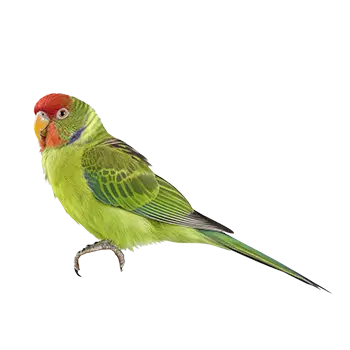

The name kakariki is a Maori word meaning "small green parrot," derived from the Maori kakariki, which itself describes the color green and by extension the small green parakeets that were once abundant throughout the forests of Aotearoa New Zealand. The word has been adopted into New Zealand English as the standard common name for parakeets of the genus Cyanoramphus, and it is used internationally in aviculture to distinguish these birds from the hundreds of other parakeet species worldwide. In formal ornithological contexts, the most commonly kept species are the red-crowned parakeet (Cyanoramphus novaezelandiae) and the yellow-crowned parakeet (Cyanoramphus auriceps), though the genus contains additional species and subspecies distributed across New Zealand's offshore islands and several subantarctic island groups.
The genus Cyanoramphus belongs to the family Psittaculidae within the order Psittaciformes, placing kakarikis within the broad-tailed parrot lineage that includes rosellas, lorikeets, and other Australasian parakeets. The genus name derives from the Greek kyanos (blue) and ramphos (bill), referring to the bluish tinge visible on the upper mandible of several species, though the bill is predominantly horn-colored in most individuals. The species epithet novaezelandiae for the red-crowned parakeet references New Zealand directly, while auriceps for the yellow-crowned species combines the Latin aureus (golden) and -ceps (headed). Together, these names accurately describe the distinguishing head markings that separate the two most familiar species.
Kakarikis hold deep cultural significance within Maori tradition, where they appear in oral histories, proverbs, and artistic representations. The birds were historically snared for food and their feathers were used in cloaks and ceremonial garments, with the vivid green plumage particularly valued. In Maori mythology, birds occupy a central role as messengers and omens, and the chattering flocks of kakarikis in the forest canopy contributed to the acoustic landscape that Maori culture wove into its understanding of the natural world. The arrival of European settlers and the introduction of mammalian predators devastated kakariki populations on the New Zealand mainland, transforming these formerly common birds into conservation-dependent species whose mainland recovery is one of New Zealand's most important ecological restoration stories.
Recognition of kakarikis in organized aviculture is managed through national and international parrot fancier organizations. The American Federation of Aviculture (AFA) recognizes Cyanoramphus species within its parakeet division, and European avicultural societies, particularly in the United Kingdom, the Netherlands, and Belgium, maintain active kakariki breeding communities with established color mutation registries. The World Parrot Trust includes Cyanoramphus species in its conservation programs, and several species within the genus are subject to CITES regulation. Captive breeding has produced a growing number of color mutations including cinnamon, pied, lutino, and fallow varieties, particularly in the red-crowned species, expanding the palette available to aviculturists beyond the wild-type green.
Aviculture Registry Recognition
- American Federation of Aviculture (AFA): Recognized, Parakeet
- wpa: Recognized, Psittaciformes