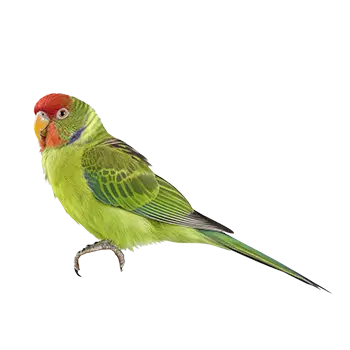

Growth & Physical Development

The juvenile period in kakariki begins at fledging, typically around five to six weeks of age, and extends through the first molt and into early maturity. During this phase, the young bird undergoes rapid physical changes as it transitions from a clumsy fledgling into a coordinated, fully feathered juvenile. Flight feathers continue to strengthen, muscle mass develops through increasingly confident flying, and the bird's overall body condition fills out as it learns to eat independently.

One of the most noticeable physical changes during the juvenile period is the first molt, which generally occurs between three and six months of age. During this molt, the soft, somewhat duller juvenile plumage is gradually replaced by the brighter, more defined adult feathering. The characteristic red frontal band on red-crowned kakariki, or the yellow markings on yellow-crowned varieties, become more vivid and clearly delineated after this first feather replacement.

Growth rates during the juvenile period can vary depending on diet quality, genetics, and overall health. Regular weight monitoring remains valuable even after the intensive newborn period has passed. A juvenile kakariki should maintain a stable weight appropriate for its age and subspecies, without dramatic fluctuations. Sudden weight loss may indicate illness, stress, or inadequate nutrition, while excessive weight gain could suggest an overly rich or unbalanced diet.

Beak and nail growth also accelerate during the juvenile period. The beak should wear naturally if the bird has access to appropriate chewing materials such as untreated wood perches, mineral blocks, and foraging toys. Nails may need occasional trimming if the bird's perching surfaces do not provide sufficient natural abrasion. An avian veterinarian or experienced keeper can demonstrate proper trimming technique to avoid injury to the quick.

Nutrition & Diet Transition

The weaning process is one of the most important transitions in a young kakariki's life. For hand-raised birds, weaning typically begins around six to eight weeks of age, when the chick starts showing interest in solid food. This is a gradual process that should never be forced. The chick should be offered a variety of solid foods while formula feedings are slowly reduced in frequency, allowing the bird to build its independent eating skills at its own pace.

Kakariki are naturally enthusiastic foragers, and this instinct emerges strongly during the juvenile period. Offer a diverse diet that includes a high-quality pellet base, fresh vegetables such as broccoli, peas, corn, spinach, and carrot, and a controlled amount of seed mix. Fresh fruits like apple, grape, and kiwi can be offered in moderation as treats. Kakariki are known for their love of greens and will often bathe in wet leafy vegetables, combining feeding and bathing into one exuberant activity.

Sprouted seeds are an excellent transitional food and ongoing dietary component for juvenile kakariki. Sprouting increases the nutritional value of seeds by converting stored starches into more digestible and nutrient-dense forms. Mung beans, sunflower seeds, and various millet types sprout easily and are readily accepted by most kakariki. Always ensure sprouted seeds are fresh and free of mold before offering them.

Calcium and mineral supplementation deserves particular attention during the juvenile growth phase. Cuttlebone should be available in the cage at all times, and a mineral block provides additional trace nutrients. The rapid bone development and feather growth occurring during this period create elevated nutritional demands, and deficiencies established during the juvenile stage can have lasting consequences for skeletal health and feather quality.

Behavioral Changes

Juvenile kakariki are among the most active and energetic of all parrot species at any age, and the adolescent period amplifies this characteristic to its peak. Expect a young kakariki to be in nearly constant motion during waking hours, hopping, climbing, swinging, foraging, and investigating every object within reach. This level of activity is entirely normal and reflects the species' natural foraging behavior in their native New Zealand bush habitat.

As the bird matures through the juvenile phase, you may notice the emergence of hormonal behaviors, particularly as the bird approaches six to twelve months of age. These can include increased territoriality around the cage or a favorite perch, regurgitation directed at a favored person or toy, and in some individuals, nippiness that was not present during the compliant hand-feeding phase. These behaviors are a normal part of avian adolescence and should be managed with patience and consistent handling rather than punishment.

Vocalizations become more varied and complex during the juvenile period. Kakariki are not known as strong talkers compared to some parrot species, but they develop a rich repertoire of chirps, chatters, trills, and contact calls. Some individuals do learn to mimic words or household sounds, and this learning capacity is highest during the juvenile and young adult phases. Regular, calm verbal interaction with the bird encourages vocal development and strengthens the human-bird bond.

Fear periods may also occur during the juvenile stage, during which a previously confident bird suddenly becomes wary of familiar objects, people, or situations. These periods are a normal part of neurological development and typically resolve on their own with continued gentle, positive interaction. Forcing a frightened bird to confront the source of its fear is counterproductive and can cause lasting behavioral damage.

Training Priorities

The juvenile period represents the optimal window for establishing foundational training with a kakariki. These intelligent, food-motivated birds respond exceptionally well to positive reinforcement techniques, and habits formed during this stage tend to persist throughout the bird's life. The three most important baseline behaviors to establish are stepping up reliably onto the hand, returning to the cage on cue, and accepting gentle handling for health checks.

Step-up training should be practiced daily in short, positive sessions. Offer a treat, such as a small piece of millet spray or a favorite seed, as the bird steps onto your hand. Consistency is key. Use the same verbal cue each time, keep your hand steady, and reward immediately upon compliance. Most juvenile kakariki learn the step-up command quickly due to their naturally bold and curious temperament, but patience is still required for individuals that are more cautious.

Recall training, teaching the bird to fly to you on command, is particularly valuable for kakariki given their strong flight ability and speed. Begin in a small, enclosed room free of hazards. Call the bird with a consistent cue and reward it generously when it flies to your hand. Gradually increase the distance as the bird's confidence and reliability grow. A kakariki with reliable recall is significantly safer during out-of-cage time and much easier to manage in an emergency.

Target training, in which the bird learns to touch its beak to the end of a small stick or chopstick in exchange for a reward, is a versatile foundation for more advanced training. Once a kakariki understands the target concept, it can be guided through obstacle courses, taught to enter a travel carrier voluntarily, or directed to a scale for weighing without the stress of being captured and restrained. The mental stimulation provided by regular training sessions also helps channel the juvenile kakariki's boundless energy in constructive directions.

Exercise & Activity

Kakariki require more daily exercise and activity than many similarly sized parrot species. Their natural behavior involves near-constant movement through dense bush, foraging on the ground and in the canopy, and flying between feeding sites. A juvenile kakariki that is confined to a cage without adequate out-of-cage time and enrichment will quickly develop behavioral problems including feather plucking, excessive screaming, and repetitive stereotypic movements.

Out-of-cage time should be provided daily in a bird-safe room. This means a space where windows and mirrors are covered or marked to prevent collision injuries, ceiling fans are turned off, toxic houseplants are removed, and other pets are excluded. Kakariki are ground foragers by nature and will spend a great deal of their free time running along floors, exploring under furniture, and investigating anything at ground level. This ground-foraging tendency makes them particularly vulnerable to being stepped on, so awareness and caution are essential during out-of-cage time.

Enrichment within the cage is equally important. Provide a variety of foraging opportunities, such as food hidden in paper cups, wrapped in paper, or tucked inside foraging toys that require manipulation to access. Rotate toys regularly to maintain novelty, as kakariki are intelligent enough to lose interest in objects they have fully explored. Swings, ladders, and natural wood perches of varying diameters promote foot health and physical activity even when the bird is caged.

Bathing is a form of exercise and enrichment that most kakariki thoroughly enjoy. Offer a shallow dish of water for bathing several times per week, or mist the bird gently with a spray bottle if it enjoys that method. Many kakariki will also bathe in wet lettuce or spinach leaves, turning mealtime into an enthusiastic splashing session. Regular bathing supports feather condition and provides valuable sensory stimulation during the juvenile developmental period.

Veterinary Care & Disease Prevention

A comprehensive veterinary examination is recommended for juvenile kakariki at around three to four months of age, coinciding with the weaning period and the early stages of independence. This visit establishes a baseline health profile against which future examinations can be compared. The avian veterinarian will typically assess body condition, examine feather quality, evaluate the beak and nails, listen to the heart and air sacs, and may recommend blood work or fecal screening depending on the bird's history and living situation.

Parasite prevention is an important consideration for juvenile kakariki, particularly for birds housed in outdoor aviaries or those that have contact with wild birds. Internal parasites such as roundworms and coccidia, and external parasites including feather lice and mites, can affect young birds whose immune systems are still maturing. Regular fecal testing allows for early detection and treatment before a parasite burden becomes clinically significant.

Vaccination protocols for pet birds vary by region and species, and your avian veterinarian can advise on what is recommended or available in your area. Polyomavirus vaccination, where available, may be recommended for young parrots in breeding or multi-bird environments. Regardless of vaccination status, good hygiene practices including regular cage cleaning, fresh food and water daily, and quarantine procedures for any new birds entering the home form the foundation of disease prevention.

The juvenile period is also the time to establish grooming routines that the bird will accept throughout its life. Nail trims, wing clip evaluations if applicable, and beak checks should become familiar experiences rather than traumatic events. An avian veterinarian or experienced avian groomer can handle these procedures while demonstrating proper technique to the owner. Birds that are accustomed to routine handling for grooming purposes from a young age are generally calmer and more cooperative during veterinary examinations as adults.

Socialization & Exposure

Continued socialization during the juvenile period builds on the foundation established during the newborn and hand-rearing phase. A juvenile kakariki that is exposed to a wide variety of people, environments, sounds, and experiences during this formative window is far more likely to develop into a confident, well-adjusted adult bird. The goal is to make new experiences positive and to build the bird's resilience to change and novelty.

Introduce the juvenile kakariki to different family members and trusted visitors. Encourage gentle handling by people of different ages and appearances, always supervising closely to ensure the bird's safety and comfort. If the bird shows signs of stress, such as flattened feathers, rapid breathing, or attempts to flee, reduce the intensity of the interaction and return to a more familiar situation. Positive associations can be built by having new people offer favorite treats.

Environmental enrichment and exposure go hand in hand. Move the bird's cage to different locations in the home periodically so it becomes comfortable in various settings. Take the bird in a secure travel carrier to different rooms, onto a covered porch, or on short car rides to accustom it to travel. Kakariki that are only ever kept in a single location and handled by a single person may develop into anxious, one-person birds that are difficult to manage in new situations.

If the household includes other pets, supervised introductions can begin during the juvenile period, though direct physical contact between a kakariki and a dog or cat should never be permitted regardless of how trustworthy the other animal seems. Even a well-meaning paw swipe can be fatal to a small bird. The goal of inter-species exposure is simply to reduce fear and reactivity, not to establish play relationships. Many kakariki will learn to coexist peacefully in the same household as other animals when proper boundaries are maintained.

Socialization with other birds is also valuable, particularly if the kakariki will eventually share living space with companions. Introduce birds gradually, starting with visual contact from separate cages before progressing to supervised shared out-of-cage time. Monitor interactions closely for aggression, and be prepared to separate birds that do not establish a compatible dynamic. Kakariki can be assertive and may attempt to dominate more passive species, so species compatibility and individual temperament should be carefully considered.

Always consult a qualified professional before making any health-related decisions. This content is provided for informational reference only and should not replace professional guidance specific to your animal.