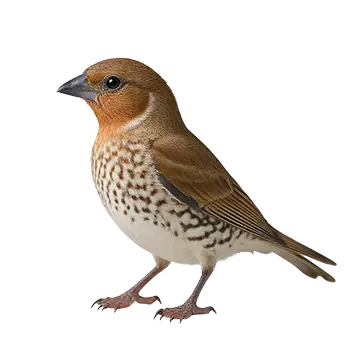

Spice Finch chicks hatch after an incubation period of roughly 12 to 14 days, emerging as tiny, nearly helpless creatures that weigh barely two grams. Like all estrildid finches, hatchlings are altricial, meaning they are born blind, naked, and completely reliant on their parents for warmth and food. The skin of a freshly hatched Spice Finch chick is translucent and pinkish, and the chick will have a few wisps of sparse natal down along the dorsal tract. During these critical first hours, the chick's survival depends almost entirely on the attentiveness of the parent birds and the stability of the nest environment.
In a parent-raised clutch, both the hen and the cock typically participate in feeding duties from the outset. The parents regurgitate partially digested seed into the gaping mouths of the chicks, a process that delivers essential nutrients and beneficial gut flora to the newborns. Spice Finches are generally reliable parents, but first-time pairs may be inconsistent with feedings during the initial hours. Observing the nest from a respectful distance, using a small mirror or camera if needed, allows you to confirm that feeding is occurring without causing unnecessary disturbance.
The nest itself plays a vital role in chick survival during this window. Spice Finches construct domed or enclosed nests that provide natural insulation, trapping the body heat of the brooding parent and maintaining a stable microclimate for the chicks. If the pair is housed in a breeding cage, ensure the cage is positioned away from drafts, direct sunlight, and temperature extremes. Room temperature should ideally be maintained between 72 and 80 degrees Fahrenheit to support the parents' ability to keep the chicks warm.
Avoid handling the chicks or disturbing the nest during the first 24 hours unless there is a clear emergency, such as a chick that has fallen from the nest onto the cage floor. Spice Finches are more tolerant of nest inspections than some finch species, but unnecessary intrusions during this fragile period can cause nervous parents to abandon the clutch. If a chick is found outside the nest and is still warm, return it gently and observe from a distance to confirm the parents resume care.