Oska

Azawakh

Quick Facts

🐕 Breed Group
Hound Group
📏 Size Category
Large
📏 Height
Males: 25-29 inches, Females: 23.5-27.5 inches
⚖️ Weight
Males: 44-55 lbs, Females: 33-44 lbs
⏱️ Life Expectancy
12-15 years
🧣 Coat Type
Short and fine
🎨 Coat Colors
Sand, fawn, red, brindle, blue, black, brown, parti-color, white markings
😀 Temperament
Loyal, reserved, independent, affectionate with family
🏃 Exercise Needs
High - daily sprinting opportunities required
🎓 Training Difficulty
Moderate to high - independent thinker requiring positive methods
👶 Good with Children
Better with older, respectful children
🐾 Good with Other Pets
Good with dogs raised together; strong prey drive toward small animals

Other Names & Breed Recognition

Oska is the name that the Tuareg people of the Sahara and Sahel have used for centuries to describe the lean, swift sighthound that shares their camps and guards their livestock. Long before this breed acquired any Western designation, Oska was the word spoken across the arid expanses of Mali, Niger, and Burkina Faso when nomads called their dogs to heel or sent them streaking across the sand after gazelle and hare. The name belongs to Tamasheq, the Berber language spoken by the Tuareg, and it carries no translation beyond its meaning as the dog itself. To know an Oska was to know a particular kind of animal: fiercely bonded to its family, indifferent to outsiders, and built for explosive speed under a brutal sun.

The breed became known internationally as the Azawakh, a name drawn from the Azawagh Valley in the southern Sahara where many of these dogs were documented by European enthusiasts who first encountered them in the late 1960s and early 1970s. That geographic label stuck as the breed moved into European and eventually North American kennel club registries, but it was never the only name in use. Across the Sahel, different ethnic groups applied their own terms. The Fula people called this dog Rawondu. Among the Hausa it was known as Bareeru. Other regional names include Idi, Hanshee, and Wulo. The older Western designation Tuareg Sloughi reflected an early European assumption that the breed was simply a regional variant of the North African Sloughi, an error that genetic research has since helped clarify by showing the Azawakh possesses a distinct genetic profile, including a rare glucose isomerase allele shared with very few other canid populations.

Today the Azawakh is recognized by the American Kennel Club, which granted full recognition in 2019 and places the breed in the Hound Group. The Federation Cynologique Internationale classifies it within Group 10, Section 3, among short-haired sighthounds. The United Kennel Club registers it under Sighthounds and Pariah Dogs. The Canadian Kennel Club added recognition in 2024. Across all of these registries, the official breed name is Azawakh, but the FCI breed standard itself acknowledges that among the Tuareg the dog is known as Oska. That dual identity reflects the fundamental story of this breed: an ancient working animal shaped entirely by the people who depended on it, now carrying a valley's name through show rings and suburban homes while its original name endures in the language of the desert.

Oska Organizations & Standards

The American Azawakh Association serves as the AKC parent club for this breed in the United States. As the designated steward of the breed standard, the AAA works to preserve the Oska's heritage as a dual-purpose guardian and hunter while promoting responsible breeding practices and health testing among its members. The club also oversees breed education for judges, a task of particular importance given the Azawakh's unusual conformation and temperament. Because this breed does not appreciate handling by strangers, AKC judges have adapted their examination approach to be less intrusive than what is standard for most hound breeds.

The AKC breed standard describes a dog that is particularly leggy and elegant, with bone structure and musculature visible through thin, lean skin. Males stand 25 to 29 inches at the shoulder and weigh 44 to 55 pounds, while females range from 23.5 to 27.5 inches and 33 to 44 pounds. The standard emphasizes that three to five visible ribs in proper condition is normal and expected, not a sign of neglect. This point remains one of the most commonly misunderstood aspects of the breed by the general public and even by veterinarians unfamiliar with sighthound body types. The movement described in the standard is supple and elastic, with a high-stepping action at the walk and trot and a distinctive double-suspension gallop. Any color or combination of colors found in the breed's native Africa is acceptable under the AKC standard, which places no disqualifications on coat color.

The FCI standard, registered as number 307, is somewhat more restrictive in color allowances, permitting fawn with or without brindle in black only, with white limited to the extremities. The FCI places the breed in Group 10, Section 3 among kurzhaarige Windhunde, or short-haired sighthounds. This standard shares the AKC's emphasis on the breed's dry musculature and elegant outline but includes specific disqualifications for non-standard coat colors, rose ears, and hips set lower than the withers.

Health testing requirements through the CHIC program include hip evaluation, cardiac screening, and thyroid panel assessment. The OFA recommends these screenings for all breeding stock, with the thyroid panel being of particular relevance given the documented incidence of autoimmune thyroiditis in this breed. CHIC certification requires that results be made public regardless of outcome, ensuring transparency for prospective puppy buyers. Breeders within the AAA community also commonly run full Embark genetic panels to screen for broader genetic diversity markers and to build a data set that may eventually support research into conditions like idiopathic epilepsy, for which no DNA test currently exists. The emphasis on health testing is especially critical in the Oska because the Western breeding population descends from a relatively small number of imported foundation dogs, making careful genetic stewardship essential to the breed's long-term viability outside its native range.

Kennel Club Recognition

  • American Kennel Club (AKC): Recognized in 2019, Hound Group
  • United Kennel Club (UKC): Recognized, Sighthounds and Pariah Dogs
  • Canadian Kennel Club (CKC): Recognized, Hounds
  • FCI: Recognized, Group 10: Sighthounds
  • The Kennel Club (UK): Recognized, Hound

Oska Physical Description

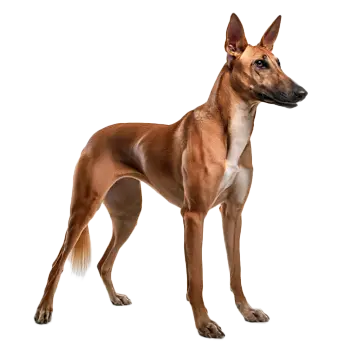
The Oska is a dog designed by the Sahara itself. Every feature of this animal reflects thousands of years of natural and selective pressure in one of the harshest climates on earth, and the result is a sighthound unlike any that evolved in Europe or the Middle East. Where breeds like the Greyhound carry rounded, powerful musculature for short explosive sprints, the Oska is drawn in flat planes and sharp angles. Its muscles lie close against the bone, dry and defined, creating a silhouette that reads more like an anatomical illustration than a show dog. To anyone unfamiliar with sighthound conformation, the first sight of a healthy Oska can provoke alarm. Ribs are not merely visible but prominent, hip bones are clearly defined, and the flat belly tucks dramatically upward behind a deep but narrow chest. This is precisely how the breed is supposed to look. The breed standard explicitly calls for three to five visible ribs in correct condition.

The head is long and refined, with a nearly flat skull that narrows gradually toward a tapered muzzle. The stop is barely perceptible. Almond-shaped eyes are set somewhat obliquely and range from dark brown to amber, carrying an expression that most observers describe as distant or contemplative. The ears are flat, pendant, and set high, falling close to the cheeks. In their native environment, some Oska have ears that are cropped, but this practice is not followed in Western breeding and the natural ear shape is required in the show ring.

The neck is long and muscular without being thick, rising from well-laid-back shoulders that support a body built for covering ground at speed with minimal energy expenditure. The chest is deep, reaching to or nearly to the elbow, but conspicuously narrow when viewed from the front. This narrow chest profile is not a fault but a deliberate feature: it reduces wind resistance and reflects the breed's adaptation to sustained effort in extreme heat. The ribcage is long and moderately sprung, transitioning into a severe abdominal tuck that is among the most dramatic of any breed.

The back is short and nearly level, though one of the breed's distinguishing characteristics is that the hip bones sit slightly higher than the withers. This gives the Oska an uphill appearance that is unusual among sighthounds and immediately sets it apart from the Sloughi or Saluki with which it is sometimes confused. The hindquarters are powerful despite their lean appearance, providing the explosive drive needed for the double-suspension gallop that is a hallmark of the breed in motion.

The legs are exceptionally long relative to body depth, contributing to the breed's tall, leggy silhouette. Feet are round with arched toes, well suited to running across sand and rocky terrain. Dewclaws on the rear legs are absent and any trace of them is a disqualification. The tail is thin, tapered, and set low, carried in a gentle curve and often with a white tip.

The coat is short, fine, and close fitting, with hair that becomes even sparser or entirely absent on the belly. This minimal coat is a direct adaptation to the extreme heat of the Sahel and offers virtually no protection against cold. In their native environment, Oska sleep huddled together in piles for warmth during cool desert nights. Colors found across the native population are wide ranging and include clear sand, red, fawn, brindle, blue, black, and various combinations with white markings. The AKC standard places no color restrictions, while the FCI standard is more conservative, permitting fawn with black brindle and limited white on the extremities. Regardless of color, the skin beneath the coat is thin and tight fitting, a feature that makes these dogs somewhat prone to lacerations and scrapes during vigorous activity.

Affectionate With Family
The Oska forms deep, intense bonds with its household and expresses devotion through quiet companionship and physical closeness with the people it has chosen as its own.
Good With Young Children
This breed's thin build, sensitivity to rough handling, and preference for calm interactions make it a poor match for households with toddlers or very young children.
Good With Other Dogs
The Oska is pack oriented and coexists well with dogs it knows, particularly other sighthounds, but introductions to unfamiliar dogs require careful management.
Shedding Level
Minimal shedding is one of the practical advantages of this breed's short, fine coat. Loose hair is barely noticeable on furniture or clothing.
Coat Grooming Frequency
A weekly brushing with a bristle brush or grooming mitt is all the coat maintenance this breed requires. Baths are rarely necessary.
Drooling Level
The Oska's refined, dry muzzle produces virtually no drool under normal circumstances.
Coat Type
The coat is short, fine, and close-fitting, becoming sparse or entirely absent on the belly. It provides almost no insulation against cold.
Openness To Strangers
Reserve with unfamiliar people is a defining breed characteristic. The Oska actively avoids contact with strangers and prefers not to be touched by people it does not know.
Playfulness Level
The Oska has a playful side that emerges with trusted family members, particularly during outdoor activity, though it is generally more composed than exuberant.
Watchdog/Protective Nature
Guarding is one of the breed's original and strongest functions. The Oska is naturally vigilant, alert to changes in its environment, and will bark to warn of perceived threats.
Adaptability Level
This breed is sensitive to environmental changes, cold weather, and disruptions in routine. It thrives in stable, predictable households with warm climates.
Trainability Level
Intelligent but deeply independent, the Oska requires patient, positive training methods and does not respond to correction or repetitive drills.

Oska History & Development

The word Oska predates every other name this breed has carried. It belongs to Tamasheq, the language of the Tuareg, and it was in use long before any European set foot in the Azawagh Valley or any kennel club assigned a registry number. Understanding the significance of this name requires understanding the Tuareg themselves. These semi-nomadic Berber people have traversed the Sahara and Sahel for over a thousand years, herding livestock, conducting trans-Saharan trade, and navigating some of the most unforgiving terrain on the planet. Their dogs were not pets in any Western sense. An Oska was a working member of the encampment, entrusted with guarding livestock against jackals and hyenas, hunting gazelle and hare to supplement the diet, and alerting the camp to approaching strangers. The Tuareg did not traditionally sell their dogs. An Oska was given as a gift of great respect, a practice that kept the breed closely held within Tuareg communities for centuries.

European contact with the breed began in the late 1960s when French diplomats and military personnel stationed in the Sahel encountered these striking sighthounds. The first documented exports to Europe occurred around 1968, when a small number of dogs were brought to France. Early European breeders worked with the guidance of Tuareg owners who maintained the original lines, and these foundation imports established the basis for the Western breeding population. The FCI granted formal recognition in 1981 under the name Azawakh, derived from the Azawagh Valley in Niger where many of the dogs were documented. The standard itself, however, acknowledges the Tuareg name, noting that within the culture that domesticated and shaped this breed, it is known as Oska.

The journey to American recognition was slower. Azawakh arrived in the United States in the mid-1980s, and for years they remained registered only through the AKC Foundation Stock Service. The American Azawakh Association was eventually established as the parent club, and after decades of building a sufficient population base and club infrastructure, the breed received full AKC recognition on January 1, 2019, entering the Hound Group. The breed has also gained recognition from the United Kennel Club, which places it among Sighthounds and Pariah Dogs, and the Canadian Kennel Club, which added the breed in 2024.

Throughout this process of Western registration and standardization, the name Oska has persisted as a thread connecting the modern show dog to its origins. It is a reminder that this breed was not developed by European breeding programs or shaped by kennel club standards. The Oska was already a finished product when Europeans discovered it, refined over millennia by the most demanding breeding program imaginable: survival in the Sahel. The dogs that could not run fast enough, guard effectively enough, or withstand the heat and scarcity of the desert did not reproduce. What survived was an animal of extraordinary efficiency, and the Tuareg named it simply and without embellishment. It was the Oska. That name still carries weight among breed enthusiasts who understand that the elegant show dogs trotting in climate-controlled arenas descend directly from animals that slept under open skies and earned their keep every day of their lives.

Oska Temperament & Personality

The Oska's temperament is a direct inheritance from its working life in the Sahel, and anyone who expects a conventionally friendly companion dog will find this breed bewildering. These are not golden retrievers in greyhound bodies. The Oska bonds with extraordinary intensity to its immediate family and can be profoundly affectionate within that circle, but this devotion does not extend casually to the wider world. Strangers are met with reserve that ranges from quiet indifference to active avoidance of physical contact. This is not aggression and should never be mistaken for it. The Oska simply does not see any reason to invite familiarity from people it has not chosen to trust. This trait is so deeply embedded that the AKC has modified its judging protocol for the breed, asking judges to examine these dogs with a lighter touch than they would apply to most hound breeds.

Within the family, the Oska is deeply attuned to the emotional atmosphere of its household. These dogs are sensitive to tension, raised voices, and changes in routine. Owners consistently report that their Oska seems to read moods and will position itself close to a distressed family member without being asked. This emotional intelligence comes with a cost. The breed does not tolerate chaotic environments well. Households with constant noise, frequent visitors, or unpredictable schedules can produce an anxious and unsettled Oska. Separation anxiety is a genuine concern, particularly in single-dog households where the Oska lacks the pack companionship it was designed to live with.

The prey drive in this breed is formidable and non-negotiable. The Oska was bred to sight, chase, and take down fast-moving game in open terrain, and that instinct remains fully intact. Cats, rabbits, squirrels, and even small dogs that run can trigger an immediate chase response. Off-leash exercise must occur only in securely fenced areas with barriers tall enough to contain an animal that can clear a surprising height. Six-foot fencing is considered a minimum. Some Oska have been observed scaling even taller barriers when sufficiently motivated.

Among other dogs, the Oska is pack oriented and forms complex social hierarchies. The breed generally coexists well with other Azawakh and with dogs it has been raised alongside since puppyhood. Introductions to unfamiliar dogs should be handled carefully, particularly between same-sex pairs, where tension over rank can escalate. This is not a breed that thrives at dog parks or in unstructured social settings with unknown animals.

When an Oska's needs for exercise, companionship, and mental engagement are met, it is a remarkably calm house dog. These dogs are capable of long stretches of quiet rest, draped across furniture with the boneless elegance that sighthound owners know well. But when those needs go unmet, the fallout is predictable. Bored or under-exercised Oska become destructive diggers, restless pacers, or anxious vocalizers. The breed requires owners who understand that its apparent independence is not low maintenance. The Oska demands a specific kind of attention: consistent, respectful, and deeply engaged.

Oska Family Life & Living Requirements

Living with an Oska requires an honest assessment of whether your household can provide what this breed genuinely needs, not just what you wish it needed. The ideal home is quiet, stable, and occupied by people who are present for significant portions of the day. Single adults and couples with calm lifestyles tend to be the best match. Families with respectful older children can succeed, but homes with toddlers or very young kids present a challenge. The Oska does not tolerate being grabbed, pulled, or startled, and its instinctive response to erratic movement from small children is to retreat or, in rare cases, to snap as a warning. This is not malice. It is a breed with thin skin, prominent bones, and a deeply ingrained preference for gentle handling.

Space matters considerably. The Oska is not a large dog by weight, typically ranging from 33 to 55 pounds, but it is tall and leggy and was built to run at speeds approaching 40 miles per hour. A house with a securely fenced yard is strongly preferred. Apartment living is possible if the owner commits to daily structured exercise in appropriate settings, but the fencing question becomes more complicated. This breed needs access to enclosed spaces large enough for full-speed sprinting, not just leash walks around the block. A fenced dog park might seem like a solution, but given the Oska's selectiveness about unfamiliar dogs and its formidable prey drive, unsupervised or crowded park visits are usually a poor idea.

Climate is another practical consideration. The Oska thrives in warm weather and is nearly impervious to heat that would exhaust most other breeds. Cold weather is a different story entirely. With virtually no body fat and a coat that barely qualifies as coverage, these dogs are profoundly cold sensitive. In northern climates, a winter coat or sweater is not optional, and extended outdoor time in freezing temperatures should be avoided. Many Oska owners report that their dogs refuse to go outside in rain or cold, and some will hold their bladder for uncomfortable lengths of time rather than step into wet grass.

The Oska is also a breed that genuinely prefers the company of its own kind. Households with multiple Azawakh or compatible sighthounds tend to have happier, more settled dogs than single-dog homes. This pack orientation means that adding a second Oska is often the most effective solution for separation anxiety and general contentment, though introducing a new dog to an established Oska requires patience and careful management.

Oska Training & Exercise Needs

Training an Oska demands a fundamental shift in expectations for anyone accustomed to working with biddable breeds. This is not a dog that lives to please its handler. The Oska is intelligent, observant, and fully capable of learning complex behaviors, but it will decide for itself whether compliance serves its interests at any given moment. Harsh corrections, raised voices, and physical punishment are not merely ineffective with this breed. They are destructive. The Oska shuts down under pressure. A dog that was engaged and willing becomes withdrawn and avoidant, and rebuilding that trust takes far longer than the training session that broke it. Positive reinforcement using high-value food rewards is the only viable approach, delivered with patience and a willingness to accept that progress happens on the dog's timeline.

Socialization is the single most critical training priority and must begin the moment you bring an Oska puppy home. The window between eight and sixteen weeks is when this breed forms its foundational impressions of the world, and under-socialized Oska develop into fearful or reactive adults that are extremely difficult to rehabilitate. Exposure to varied people, environments, surfaces, sounds, and animals during this period pays dividends for the rest of the dog's life. The goal is not to make the Oska gregarious. It will always be reserved with strangers. The goal is to teach it that unfamiliar situations are manageable rather than threatening.

Exercise needs are significant but often misunderstood. The Oska is not a marathon runner requiring hours of sustained activity. It is a sprinter. Short, explosive bursts of full-speed running satisfy this breed's physical requirements far more effectively than long, monotonous leash walks. Lure coursing is an ideal outlet that engages both the body and the prey drive in a controlled setting, and many Oska excel at Fast CAT events that measure straight-line speed. A securely enclosed area where the dog can run flat out for ten to fifteen minutes, combined with a moderate daily walk, is usually sufficient for an adult in good condition.

Mental engagement matters as much as physical exercise. Scent work, trick training, and puzzle toys provide cognitive stimulation that prevents boredom-related behavior problems. Some Oska have proven surprisingly capable in activities like barn hunt, rally obedience, and even agility, challenging the assumption that sighthounds lack versatility. The key is approaching every training activity as a collaboration rather than a command, meeting the Oska's independence with respect rather than trying to override it.

Oska Health Concerns

The Oska benefits from the genetic hardiness that comes with centuries of natural selection in unforgiving conditions, but the transition from open Sahel to closed Western breeding populations has introduced health concerns that prospective owners need to understand. The most prevalent condition in the breed is autoimmune thyroiditis, a disorder in which the immune system attacks the thyroid gland, leading to hypothyroidism. Affected dogs develop symptoms including lethargy, unexplained weight gain, chronic skin infections, and coat changes. The condition is manageable with daily thyroid hormone supplementation, but it requires lifelong medication and periodic blood monitoring. Thyroid panels should be run regularly throughout the dog's life because the condition can develop after multiple clear tests.

Anesthesia sensitivity is a critical concern for any sighthound owner. The Oska's low body fat percentage and unique metabolism require veterinarians to use sighthound-appropriate anesthetic protocols. Standard dosing calculated for breeds with higher body fat can be dangerous or fatal. Every Oska owner should ensure their veterinarian is experienced with sighthound physiology before any surgical procedure.

Common Health Issues

  • Autoimmune thyroiditis leading to hypothyroidism - The most prevalent endocrine condition in the breed, causing lethargy, weight gain, chronic skin infections, and coat deterioration. Requires lifelong daily thyroid hormone supplementation and periodic blood monitoring.
  • Idiopathic epilepsy - A heritable neurological condition that produces recurring seizures typically appearing between six months and six years of age. Managed with daily anticonvulsant medication, though side effects of long-term drug therapy are a consideration.
  • Masticatory muscle myositis - An autoimmune disorder that causes inflammation and eventual atrophy of the jaw and facial muscles. In the Oska this tends to present as facial muscle wasting rather than complete lockjaw, and responds to immunosuppressive corticosteroid treatment.
  • Cervical spondylopathy or Wobbler syndrome - Caused by malformed cervical vertebrae compressing the spinal cord, producing progressive weakness and an uncoordinated gait. Onset is typically between four and six years of age and may require surgical intervention.
  • Sighthound anesthesia sensitivity due to low body fat and unique drug metabolism - Standard anesthetic protocols designed for breeds with higher body fat percentages can produce dangerous or fatal reactions in this breed.
  • Bloat and gastric dilatation-volvulus - A risk associated with the breed's deep, narrow chest. Feeding smaller meals and avoiding vigorous exercise around feeding times helps reduce incidence.

Preventive Care & Health Monitoring

  • Thyroid panel testing at regular intervals beginning at two years of age and repeated throughout the dog's life - As autoimmune thyroiditis can develop after previously normal results. This is part of the CHIC health testing protocol for the breed.
  • Cardiac screening through auscultation or echocardiography as recommended by the OFA CHIC program - To monitor for heart conditions that, while not commonly reported, occur in related sighthound breeds.
  • Hip evaluation through OFA radiographs - Though hip dysplasia is rare in sighthounds. This screening is included in the CHIC program requirements for the breed.
  • Comprehensive genetic panel screening through services like Embark to assess genetic diversity and identify carriers of known conditions - Building data that supports ongoing breed health research.
  • Sighthound-experienced veterinary care with protocols adjusted for low body fat - Including modified anesthetic dosing and awareness of breed-specific drug sensitivities.
  • Socialization and environmental enrichment programs beginning in puppyhood to prevent anxiety-related behavioral problems that can develop in under-stimulated or isolated Oska. - Socialization and environmental enrichment programs beginning in puppyhood to prevent anxiety-related behavioral problems that can develop in under-stimulated or isolated Oska.

Oska Grooming & Maintenance

Grooming an Oska is about as straightforward as dog care gets. The short, fine coat requires nothing more than a weekly pass with a bristle brush or rubber grooming mitt to distribute natural skin oils and remove loose hair. Shedding is minimal compared to most breeds, and the hair that does shed is short and fine enough that it rarely becomes a nuisance on furniture or clothing. Bathing is seldom necessary. Dried mud and dirt can usually be brushed out once it has set, and the coat's natural texture tends to resist holding onto debris. When a bath is genuinely needed, a gentle dog-specific shampoo is sufficient, but owners should be cautious about frequency. The Oska's skin is notably thin and can become dry or irritated with overbathing. Bathing every two to three months or only as needed is a reasonable guideline.

The areas that demand more consistent attention are the ones that apply to every breed but carry particular relevance here. Nail trimming is essential on a regular schedule, typically every two to three weeks. The Oska's long, lean toes and active running style mean that overgrown nails can cause discomfort and alter gait mechanics. If the dog has regular access to hard surfaces for running, nails may wear down naturally and require less frequent trimming, but this should be checked rather than assumed.

Dental care should include brushing several times per week with a canine-appropriate toothpaste. Periodontal disease can develop in any breed if dental hygiene is neglected, and given the Oska's thin facial structure, infections in the mouth can become visible and uncomfortable more quickly than in breeds with heavier muzzle padding.

Ear cleaning deserves regular attention because the pendant ears can trap moisture and debris, creating conditions favorable for bacterial or yeast infections. A weekly check with a gentle ear cleaning solution and a cotton pad is adequate for most dogs. The thin skin of the ear flap also means that minor scrapes or nicks from play or brush can occur more easily than in thicker-skinned breeds. Keeping the ear margins clean and dry helps prevent minor injuries from becoming infected. Cold weather wardrobe is the final grooming-adjacent consideration. In cool or cold climates, a well-fitted coat or sweater is a genuine necessity rather than a fashion choice.