Idi

Azawakh

Quick Facts

🐕 Breed Group
Hound Group
📏 Size Category
Medium to Large
📏 Height
Males: 25 - 29 inches, Females: 23 - 27 inches
⚖️ Weight
Males: 44 - 55 lbs, Females: 33 - 44 lbs
⏱️ Life Expectancy
12 - 15 years
🧣 Coat Type
Short, fine
🎨 Coat Colors
Red, Clear Sand, Fawn, Brindled, Parti-color, Blue, Black, Brown, White
😀 Temperament
Loyal, Independent, Reserved, Protective
🏃 Exercise Needs
High
🎓 Training Difficulty
Moderate to Difficult
👶 Good with Children
Best with older, respectful children
🐾 Good with Other Pets
Good with dogs raised together, high prey drive with small animals

Other Names & Breed Recognition

Idi is not a nickname invented by Western dog fanciers. It is the word for dog in Tamasheq, the language of the Tuareg people who bred and lived alongside this sighthound for centuries across the Sahel region of West Africa. When a Tuareg says Idi, they are not speaking generically. In practice, the word refers specifically to their sighthound, the dog Westerners eventually named the Azawakh after the valley where it was most commonly found. The name carries the weight of an entire culture's relationship with its dogs, a relationship built on mutual dependence in one of the most demanding environments on earth.

The Azawakh, the breed's formal Western name, comes from the Azawakh Valley that stretches across portions of Mali, Niger, and Burkina Faso. This is the geographic heart of the breed's origin, the dry basin where Tuareg, Dahoussahaq, and Peul peoples developed the dog as a hunter, guardian, and companion. Other names used within the breed's native region include Oska, another Tuareg term, and various local designations that reflect the specific tribes and languages of the Sahel.

In Europe, the breed first became known in the late 1960s when early exports reached France and other countries. The FCI recognized the breed under the name Azawakh, classifying it in Group 10 as a Short-haired Sighthound. European breed clubs adopted this name, and it became the international standard. The AKC granted full recognition much later, in 2019, making the Azawakh one of the most recently recognized breeds in the American registry. The breed currently ranks 193rd in AKC popularity, reflecting its genuine rarity in the United States.

The American Azawakh Association serves as the primary breed organization in the United States, promoting responsible ownership and breeding practices. For people who encounter the name Idi in breed literature or conversation with owners familiar with the breed's African heritage, it connects directly to the Azawakh's identity as more than a show dog or pet. It is the dog of the Tuareg, and the name Idi carries that history with it.

Idi Organizations & Standards

The American Azawakh Association is the breed's primary organizational presence in the United States, working to promote responsible breeding, educate potential owners about the breed's unique requirements, and coordinate health research within the small American population. The AKC recognized the Azawakh in 2019, making it one of the newest additions to the registry, and the breed club has been building infrastructure around health testing, breeder standards, and public education since well before that formal recognition arrived.

The FCI standard, which serves as the international reference, describes a dog of particularly leggy and elegant build that gives an impression of great fineness. The standard emphasizes that bone structure is visible under fine, tight skin, and that the outline of the hip bones and ribs should be apparent in a dog of correct weight. This is a critical point that the standard makes explicit because the Azawakh's natural condition looks alarmingly thin to people accustomed to stockier breeds. Visible ribs are normal and healthy on this dog. The standard calls for a minimum of three to five ribs visible in proper condition, and an Azawakh carrying enough weight to hide its ribs is actually overweight and at risk for structural problems.

The breed standard specifies a tall, upstanding sighthound with a flat back, long legs, and a deep but narrow chest. The head is long and refined with a slight stop and dark, almond-shaped eyes that carry an alert, somewhat distant expression. Ears are set high and carried drooping flat against the head, thin and triangular. The tail is long, thin, and set low, often carried with a slight upward curve at the tip. Movement is described as light and elastic, with a high-stepping gait at the walk and trot that reflects the breed's desert origins.

Color in the Azawakh is exceptionally variable. The FCI standard accepts all shades of red, clear sand to fawn, brindled, parti-color that may be predominantly white, blue, black, and brown. This wide color range reflects the breed's diverse genetic background across different tribal lines in the Sahel.

Health testing recommendations include thyroid evaluation, hip screening, cardiac examination, and eye evaluation. The breed's relatively recent AKC recognition means that the formal CHIC protocol is still developing, but responsible breeders in the United States are already performing these core screenings and making results available through OFA databases.

Kennel Club Recognition

  • American Kennel Club (AKC): Recognized in 2019, Hound Group
  • United Kennel Club (UKC): Recognized, Sighthound and Pariah Group
  • Canadian Kennel Club (CKC): Recognized, Hounds
  • FCI: Recognized, Group 10
  • The Kennel Club (UK): Recognized, Hound

Idi Physical Description

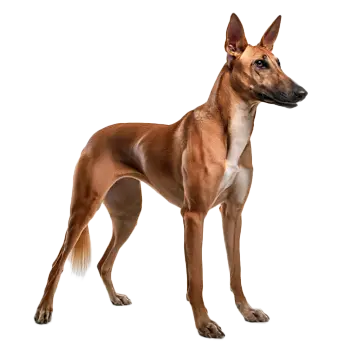
The Idi is a study in efficient engineering for extreme heat. Every feature of this dog's body reflects adaptation to the Saharan and Sahelian environments where the breed developed, and understanding that context is essential to appreciating why the dog looks the way it does. To someone unfamiliar with sighthounds, the first reaction to an Azawakh is often concern that the dog is underfed. It is not. This is what a healthy desert sighthound looks like, and the leanness is the point.

The overall silhouette is tall and vertical, with legs that seem to go on forever relative to the body's length. The Idi stands taller than it is long, creating a rectangular profile oriented in the opposite direction from most breeds. Males range from 25 to 29 inches at the shoulder, and females from 23 to 27 inches, with weight falling between 33 and 55 pounds depending on sex and build. The bone structure is fine but strong, visible under skin that fits tightly against the underlying musculature with almost no subcutaneous fat. The ribs, hip bones, and muscle definition are clearly apparent in a dog of correct condition.

The head is long, lean, and aristocratic, with a skull that is almost flat when viewed from the front. The muzzle tapers gently without becoming snipey, and the nose is typically black or dark brown. The eyes are large, almond-shaped, and dark, set slightly obliquely in the skull. Their expression is watchful and somewhat remote, reflecting the breed's characteristically reserved temperament. The ears are thin, triangular, and set high, carried drooping flat against the sides of the head. Unlike the dramatic erect ears of some sighthound types, the Idi's ears fold down and contribute to a smooth, aerodynamic profile.

The chest is deep and narrow, providing lung capacity without the barrel shape that would add bulk and trap heat. The brisket does not extend to the elbow in most individuals, another adaptation that reduces mass in a hot climate. The back is nearly level with a slight rise over the loin, and the tuck-up is dramatic. The abdomen rises sharply from the brisket, creating the wasp-waisted look that is one of the breed's most distinctive features.

The musculature is flat, dry, and extremely well-defined. There is no padding or bulk to this dog. The muscles lie close against the bone and are visible through the skin during movement, giving the dog an almost anatomical appearance when it runs. The legs are long and perfectly straight, with fine-boned construction that belies real structural strength. The feet are round with well-arched toes and pigmented pads.

The coat is short, fine, and close-lying across the body, with the belly sometimes nearly bare. There is essentially no undercoat, which means the Idi has zero tolerance for cold or wet weather and will need a coat for outdoor time in anything below moderate temperatures. The tail is long, thin, set low, and typically carried with a slight upward curve. In motion, the Idi moves with a light, elastic gait that appears almost effortless, covering ground with long strides and a high-stepping action that showcases the breed's desert heritage. At full gallop, the movement becomes a breathtaking display of speed and efficiency, with the long legs extending to their maximum reach and the lean body compressing and stretching like a spring. The dog appears to float above the ground, each stride covering an improbable distance for what looks like minimal effort. Speeds can reach 40 miles per hour in a flat-out run, and watching an Idi stretch out across open ground explains immediately why the Tuareg trusted these dogs to bring down fleet-footed prey across the open Sahel. The combination of that explosive running ability, the visible structural anatomy, and the quiet dignity the dog carries at rest creates an animal that looks unlike anything else in the canine world.

Affectionate With Family
Within its own household the Idi forms fierce, devoted bonds, often attaching most intensely to one person while remaining loyal to the entire family unit.
Good With Young Children
Their reserved nature and sensitivity to sudden movements make them better suited to homes with older children who understand how to interact calmly.
Good With Other Dogs
They coexist well with dogs they are raised alongside, particularly other sighthounds, but introductions to unfamiliar dogs require careful management.
Shedding Level
The short, fine coat sheds minimally, leaving very little hair on furniture or clothing compared to most breeds.
Coat Grooming Frequency
A weekly rubdown with a soft brush or grooming mitt is all the coat requires, making maintenance practically effortless.
Drooling Level
The Idi produces essentially no drool, keeping its lean face and your belongings clean.
Coat Type
The coat is short, fine, and close-lying with virtually no undercoat, providing minimal insulation but maximum elegance.
Openness To Strangers
Characteristically reserved to aloof with people they do not know, requiring time and patience before accepting unfamiliar visitors.
Playfulness Level
Playful with trusted family members in short bursts, often engaging in spirited games before settling back into their typically calm composure.
Watchdog/Protective Nature
Deeply territorial and alert, the Idi takes its guardian role seriously and will bark decisively to announce any approach to its territory.
Adaptability Level
Sensitive to environmental changes, cold weather, and disruptions to routine, this breed does best with stability and a warm climate.
Trainability Level
Intelligent but independently minded, requiring patient positive methods and an experienced handler who respects the breed's need to think for itself.

Idi History & Development

The word Idi predates everything else about this breed's journey into Western awareness. Long before anyone called this dog an Azawakh, long before European enthusiasts discovered it, and centuries before any kennel club considered recognizing it, the Tuareg people of the Sahel simply called it their dog. The name Idi in Tamasheq carries no qualifier about function or appearance. It does not mean hunting dog or guard dog or companion dog. It means dog, because for the Tuareg, there was only one kind of dog that mattered, and this was it.

The Idi's origins stretch back thousands of years in the dry flatlands and valleys of what is now Mali, Niger, and Burkina Faso. Wall paintings in the central Sahara depict lean, long-legged dogs that bear unmistakable resemblance to the modern breed, suggesting that sighthounds of this type have inhabited the region since before recorded history in that area. As the Sahara became increasingly arid over millennia, the peoples who lived there migrated southward into the Sahel with their dogs, settling along the Azawakh Valley and other areas where water and grazing land could sustain both humans and livestock.

The Tuareg, Dahoussahaq, and Peul peoples developed the Idi for multiple roles. As a hunter, the dog pursued hare and gazelle across the flat terrain at speeds approaching 40 miles per hour. As a guardian, it protected camps and livestock from predators including hyenas and jackals, barking to alert the camp and confronting threats with surprising courage for a lean-bodied sighthound. As a companion, it shared the camp life of the nomads, sleeping close to the family and forming bonds of genuine loyalty.

The breed remained virtually unknown outside Africa until the late 1960s, when a Yugoslavian diplomat received an Idi as a gift after a successful hunt in the Sahel. He brought the dog to Europe, where it attracted immediate interest from sighthound enthusiasts. More exports followed, primarily to France, and European breeders began the work of establishing the breed in a Western context. The FCI recognized the Azawakh in 1981, using the valley name rather than the Tuareg word.

The American story began more slowly. The first Azawakhs arrived in the United States in the 1980s, but the breed remained extremely rare and was not eligible for AKC conformation competition until full recognition came in 2019. Today the Idi remains one of the rarest breeds in the American registry, with a small but passionate community of owners and breeders who understand that this dog's identity is inseparable from the Sahelian culture that created it. The name Idi persists in breed circles as a reminder of that origin, a word that connects the dog in your living room to its ancestors running across the flat, sun-baked terrain of the Azawakh Valley.

Idi Temperament & Personality

The Idi's temperament is unlike anything most dog owners have encountered, and understanding that upfront saves a lot of confusion down the road. This is not a Golden Retriever in a lean body. The emotional architecture of the breed operates on principles that are closer to what you might expect from a cat than from a typical dog, combined with a protective instinct that can catch people off guard if they only see the elegant exterior.

Within its own family, the Idi is deeply loyal and genuinely affectionate. Most individuals form an especially intense bond with one person, though they remain attached to the entire household. They express affection on their own schedule rather than on demand, offering closeness when they choose to and maintaining distance when they need space. This is not coldness. It is the self-contained nature of a dog that was bred to make independent decisions in the field and that carries that autonomy into every aspect of its life.

With strangers, the Idi is reserved at best and actively suspicious at worst. This breed does not greet unfamiliar people with enthusiasm. It studies them from a distance, takes its time forming an opinion, and may never fully warm up to someone who visits infrequently. Forcing introductions creates stress rather than friendliness. The most effective approach is to let the dog set the pace, allowing it to approach new people when its own assessment says the situation is safe. Experienced Idi owners learn to warn visitors in advance and to give the dog the space it needs.

The protective instinct is strong and genuine. Unlike breeds that bark at everything, the Idi reserves its alerting for situations it considers genuinely noteworthy. When it does bark, the warning is decisive and carries real authority. In its native environment, the breed guarded camps against hyenas and jackals, and that guardian temperament translates directly into a dog that takes territory seriously. This makes socialization from earliest puppyhood absolutely critical. An unsocialized Idi can become territorial to the point of being difficult to manage in normal situations like visitors arriving or encountering strangers on walks.

The independence in this breed runs deep. The Idi was never bred to look to humans for direction the way herding or sporting breeds were. It was bred to hunt, guard, and make decisions on its own, and that heritage shows up as a dog that cooperates when it sees the value in cooperating and disengages when it does not. Harsh training methods are counterproductive and can damage the trust that forms the foundation of the Idi's relationship with its handler. Patience, consistency, and positive reinforcement build cooperation. Force builds avoidance.

Emotionally, the Idi is remarkably sensitive. Changes in household dynamics, raised voices, and environmental disruptions register strongly with this breed. They do not bounce back from stress the way more resilient breeds might. A calm, stable home environment is not a luxury for this dog. It is a genuine requirement for emotional wellbeing.

Idi Family Life & Living Requirements

Bringing an Idi into your household works best when the entire family understands what this breed needs and what it does not offer. This is not a dog that will play fetch in the backyard with the kids, welcome your dinner party guests, or happily adjust to a constantly rotating social calendar. It is a dog that will be profoundly loyal to its people, fiercely protective of its home, and quietly present in a way that deepens over years rather than announcing itself in the first week.

The Idi does best in homes with older children or adults who can interact calmly and predictably. Young children's sudden movements, loud voices, and unpredictable behavior can overwhelm a breed that processes its environment with this level of sensitivity. This is not aggression. It is a stress response in a dog that was shaped by an environment where sudden movements usually meant something was wrong. Families with older kids who understand how to approach the dog on its terms tend to build excellent relationships.

Climate is a real consideration. The Idi's short, fine coat with virtually no undercoat means this dog has essentially no protection against cold or wet weather. In warmer climates, the breed is in its element and requires no special accommodation. In cooler regions, a sighthound-specific coat is necessary for outdoor time during fall, winter, and early spring. Indoor living is non-negotiable regardless of climate. This is not a kennel dog or a backyard dog. It needs to be part of the household.

Exercise requirements are high but specific. The Idi needs daily opportunities to run at full speed in a safely enclosed area. A large fenced yard or access to a fenced field is ideal. Off-leash exercise in unfenced areas is not advisable because the breed's prey drive and speed make recall unreliable when a chase instinct triggers. Between running sessions, the breed is surprisingly calm indoors, often settling into a quiet, almost regal stillness that can make you forget you are living with a dog capable of hitting 40 miles per hour.

The Idi generally does well with other dogs it was raised alongside, particularly other sighthounds. Introducing new dogs into an established household requires patience and careful management. Same-sex aggression can occur, particularly between unfamiliar adults. Small animals including cats trigger strong prey drive responses in most individuals, so households with small pets should proceed with extreme caution or avoid the combination entirely.

Idi Training & Exercise Needs

Training an Idi requires recalibrating your expectations if you have experience with breeds that were developed to follow human direction. The Idi was bred to hunt independently across open terrain and to make guardian decisions without waiting for a command. That heritage produces a dog that respects competent leadership but does not defer to authority for its own sake. You earn cooperation with this breed through trust and consistency, not through repetition or insistence.

Positive reinforcement is the only training methodology that produces lasting results. The Idi responds to food rewards, calm praise, and the natural satisfaction of cooperating with a trusted handler. Harsh corrections, raised voices, or physical handling create fear responses that damage the relationship and make future training harder rather than easier. The breed's emotional sensitivity means that what would be a mild correction for a Labrador registers as a serious event for an Idi. Calibrate accordingly.

Basic obedience is achievable with patience. The Idi can learn reliable sits, downs, stays, and leash manners, though the timeline may be longer than with more biddable breeds. The key is keeping sessions short, varied, and rewarding. Repetitive drilling bores this breed quickly, and a bored Idi simply stops participating. Five focused minutes several times daily produces better results than one thirty-minute session.

Recall is the single most challenging command with this breed, as it is with most sighthounds. The prey drive operates on a faster circuit than the thinking brain, and when a rabbit or squirrel triggers the chase instinct, no amount of training consistently overrides it. Managing the environment through fencing and leash work is the realistic approach rather than expecting reliable off-leash recall.

Exercise needs center on opportunities to run. The Idi is built for explosive speed across flat ground, and daily access to a safely fenced area where it can sprint satisfies the breed's deepest physical need. Lure coursing provides an excellent structured outlet for the prey drive and speed, and many Idi owners find that regular coursing sessions produce a noticeably calmer, more settled dog at home. Fast CAT events offer another speed-based activity. Between running sessions, moderate walks provide mental stimulation through environmental exploration. The breed is not built for endurance jogging or sustained high-impact activity, but short bursts of intense speed followed by rest periods mirror the hunting pattern it was designed for.

Idi Health Concerns

The Idi benefits from centuries of natural selection in harsh desert conditions, which produced a breed with relatively strong genetic diversity and fewer inherited health problems than many purebred dogs. The breed's recent introduction to Western breeding programs has preserved much of that genetic resilience, though specific conditions have been identified that responsible owners and breeders need to monitor.

Masticatory muscle myositis is a condition that has been observed in the breed, causing the muscles of the head and jaw to atrophy and making it painful or difficult for the dog to open its mouth. Early veterinary intervention is essential if you notice reluctance to eat or a visible change in the musculature around your dog's head. Von Willebrand disease, a blood clotting disorder, has been reported in some lines and may become apparent after surgery or vaccination. The breed also shares the sighthound sensitivity to certain anesthetic protocols, and any veterinarian working with an Idi should be informed of this before procedures requiring sedation.

Common Health Issues

  • Hypothyroidism is the most commonly documented endocrine condition - Where reduced thyroid hormone production causes weight gain, lethargy, coat changes, and chronic skin infections, requiring awareness that sighthound thyroid values may differ from standard canine reference ranges.
  • Idiopathic epilepsy produces seizures of variable severity and frequency - Manageable through medication in most cases, with some breed community evidence suggesting a possible link to hypothyroidism in certain lines.
  • Gastric dilatation-volvulus is a life-threatening emergency risk due to the breed's deep - Narrow chest conformation, where the stomach fills with gas and may twist on itself, requiring immediate veterinary intervention.
  • Masticatory muscle myositis causes the jaw and head muscles to atrophy - Making it painful or difficult for the dog to open its mouth, and requires early veterinary intervention to prevent permanent damage.
  • Von Willebrand disease - A blood clotting disorder, has been reported in some lines and may become apparent after surgery, vaccination, or injury when abnormal bleeding occurs.
  • Sighthound anesthesia sensitivity requires that veterinarians use breed-appropriate sedation protocols - As the Idi's lean physiology and metabolic rate process certain drugs differently than standard breeds.

Preventive Care & Health Monitoring

  • Thyroid screening should be performed regularly beginning at two years of age - Using a veterinarian familiar with sighthound-specific reference ranges to avoid false positives or negatives based on standard canine values.
  • Hip evaluation through OFA screening is recommended before breeding to assess joint health - Along with cardiac examination and eye evaluation to establish baseline health data.
  • Feed multiple smaller meals throughout the day rather than one large meal - And avoid vigorous exercise immediately before and after eating to reduce the risk of gastric dilatation-volvulus.
  • Inform your veterinarian about sighthound anesthesia sensitivity before any procedure requiring sedation - Ensuring that breed-appropriate protocols are used for the Idi's lean physiology.
  • Monitor for signs of masticatory muscle myositis including reluctance to eat - Difficulty opening the mouth, or visible changes in head musculature, seeking veterinary attention promptly if any symptoms appear.

Idi Grooming & Maintenance

Grooming the Idi is about as close to zero-maintenance as a dog gets, which is consistent with a breed that developed in an environment where grooming tools did not exist and the dog needed to maintain itself. The short, fine coat requires nothing more than a weekly rubdown with a soft bristle brush or grooming mitt to remove loose hair and distribute the skin's natural oils. That is genuinely the extent of the coat care routine for most of the year.

Bathing is rarely necessary. The Idi's coat does not trap dirt or odor the way longer or denser coats do, and the breed tends to keep itself clean without intervention. A bath every few months or after the dog has gotten into something genuinely dirty is more than sufficient. Over-bathing strips the natural oils from the skin and coat, which can cause dryness and irritation on the breed's already thin, close-fitting skin.

Shedding is minimal. The lack of undercoat means there are no seasonal coat blows, and the daily hair loss is light enough that most owners barely notice it. If you are coming from a breed that sheds heavily, the Idi's coat will feel like a revelation. A weekly brush keeps whatever minimal shedding occurs well under control.

The areas that do require consistent attention are dental care, nail maintenance, and skin inspection. The Idi's lean physiology means that dental health impacts overall condition more noticeably than in bulkier breeds. Regular brushing with canine toothpaste several times per week and professional cleanings as recommended by your veterinarian help prevent the tartar buildup and gum disease that affect all dogs over time.

Nail trimming should happen every two to three weeks. The breed's fine bone structure and light build mean that overgrown nails can affect gait and contribute to foot discomfort more quickly than in heavier breeds. Active dogs running on hard surfaces may partially self-maintain their nails, but most pet Idis need regular trimming. Skin inspection is worth doing during your weekly grooming session. The tight, thin skin shows injuries, irritation, and lumps more readily than thicker-skinned breeds, which is actually an advantage for early detection. Pay attention to the belly, where the coat is thinnest, and to the legs and feet where contact with rough surfaces can cause abrasions.