Hanshee

Azawakh

Quick Facts

🐕 Breed Group
Hound Group
📏 Size Category
Large
📏 Height
Males: 25-29 inches, Females: 23-27 inches
⚖️ Weight
Males: 44-55 lbs, Females: 33-44 lbs
⏱️ Life Expectancy
12-15 years
🧣 Coat Type
Short, fine, thin
🎨 Coat Colors
Red, clear sand to fawn, brindled, parti-color, blue, black, brown
😀 Temperament
Loyal, independent, reserved with strangers, protective
🏃 Exercise Needs
High
🎓 Training Difficulty
Moderate to high - independent and sensitive
👶 Good with Children
Yes with older children, reserved with unfamiliar children
🐾 Good with Other Pets
Requires careful management due to high prey drive

Other Names & Breed Recognition

Hanshee is one of several indigenous names used for the sighthound breed known internationally as the Azawakh, a dog whose identity is so interwoven with the Tuareg and related Sahelian peoples that it carries different names depending on which language and cultural group is speaking about it. The Hanshee designation appears in some accounts of the breed's traditional nomenclature, though the more frequently documented Tuareg name is Oska. Other indigenous names encountered in breed literature include Idi n Illeli, which translates roughly to sighthound of the free people, a phrase that captures the breed's relationship with the nomadic Tuareg who have lived alongside these dogs for millennia.

The name Azawakh itself derives from the Azawakh Valley in the border region between Mali and Niger, where these dogs were most densely concentrated among the nomadic herding communities of the Sahel. When European enthusiasts first encountered the breed in the 1960s and 1970s and began exporting dogs to France and other Western nations, Azawakh became the internationally recognized designation. The FCI standardized this name when it granted formal recognition, and subsequent kennel clubs around the world followed suit.

For someone searching for information under the name Hanshee, the essential thing to understand is that you are looking at the same ancient sighthound regardless of which name you encounter. This is a breed whose identity was shaped by thousands of years of partnership with Sahelian nomads, and the multiplicity of names reflects the multiple cultures and languages that have valued these dogs across a vast geographic range. The Azawakh was formally recognized by the AKC in 2019 under the Hound Group, by the UKC under the Sighthound and Pariah Group, and by the FCI under Group 10 for short-haired sighthounds.

Despite international recognition, the Azawakh remains one of the rarest breeds in the United States. The AKC ranked it as the fifth rarest breed in the country as recently as 2024. Finding a puppy typically means joining a waiting list with one of a small number of dedicated breeders, and that rarity has helped maintain the breed's genetic integrity and working character.

Hanshee Organizations & Standards

The international breed standard for the Azawakh, under which the Hanshee is registered and judged, is maintained by the FCI and describes a sighthound of exceptional elegance, speed, and functional refinement. The standard calls for a tall, lean dog with a distinctly leggy appearance, standing 25 to 29 inches at the withers for males and 23 to 27 inches for females. Weight ranges from approximately 33 to 55 pounds, with the breed's thin skin and minimal body fat contributing to a visible musculature and skeletal structure that can alarm unfamiliar observers. Some visibility of the ribs, hip bones, and underlying muscle is a sign of correct condition in this breed, not neglect.

In the United States, the Azawakh Club of America serves as the AKC parent club responsible for breed education, health initiatives, and breeding guidance. The club emphasizes the breed's dual heritage as both a hunting sighthound and a camp guardian, and its educational materials stress the importance of understanding the breed's independent temperament and strong territorial instincts before committing to ownership. The club also works to maintain connections with the breed's source populations in West Africa, recognizing that the genetic health and behavioral integrity of the Azawakh depend on preserving the diversity of its original gene pool.

The FCI standard describes movement as an essential characteristic of the breed. The Azawakh should be supple and high-stepping at the walk and trot, with a springy gallop that demonstrates the explosive acceleration these dogs were bred for. The standard faults heavy or clumsy heads, overly thick tails, bodies that are too long, and chests that are either too narrow or show extreme thinness. The presence of dewclaws on the hind legs is grounds for disqualification.

Health testing recommendations for the breed include thyroid evaluation, cardiac screening, hip evaluation through OFA, and testing for von Willebrand disease. The breed's parent club strongly encourages all breeders to submit results to the OFA database regardless of outcome, building the kind of transparent health data that helps the entire breed community make informed decisions about pairings and priorities. The breed's unique evolutionary history means its blood chemistry and baseline lab values often differ from those of most domestic dog breeds, a reality that breeders and veterinary professionals working with these dogs must understand. Breeders pursuing health certification should submit all recommended evaluation results to the public OFA database so that prospective buyers can verify testing independently before committing to a puppy. Veterinarians unfamiliar with sighthound norms may misinterpret perfectly healthy bloodwork as evidence of disease, making it important to work with a vet who has experience with this type of dog.

Kennel Club Recognition

  • American Kennel Club (AKC): Recognized in 2019, Hound Group
  • United Kennel Club (UKC): Recognized, Sighthound & Pariah Group
  • FCI: Recognized, Group 10
  • The Kennel Club (UK): Recognized, Hound

Hanshee Physical Description

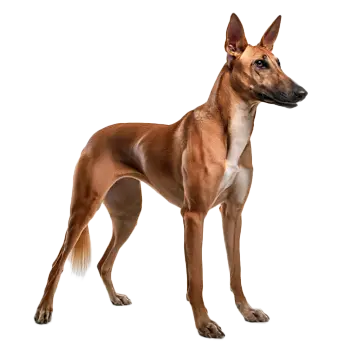
The Hanshee is a study in functional minimalism. Every ounce of this dog exists for a reason, and there is nothing decorative about its construction. Standing tall on long, clean-boned legs with a deep chest, flat musculature, and skin stretched thin over every visible anatomical landmark, the Azawakh looks less like a domestic dog and more like something sculpted by the Saharan wind itself. To people accustomed to well-padded retrievers and fluffy companion breeds, the Hanshee's lean frame can look alarming. But for this breed, the visible architecture of ribs, hip points, and muscle bellies is correct and healthy. A fat Azawakh is an unhealthy Azawakh.

The head is long, lean, and refined, with a flat skull that narrows slightly toward the eyes. The muzzle is straight and elongated, and the jaw is strong without being heavy. The stop is barely perceptible, giving the head a smooth, almost aerodynamic profile when viewed from the side. The eyes are large and almond-shaped, set slightly obliquely in the skull, and they range in color from dark brown to amber depending on coat color. The expression they carry is watchful, intelligent, and slightly remote, as though the dog is always assessing its surroundings from a place of calm authority.

The ears are triangular, thin, and set high on the skull, hanging flat against the head when the dog is relaxed and lifting slightly at the base when the dog is alert. The ear leather in many Hanshee dogs is remarkably thin and can be prone to splitting or tearing, a practical concern that owners need to watch for, especially in cold or dry climates where skin becomes more fragile.

The body is built for speed and endurance in extreme heat. The chest is deep, reaching to or near the elbow, but it is not broad. The ribcage is long and well sprung but flat-sided, providing lung capacity without the barrel shape that would add unnecessary weight. The waist is sharply tucked up, giving the dog a pronounced abdominal arch that is one of its most recognizable features. The back is nearly level or slightly arched over the loin, and the croup drops away noticeably toward the tail set.

The legs are long, straight, and fine-boned but remarkably strong for their diameter. The hindquarters are well angulated with long, flat muscle that provides explosive sprinting power. These dogs were bred to chase gazelle, hare, and even ostrich across open Sahelian terrain, and the rear assembly reflects that performance demand. The feet are compact, round, and tightly knuckled, with thick pads adapted to hot sand and rocky ground.

The coat is short, fine, and lies flat against the skin with virtually no undercoat. On the belly and inner thighs, the coat may be almost absent. Colors range widely and include red, clear sand, fawn, brindled, black, blue, brown, and parti-color combinations, often with white stockings, chest patches, and tail tips. The coat provides almost no insulation, which means the Hanshee is poorly suited to cold climates without management and should always have access to warm shelter and clothing when temperatures drop.

In motion, the Hanshee is one of the most striking sighthounds you will ever watch. The walk and trot are high-stepping and supple, with a fluid elasticity that makes the dog look almost weightless. The gallop is explosive and springy, capable of reaching speeds that surprise anyone unfamiliar with what a lean 45-pound dog can do when it locks onto a target. The movement standard considers gait an essential breed characteristic, and any heaviness or clumsiness is faulted severely.

The overall impression the Hanshee leaves is one of elegant utility refined over millennia. Nothing about this dog is accidental or decorative. The long legs provide stride length and ground clearance for rough terrain. The deep narrow chest maximizes respiratory efficiency without adding frontal drag. The tucked abdomen reduces weight carried over those long distances. The thin coat sheds heat in an environment where overheating is a greater threat than cold. Every structural feature traces back to a practical survival advantage in the Sahel, and that functional integrity is what gives the breed its striking beauty.

Affectionate With Family
Hanshee dogs form deep bonds with their family circle, offering quiet devotion and physical closeness to the people they trust most.
Good With Young Children
This breed does best with older children who understand its boundaries. Rough handling or sudden movements from small children can overwhelm a dog this sensitive.
Good With Other Dogs
Hanshee dogs can coexist with other dogs, particularly those they are raised with, but introductions to unfamiliar dogs should be managed carefully.
Shedding Level
The fine, sparse coat produces minimal shedding, making this one of the lower-maintenance sighthounds in terms of loose hair around the house.
Coat Grooming Frequency
Very little coat maintenance is needed. An occasional wipe-down or light brushing to distribute natural oils is all this thin coat requires.
Drooling Level
The Hanshee's clean, tight lip structure means drooling is essentially nonexistent in this breed.
Coat Type
The coat is extremely short and fine, lying close to the skin with virtually no undercoat, reflecting the breed's adaptation to intense Saharan heat.
Openness To Strangers
This breed is notably reserved and watchful around people it does not know. Trust is earned slowly and on the dog's own terms.
Playfulness Level
Hanshee dogs can be surprisingly playful and even silly with trusted family members, despite their regal public demeanor.
Watchdog/Protective Nature
Guarding camp and territory is hardwired into the breed. The Hanshee is alert, vocal when strangers approach, and fiercely protective of its people and home.
Adaptability Level
This breed does not transfer loyalty easily and struggles with rehoming as an adult. Environmental changes require patient, gradual transitions.
Trainability Level
Intelligent but deeply independent, the Hanshee learns quickly but decides for itself when cooperation is worthwhile. Harsh methods backfire completely.

Hanshee History & Development

The name Hanshee connects to the deep pre-colonial history of the Sahelian sighthound tradition, where multiple communities across a vast geographic range kept and bred these dogs under different names but with broadly similar purposes and selection pressures. Understanding the Hanshee means understanding a breed that was not developed in the Western sense of planned pedigree programs and written standards but was instead shaped over thousands of years by the practical demands of nomadic survival in one of the harshest environments on Earth.

The earliest origins of the Azawakh line are genuinely ancient. Wall paintings in the Central Sahara dating back thousands of years depict sighthound-type dogs that bear unmistakable resemblance to the modern breed. As the Sahara became increasingly arid and uninhabitable, the Tuareg, Dahoussahaq, and Peul peoples who had lived in the region migrated south into the Sahel, the semi-arid band stretching across West Africa below the desert. They brought their dogs with them into the Azawakh Valley and surrounding areas of what are now Mali, Niger, and Burkina Faso.

In these communities, the dogs served three overlapping functions that shaped every aspect of their temperament and physiology. As hunting dogs, they were expected to chase and bring down fast-moving game including gazelle, hare, and occasionally even ostrich and wild boar, providing critical protein for their families. As guard dogs, they protected the camp and livestock from predators including jackals, hyenas, and in earlier centuries, even lions. As companions, they shared the camp life of the nomads, sleeping close to their families and participating in the daily rhythms of community existence.

Genetic research has revealed that the Azawakh is not, as its appearance might suggest, closely related to Middle Eastern or European sighthounds like the Greyhound or Saluki. Mitochondrial DNA analysis shows the breed descends from an ancient branch of pariah-type bush dogs indigenous to sub-Saharan Africa. Thousands of years of geographic isolation, with the Sahara serving as a genetic barrier, kept this lineage distinct from the rest of the global canine gene pool. This deep genetic independence is one of the reasons the breed has such a distinctive health profile and behavioral character.

European discovery of the breed began in the late 1960s when French diplomats and military personnel stationed in West Africa encountered the dogs and arranged the first exports to France. The Yugoslavian diplomat Dr. Pecar is often credited with bringing the first Azawakh to Europe in 1970. These early imports generated immediate fascination among European sighthound enthusiasts, who recognized something genuinely different from the Greyhounds, Whippets, and Salukis they already knew. The Azawakh's combination of lean athleticism, fierce independence, and guardian instinct set it apart from every other sighthound in the Western world. Selective breeding in Europe proceeded with guidance from owners of the original exported lines, and the FCI granted formal recognition in 1981. The breed reached the United States later, gaining AKC recognition in 2019 after decades of dedicated work by a small community of American enthusiasts.

The name Hanshee persists in conversations about the breed's indigenous roots as a reminder that the Azawakh belongs to a tradition far older and more complex than Western kennel club pedigrees. When someone uses the name Hanshee, they are reaching past the European show-ring lens and acknowledging the Sahelian communities whose centuries of selective breeding produced one of the most distinctive and capable sighthounds the world has ever known.

Hanshee Temperament & Personality

The Hanshee's temperament is best understood as a paradox that makes perfect sense once you know where this dog comes from. Here is an animal that is simultaneously one of the most loyal dogs you will ever own and one of the most independent. It will guard your family with a fierceness that surprises people who mistake its elegance for fragility, and then it will ignore your recall command because it has decided that the squirrel on the far side of the yard is more important than anything you have to say. This is not a breed for people who expect uncomplicated obedience.

The loyalty runs deep and it runs narrow. Hanshee dogs bond intensely with their primary family and can be genuinely affectionate, playful, and even goofy behind closed doors. Breed enthusiasts often describe a private personality that visitors never see, one filled with gentle nuzzling, silly play-bows, and a fondness for claiming the warmest spot on the couch. But this warmth is reserved exclusively for trusted insiders. With strangers, the Hanshee shifts into a watchful, distant mode that can read as aloof, suspicious, or even unfriendly depending on the individual dog and the situation.

This reserve around strangers is not a training problem to be solved. It is a feature of a breed that spent thousands of years guarding nomadic camps in an environment where unfamiliar humans approaching the perimeter were a legitimate threat. You can and should socialize a Hanshee puppy extensively to prevent that natural wariness from escalating into fear-based reactivity, but you will not turn this dog into a golden retriever. A well-socialized Hanshee tolerates strangers politely without seeking their attention, and that is the correct outcome.

The territorial and protective instincts are strong enough that owners need to take them seriously. Hanshee dogs will bark loudly and assertively when someone approaches their territory, and they will position themselves between their family and any perceived threat. This makes them effective watchdogs but creates management responsibilities. Guests need to be introduced properly, delivery people need a plan, and fencing needs to be secure enough to prevent a dog from charging at someone who wanders too close to the property line.

One of the most important things to understand about Hanshee temperament is that these dogs do not rehome well as adults. The depth of their attachment to their family means that losing that family is genuinely traumatic. Adults placed in new homes may struggle with anxiety, depression, and difficulty transferring their loyalty to new people. This is a breed you commit to for life, and that commitment needs to be made with full understanding of what you are taking on. Prey drive is the other behavioral reality that shapes daily life with a Hanshee. These dogs were bred to chase down fast-moving game at speed, and that instinct remains fully operational in the modern pet. Small animals, cats, and even small dogs can trigger a pursuit response that overrides any training you have put in place. Management through secure fencing, leash walking, and careful introductions to household animals is an ongoing responsibility rather than a problem you solve once and move past.

Hanshee Family Life & Living Requirements

Bringing a Hanshee into your household works best when the family understands that this dog's affection is genuine but it comes with conditions. The breed needs a calm, stable home environment where routines are predictable and the dog has time to develop trust at its own pace. Chaotic households with constant turnover of visitors, loud environments, or unpredictable schedules can create chronic stress in a breed that is wired to assess its surroundings for threats and respond to disruptions with heightened alertness.

With children, the Hanshee is best suited to families with older kids who can read a dog's body language and respect its personal space. The breed is not aggressive toward children, but it is sensitive and fine-boned enough that rough handling, sudden grabbing, or high-pitched shrieking can provoke a defensive flinch or avoidance response rather than the patient tolerance you might expect from a Labrador or a Beagle. Families with very young children should wait until the kids are old enough to interact calmly and respectfully before adding this breed to the home.

Living space matters for the Hanshee, though not always in the way people assume. These dogs are surprisingly calm indoors once their exercise needs are met, and they spend much of their time at home resting in warm spots and monitoring the household from a favored vantage point. However, they absolutely need a securely fenced outdoor area where they can sprint. A six-foot fence is the minimum, and even that may not be sufficient for a motivated Azawakh in full stride. These dogs can achieve remarkable speed and height from a standing start, and the prey drive that made them successful gazelle hunters does not recognize the concept of a property boundary.

Temperature sensitivity is a real practical concern. The Hanshee evolved in one of the hottest regions on Earth and has almost no undercoat or body fat to provide insulation in cold weather. In northern climates, the dog will need a warm coat for outdoor excursions in winter and should never be left outside in cold temperatures. Conversely, the breed handles summer heat far better than most dogs and actually seems to come alive in warm weather.

The breed's strong attachment to its primary family means that the Hanshee does poorly when left alone for extended periods. This is not a dog you can leave in a crate for eight hours while you work and expect to find a calm, well-adjusted animal when you return. Separation anxiety is a genuine risk in this breed, and households where someone is home for most of the day or where flexible work arrangements allow regular presence are ideal.

Hanshee Training & Exercise Needs

Training a Hanshee is an exercise in mutual respect, and if you approach it any other way, you will lose. This is a dog with an ancient memory of independence, a breed that was expected to make split-second hunting decisions on its own at full speed across open terrain. It does not look to a human handler for permission to act the way a herding dog or a retriever does. The Hanshee evaluates situations independently and cooperates when cooperation makes sense to it. Your job as the trainer is to make cooperation consistently worthwhile.

Positive reinforcement is the only approach that produces results with this breed. Food rewards, praise delivered in a warm and genuine tone, and short training sessions that end before the dog loses interest are the building blocks. Harsh corrections, raised voices, physical pressure, and repetitive drilling will shut the Hanshee down completely or produce a dog that avoids you rather than engages with you. The breed has an exceptional memory and holds grudges. A single bad experience during training can set your relationship back weeks.

Socialization is the highest priority in the first year and it needs to be handled with care. The goal is exposure without flooding. You want the young Hanshee to encounter a wide range of people, environments, sounds, surfaces, and situations, but you need to let the dog process each new experience at its own pace rather than forcing it into overwhelming situations. Puppy classes can be beneficial if the instructor understands sighthound temperament, but avoid large chaotic group classes where the puppy cannot escape the stimulation when it needs to decompress.

Exercise needs are real but specific. The Hanshee is a sprinter, not a marathon runner. It needs daily opportunities to run at full speed in a safely enclosed area, supplemented by moderate-distance walks that allow for mental stimulation through scent investigation. A few explosive sprinting sessions throughout the week keep the dog physically satisfied in ways that long slow walks alone cannot. Between exercise sessions, the Hanshee is typically content to rest and does not pace or demand constant activity the way some high-energy breeds do.

Lure coursing is the sport tailor-made for this breed and provides both physical and mental engagement in a format that taps directly into the Hanshee's genetic programming. Competitive lure coursing events and casual practice with a lure on a pulley system give the dog a constructive outlet for its prey drive while building handler-dog cooperation around a structured activity.

Hanshee Health Concerns

The Hanshee benefits from an evolutionary history that produced a remarkably hardy natural breed, but it also carries some specific health vulnerabilities that owners and veterinarians need to understand. Perhaps the most important general point is that the Azawakh's blood chemistry, thyroid levels, and other baseline lab values often differ significantly from what is considered normal for most domestic dogs. Sighthounds as a group tend to run lower on certain values, and the Azawakh, with its unique genetic isolation from most other canine lineages, can show results that look abnormal on a standard reference chart but are perfectly healthy for this breed. Working with a veterinarian who understands sighthound norms is not optional. It is essential.

Demodectic mange occurs when the Demodex mites that normally live in hair follicles proliferate beyond the immune system's ability to control them. The Azawakh appears to be predisposed to this condition, which can range from a few localized patches of hair loss to a generalized skin condition requiring extended treatment. The breed's sensitivity to chemicals and harsh topical products also means that treatment protocols need to be adjusted for this population.

Common Health Issues

  • Hypothyroidism and autoimmune thyroiditis cause insufficient thyroid hormone production - Leading to weight gain, lethargy, skin problems, and behavioral changes. This is the most frequently documented health concern in the breed and requires lifelong medication management.
  • Von Willebrand disease is an inherited bleeding disorder that affects normal blood clotting. Dogs may show prolonged bleeding from wounds or surgical sites - And DNA testing is available to identify carriers before breeding.
  • Gastric dilatation-volvulus is a life-threatening emergency in which the stomach distends with gas and may rotate - Cutting off blood supply. The Azawakh's deep chest structure puts it at risk for this condition.
  • Idiopathic epilepsy has been reported in the breed - With seizures sometimes linked to underlying thyroid dysfunction. Medication can manage the condition, and affected dogs should not be used for breeding.
  • Demodectic mange occurs when Demodex mites in hair follicles proliferate beyond immune control. The Azawakh appears predisposed to this condition - Which can range from localized patches to generalized skin involvement.
  • Autoimmune disorders including a myositis-type muscle disease have been documented in the breed - Reflecting the breed's unique immune system profile shaped by its evolutionary isolation.

Preventive Care & Health Monitoring

  • OFA thyroid evaluation should be performed on all breeding stock - And periodic thyroid screening is recommended for pet dogs given the breed's documented predisposition to thyroid disease.
  • DNA testing for von Willebrand disease identifies carriers and helps breeders avoid producing affected puppies - Pre-surgical screening is also recommended for any Azawakh undergoing elective procedures.
  • Cardiac screening through OFA helps identify heart conditions including dilated cardiomyopathy that have been occasionally documented in the breed. - Cardiac screening through OFA helps identify heart conditions including dilated cardiomyopathy that have been occasionally documented in the breed.
  • Working with a veterinarian experienced in sighthound medicine is critical for this breed - As standard reference ranges for bloodwork and thyroid values may not apply to the Azawakh's unique physiology.
  • Judicious use of chemical products - Including flea and tick preventatives and vaccines, is advised by breed experts who note the Azawakh's immune system may be more sensitive than that of breeds with longer histories of exposure to Western chemical products.
  • Feeding multiple smaller meals and avoiding exercise around mealtimes reduces the risk of gastric dilatation-volvulus in this deep-chested breed. - Feeding multiple smaller meals and avoiding exercise around mealtimes reduces the risk of gastric dilatation-volvulus in this deep-chested breed.

Hanshee Grooming & Maintenance

Grooming a Hanshee is about as simple as it gets in the dog world. That fine, thin coat lies flat against the skin, sheds minimally, and does not mat, tangle, or develop odor the way denser coats do. A weekly once-over with a soft brush or grooming mitt removes loose hair and distributes the skin's natural oils, and that is genuinely all the coat requires under normal circumstances. Some owners use a rubber curry comb, which works well on the short hair and provides the added benefit of a gentle massage that most Hanshee dogs enjoy.

Bathing should be infrequent and gentle. The breed's natural coat condition is maintained by its own oils, and over-washing strips those oils away, leaving the skin dry and vulnerable. When a bath is necessary, use a mild shampoo formulated for sensitive skin and rinse thoroughly. Many Azawakh breeders recommend avoiding harsh chemical products altogether, noting that the breed's immune system, shaped by evolution in a natural environment rather than centuries of exposure to modern chemicals, can react poorly to products that other breeds tolerate without issue.

Ear care deserves attention even though the Azawakh's triangular drop ears do not trap moisture and debris to the degree that long, heavy-eared hound breeds do. Check the ears weekly for wax buildup, redness, or unusual odor, and clean with a gentle veterinary-approved solution as needed. The thin ear leather found in many Hanshee dogs is susceptible to cracking and splitting, particularly in cold or dry weather. A light application of a pet-safe moisturizer or coconut oil to the ear edges during winter months can help prevent painful splits that are slow to heal.

Nail care follows standard practice. Trim nails every two to three weeks or when you hear clicking on hard surfaces. The Hanshee's lean frame means there is very little body weight cushioning the impact of each step, so overgrown nails can affect gait and joint comfort more noticeably than in a heavier breed. Dental hygiene matters for the same reasons it matters in every dog. Regular brushing, dental chews, and periodic professional cleanings keep periodontal disease from becoming a silent drain on the dog's overall health. Given the breed's sensitivity to anesthesia, keeping dental health good enough to avoid the need for frequent anesthetic dental procedures is an especially worthwhile preventive investment.