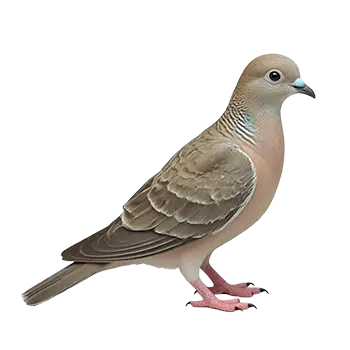

Zebra Dove chicks hatch after an incubation period of approximately 13 to 14 days, emerging as tiny, nearly helpless creatures weighing roughly 4 to 5 grams. Like all members of the Columbidae family, newborn Zebra Doves are altricial, meaning they are born with closed eyes, sparse natal down, and virtually no ability to thermoregulate or feed themselves. The hatchling's skin appears pinkish and translucent, with a light covering of pale yellowish down along the dorsal tract and head. During these critical first hours, the chick's survival depends entirely on warmth and the timely delivery of crop milk from one or both parents.
In a parent-raised setting, both the hen and the cock bird participate in feeding from the very first hours. Columbids are unique among birds in producing crop milk, a protein-rich and fat-dense secretion from the lining of the crop that serves as the exclusive food source for the first several days of life. This substance is not a true milk but a sloughed cellular secretion that contains essential immunoglobulins, lipids, and growth factors. The parents typically begin feeding the chick within a few hours of hatching, and the chick's instinctive begging behavior, consisting of gaping and head-bobbing, triggers the feeding response.
If you are hand-raising a Zebra Dove chick due to parental abandonment or a breeding program requirement, the first feeding should not occur until the yolk sac has been fully absorbed, which generally takes six to ten hours after hatching. Attempting to feed before absorption is complete risks digestive complications. A commercially prepared dove or pigeon hand-feeding formula, mixed to a thin consistency and warmed to approximately 104 to 106 degrees Fahrenheit, serves as the initial food. Use a small syringe or a modified feeding pipette, delivering tiny amounts with extreme care to avoid aspiration.
The brooder or nest environment must maintain a temperature between 95 and 99 degrees Fahrenheit during this period, as the chick has no capacity for independent thermoregulation. Even a drop of five degrees can push a newborn Zebra Dove into hypothermic stress. Keep the nesting substrate clean, dry, and free of loose fibers that could entangle the chick's legs or be ingested. Observe the chick frequently during the first day, checking for normal skin color, responsiveness to gentle stimulation, and evidence that the crop is filling after parental or hand-feedings.