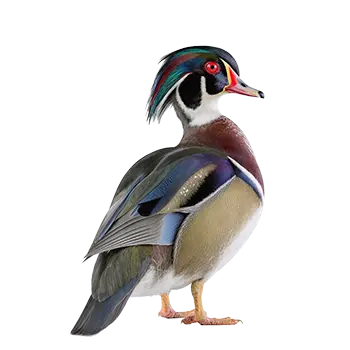

Transition from Duckling to Juvenile

The juvenile phase of the Wood Duck begins at approximately eight to ten weeks of age, when the young bird achieves its first sustained flight and its natal down has been largely replaced by juvenile contour feathers. This transition is not a single event but a gradual process that unfolds over several weeks, during which the duckling's body proportions, plumage, and behavior shift markedly toward those of an adult. The juvenile Wood Duck occupies a distinct developmental niche, no longer a vulnerable, ground-bound duckling but not yet a fully mature bird capable of breeding or migration.

Juvenile Wood Ducks of both sexes display a plumage pattern that closely resembles the adult female: mottled brown and gray tones across the body with a subdued version of the white teardrop-shaped eye patch that characterizes the species. At this stage, distinguishing juvenile males from juvenile females requires close observation. Males typically show slightly more contrast in the breast markings and may display a faint greenish gloss on the head feathers that hints at the spectacular iridescent plumage they will develop during their first prebasic molt. Bill coloration also begins to diverge, with young males showing warmer tones compared to the duller gray-brown bills of young females.

This period represents a critical shift in the bird's relationship with its environment. The juvenile Wood Duck must refine its flight skills, expand its foraging repertoire, learn to recognize and avoid predators without the immediate guidance of the hen, and begin navigating the social hierarchies that govern waterfowl communities. In captive settings, the juvenile phase is when management decisions about permanent housing, flock composition, and potential release are typically made, as the bird's behavior and physical condition at this stage provide the clearest picture of its long-term prospects.

For caregivers, the juvenile phase often feels like a welcome reprieve after the intensive demands of duckling rearing. The young birds are increasingly self-sufficient, hardy, and capable. However, this period brings its own set of challenges, from managing the transition to adult housing and diet to monitoring for developmental conditions that may only become apparent now that the bird is mobile and active.

Flight Development and Exercise

The achievement of flight is the defining milestone of the juvenile phase and one of the most exciting to witness in a captive setting. Wood Ducks are agile, fast fliers in maturity, but the path to aerial competence involves weeks of progressive muscle building, coordination refinement, and increasing confidence. First flights are typically short, low, and somewhat ungainly, often ending with clumsy landings that involve skidding across the water surface or crashing into vegetation. Within a few weeks of sustained practice, however, the young birds develop the precision and power that make adult Wood Ducks among the most maneuverable of all waterfowl.

In captive environments, providing adequate space for flight development is essential. A covered flight pen with minimum dimensions of 20 feet in length, 10 feet in width, and 8 feet in height allows juvenile Wood Ducks to practice takeoffs, sustained flight, turns, and landings safely. The pen should include a water feature deep enough for the birds to land on, as water landings are gentler than ground landings and more closely replicate natural conditions. Perching opportunities at various heights encourage the birds to practice the vertical takeoffs that Wood Ducks are uniquely adapted for among dabbling ducks, launching themselves nearly straight up through dense canopy gaps in the wild.

For birds destined for release, flight conditioning is not merely desirable but essential for survival. A wild Wood Duck must be capable of explosive takeoffs to evade predators, sustained flight during migration, and precise landings in cluttered forest environments. Captive-raised birds that have been confined to small enclosures without flight opportunities develop weaker pectoral muscles and poorer coordination than their wild counterparts, putting them at a significant disadvantage upon release. Pre-release flight conditioning should include progressively longer flight opportunities in increasingly complex environments that challenge the bird's agility.

Wing clipping, sometimes practiced in ornamental waterfowl collections to prevent escape, should be approached with great caution in juvenile Wood Ducks. Clipping flight feathers on one wing unbalances the bird and prevents flight entirely, which eliminates exercise opportunities critical for musculoskeletal development during this growth phase. If containment is necessary, a fully enclosed aviary is a far better solution than wing clipping, as it allows the birds to fly freely within a defined space. For birds being raised with the intention of eventual free-ranging within a property, pinioning, the surgical removal of the wing tip at the carpal joint, is sometimes performed during the first few days of life, well before the juvenile stage, and must only be done by a qualified veterinarian under appropriate anesthesia.

Diet and Nutritional Transition

The juvenile Wood Duck's dietary needs shift gradually from the high-protein, invertebrate-dominated diet of the duckling phase toward the more balanced omnivorous diet of the adult. This transition mirrors what occurs naturally as young Wood Ducks expand their foraging range and encounter a wider variety of food sources. In the wild, juvenile Wood Ducks begin consuming increasing quantities of seeds, acorns, berries, and aquatic vegetation while continuing to eat insects, snails, and other invertebrates whenever available.

In captive settings, the switch from waterfowl starter feed to a maintenance or grower formulation should occur gradually between eight and twelve weeks of age. Abrupt dietary changes can cause digestive upset and temporary weight loss. A practical approach is to blend the starter and grower feeds over a period of seven to ten days, progressively increasing the proportion of grower feed until the transition is complete. The grower feed should contain approximately 15 to 17 percent protein, which is lower than the starter ration but sufficient to support continued growth without the risk of angel wing that excessively high protein levels pose.

Supplementing the commercial feed with natural forage items is highly beneficial during the juvenile phase. Duckweed, water lettuce, and other floating aquatic plants can be cultivated in separate containers and offered regularly. Acorns, a staple of the wild Wood Duck diet, can be collected in autumn and offered whole or coarsely crushed. Berries including wild grapes, blackberries, and dogwood berries are eagerly consumed and provide valuable micronutrients and antioxidants. These natural foods also encourage the foraging behaviors that keep the birds mentally stimulated and physically active.

Calcium supplementation becomes increasingly important as the juvenile approaches its first full feather molt. Growing feathers place significant demands on calcium reserves, and a deficiency at this stage can result in weak, poorly formed feathers and skeletal issues. Crushed oyster shell offered in a separate dish allows the birds to self-regulate their calcium intake. Grit, in the form of small, insoluble stone fragments, should also be available at all times, as it is essential for the muscular gizzard to grind seeds and other hard food items effectively.

Fresh, clean water remains a constant requirement throughout the juvenile phase, but the water setup should evolve as the birds grow. Juvenile Wood Ducks should have access to water deep enough for full submersion and active swimming, which serves both hygienic and behavioral functions. Bathing and preening are essential for maintaining feather condition and waterproofing, and birds denied adequate swimming access develop poor feather quality and may lose the water repellency that is vital for a species that spends much of its life on the water.

Social Dynamics and Flock Integration

Juvenile Wood Ducks are inherently social animals, and the adolescent period is when the complex social behaviors of adult life begin to emerge and solidify. In the wild, juvenile broods gradually merge with other family groups and unrelated ducks, forming loose aggregations that forage and roost together through the late summer and into autumn. These gatherings provide safety in numbers and expose the young birds to the social cues, hierarchies, and behavioral norms of the broader Wood Duck community.

In captive settings, introducing juvenile Wood Ducks to an established flock requires careful management. Adult ducks, particularly dominant males, may chase and harass newcomers, causing stress and preventing the juveniles from accessing food and water. A gradual introduction process, beginning with visual contact through a wire partition before allowing physical mixing, reduces aggression and gives the juveniles time to acclimate. Providing multiple feeding and watering stations distributed throughout the enclosure ensures that subordinate birds can eat and drink without competing directly with established flock members.

Juvenile males begin to display rudimentary courtship behaviors during this phase, even though they will not breed until the following spring at the earliest. Head-bobbing, chin-lifting, and the distinctive jib call of the adult male may appear in incomplete or exaggerated forms as the young birds practice these displays. These behaviors are normal and represent an important part of social learning. Juvenile females, meanwhile, begin developing the assessment skills they will later use to evaluate potential mates, observing the displays of adult males and responding with interest or rejection.

Aggression among juvenile Wood Ducks is generally mild compared to some other waterfowl species, but it does occur, particularly when birds are crowded or when resources are limited. Pecking, chasing, and wing-flapping confrontations establish dominance hierarchies within the juvenile group. Caregivers should monitor these interactions to ensure that no individual bird is being persistently bullied or excluded from resources, as chronic social stress suppresses immune function and impairs feather development. If a particular bird is consistently the target of aggression, temporary separation followed by reintroduction in a reconfigured environment often resolves the issue.

Housing and Habitat Requirements

The housing needs of juvenile Wood Ducks expand significantly compared to the brooder environment of the duckling phase. These are active, increasingly strong-flying birds that require space, water access, natural cover, and environmental complexity to develop normally. Inadequate housing during the juvenile phase contributes to physical problems including poor feather condition, muscle atrophy, bumblefoot, and obesity, as well as behavioral issues such as feather plucking, excessive aggression, and stereotypic pacing.

An ideal juvenile enclosure includes both a land area and a water feature. The land area should provide natural substrate such as grass, leaf litter, or fine gravel rather than bare concrete or wire mesh, which damages the delicate webbed feet of waterfowl. Shade structures or natural vegetation protect the birds from direct sun exposure, which can cause heat stress, and provide the sense of overhead cover that Wood Ducks instinctively seek. Remember that this is a species adapted to life in and around forested waterways, and an open, exposed enclosure conflicts with their fundamental behavioral needs.

The water feature should be large enough for all the juvenile birds in the enclosure to swim simultaneously, with a depth of at least 12 to 18 inches to permit diving and active foraging beneath the surface. A natural pond with aquatic vegetation is ideal, but a constructed pool with regular water changes works well for smaller collections. The entry and exit points should have gentle slopes or ramps, as steep-sided pools can trap exhausted or injured birds. Water quality management is critical, and in enclosed systems, filtration or frequent complete water changes prevent the buildup of harmful bacteria and algae.

Perching structures are essential for Wood Ducks at every stage of life. Unlike most dabbling ducks, Wood Ducks have strong, clawed feet adapted for perching on branches and roosting in trees. Providing horizontal branches, wooden platforms at various heights, and elevated roosting spots within the enclosure allows the juveniles to exercise their perching instincts and develop the foot and leg strength needed for their arboreal habits. Perches should be made of natural wood with the bark left on to provide grip, and they should be positioned so that droppings do not fall into feed or water areas.

Predator protection is a non-negotiable element of any outdoor juvenile enclosure. Wood Ducks are attractive prey for a wide range of predators including raccoons, foxes, mink, hawks, owls, and domestic dogs and cats. The enclosure must be fully enclosed on all sides and from above, using hardware cloth with openings no larger than half an inch to exclude even small predators such as weasels and snakes. Buried wire aprons extending outward from the enclosure walls prevent predators from digging underneath. Locks or secure latches on all access points deter raccoons, which are dexterous enough to open simple hook-and-eye closures.

Health Management During Adolescence

The juvenile phase brings a new profile of health concerns compared to the duckling stage. While the immediate fragility of the newly hatched bird has passed, the adolescent Wood Duck faces risks associated with its increasing mobility, changing diet, exposure to new environments, and the physiological demands of rapid growth and feather development. Proactive health management during this period sets the foundation for a robust adult bird.

Parasitic infections become more likely as juvenile Wood Ducks gain access to outdoor environments, soil, and natural water sources. Internal parasites including roundworms, gizzard worms, and various protozoa can be acquired through ingestion of contaminated food, water, or intermediate hosts such as snails and insects. Routine fecal examinations every three to four months allow early detection and targeted treatment before parasite loads become heavy enough to cause clinical disease. Broad-spectrum deworming without diagnostic testing is discouraged because it promotes resistance and may not address the specific parasites present.

Lead poisoning is an insidious risk for any waterfowl with access to areas where lead shot, fishing sinkers, or other lead objects have accumulated in sediment. Wood Ducks are bottom feeders that ingest grit and small objects to aid digestion, and lead items are readily picked up along with stones. Even a single lead pellet can cause fatal lead toxicosis, with symptoms including green-stained droppings, wing droop, weight loss, and progressive weakness. Any pond or water source used for captive waterfowl should be thoroughly assessed for lead contamination, and all known lead sources should be removed from the environment.

Foot health requires ongoing attention in captive Wood Ducks. Bumblefoot, a bacterial infection of the foot pad caused by Staphylococcus or other organisms, develops when birds stand on hard, rough, or dirty surfaces for prolonged periods. The infection begins as a small callus or abrasion on the plantar surface of the foot and can progress to a deep abscess involving the bones and tendons if left untreated. Prevention involves providing soft, natural substrates, clean perching surfaces, and access to water that allows the feet to remain supple. Any swelling, redness, or lameness involving the feet should be examined by a veterinarian promptly.

Molting-related stress is a consideration during the late juvenile phase as the bird undergoes its first major feather replacement. Molting is metabolically expensive, requiring significant protein and mineral resources, and birds that are nutritionally marginal or stressed may produce poor-quality replacement feathers. Ensuring adequate nutrition, minimizing environmental stressors, and providing quiet, secure areas where molting birds can rest undisturbed all support a healthy molt. Bare patches that fail to fill in with new feathers, or feathers that emerge deformed, broken, or discolored, warrant veterinary investigation to rule out nutritional deficiency, feather dystrophy, or infectious disease.

Preparing for Independence and Release

For juvenile Wood Ducks being raised with the goal of wild release, the adolescent phase is when the critical assessment of readiness begins. A successful release requires that the bird possess not only physical health and flight capability but also the behavioral repertoire needed to survive in a wild environment. Birds that are strongly human-imprinted, unable to fly competently, unfamiliar with natural food sources, or lacking appropriate predator avoidance responses are poor candidates for release and will likely perish within days.

Flight competence is the most fundamental physical requirement. The bird must be capable of strong, sustained flight including rapid takeoffs, tight turns through obstacles, and controlled landings on water. Assessment of flight ability should take place in a large flight pen or, if local regulations permit, during supervised free-flight sessions in a secure area. Birds that show persistent weakness, asymmetry, or reluctance in flight should be evaluated for wing injuries, feather abnormalities, or musculoskeletal problems before any release is considered.

Behavioral readiness is equally important and harder to quantify. A release-candidate Wood Duck should show strong anti-predator responses, including alarm calling, rapid flight initiation, and avoidance of approaching humans, dogs, and other potential threats. It should forage efficiently on natural food items, demonstrate normal social behaviors with conspecifics, and show no signs of stress-related behavioral disorders. Birds raised with minimal human contact alongside other Wood Ducks in naturalistic enclosures are far more likely to meet these behavioral criteria than individually raised, hand-tame birds.

The timing and location of release significantly affect survival odds. Late summer and early autumn releases allow the young birds to join wild flocks during the pre-migration staging period, when large groups of Wood Ducks congregate on suitable wetlands before moving south. This timing provides the released birds with the safety of a flock and the opportunity to learn migration routes by following experienced adults. Release sites should feature established Wood Duck populations, abundant food resources, and minimal human disturbance. Coordination with local wildlife management agencies is often required and always advisable.

For juvenile Wood Ducks that will remain in permanent captivity, whether due to physical disabilities, imprinting, or the goals of the avicultural program, the adolescent phase is the time to establish their long-term housing, social groupings, and management routines. Captive Wood Ducks can live well over a decade with proper care, and the habits and social bonds formed during the juvenile period tend to persist throughout their lives. Introducing the birds to their permanent enclosure, their long-term flock mates, and a consistent daily routine during adolescence minimizes the stress of future transitions and sets the stage for a healthy, well-adjusted adulthood.

Always consult a qualified professional before making any health-related decisions. This content is provided for informational reference only and should not replace professional guidance specific to your animal.