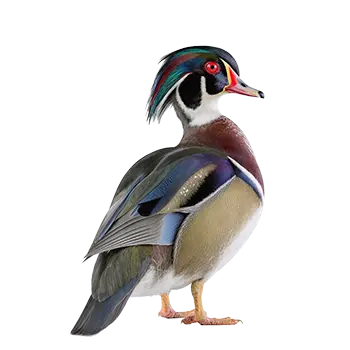

The adult Wood Duck is widely regarded as one of the most strikingly beautiful ducks in North America, and the full adult plumage of the drake is a primary reason for the species' enduring popularity in aviculture. The mature male in breeding plumage displays an iridescent green and purple crested head, a chestnut breast speckled with white, buff flanks, and a dark back with blue and green highlights. The eyes are a vivid red, and the bill is patterned in red, yellow, black, and white. The adult female, while more subdued, possesses her own elegant beauty with grayish-brown plumage, a distinctive white teardrop-shaped eye ring, and a crested head that echoes the male's silhouette.
Wood Ducks undergo two distinct molts each year, a pattern shared with most dabbling duck species but particularly dramatic in this one. The prebasic molt, occurring in late summer after the breeding season, replaces the male's brilliant breeding plumage with a drab eclipse plumage that closely resembles the female's coloring. During this molt, the flight feathers are shed simultaneously, rendering the bird flightless for a period of approximately three to four weeks. The prealternate molt, beginning in autumn and completing by early winter, restores the male's full breeding finery. Understanding this cycle is essential for caregivers, who may otherwise mistake the eclipse plumage for a sign of illness or nutritional deficiency.
The adult female's plumage changes are more subtle between molts but no less important. Her feathers undergo gradual wear throughout the breeding season, and the prebasic molt restores fresh, well-insulated plumage in preparation for migration and winter. The quality of the replacement feathers is directly tied to the hen's nutritional status during the molt, which is particularly demanding because it often coincides with the energy-depleting final stages of brood rearing. Hens that are nutritionally depleted from nesting and chick rearing may produce a substandard replacement plumage that provides less insulation and waterproofing.
For captive keepers, plumage condition serves as one of the most visible indicators of overall health and husbandry quality. Feathers that are dull, brittle, frayed, or slow to regrow during molt periods suggest nutritional deficiencies, parasitic infections, chronic stress, or inadequate bathing access. Conversely, a Wood Duck displaying vibrant, well-maintained plumage with a glossy sheen and complete feather coverage is almost certainly receiving appropriate care. Regular observation of feather condition should be a routine part of daily health monitoring.