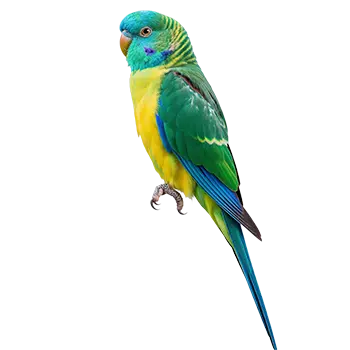

Nutrition & Daily Diet

An adult Turquoisine Parakeet's long-term health depends heavily on a balanced, varied diet that meets the specific nutritional requirements of a small Neophema species. In the wild, Turquoisine Parakeets forage on the ground across the open woodlands and grasslands of eastern Australia, consuming a diverse mix of grass seeds, herbs, native flowers, insects, and green plant material. Captive diets that rely solely on a dry seed mix, while convenient, fall short of replicating this diversity and predispose the bird to nutritional deficiencies that accumulate over years.

A high-quality small-parakeet seed mix forms a reasonable dietary base but should constitute no more than fifty to sixty percent of the total intake. The remainder should come from fresh vegetables, leafy greens, sprouted seeds, and a modest amount of fruit. Dark leafy greens such as kale, dandelion greens, Swiss chard, and endive are excellent sources of vitamins A, K, and calcium. Grated carrot, broccoli florets, snow peas, and corn on the cob provide additional variety. Fruits should be offered sparingly due to their sugar content, with small amounts of apple, pear, or berries served two to three times per week.

Sprouted seeds deserve special emphasis in the adult Turquoisine Parakeet's diet. The germination process dramatically increases the bioavailability of vitamins, minerals, and amino acids while reducing the fat content that makes dry seed problematic in excess. Mung beans, sunflower seeds, millet, and safflower can all be sprouted at home, though scrupulous hygiene during the sprouting process is essential to prevent bacterial contamination. Rinse sprouts thoroughly and discard any that develop an off smell or visible mold.

Formulated pellets designed for small parakeets can supplement the diet and help fill nutritional gaps, but many Turquoisine Parakeets are reluctant to accept pellets, especially if they were not introduced during the juvenile weaning period. If you wish to transition an adult bird to a partially pelleted diet, do so gradually over several weeks by mixing a small amount of pellets with the seed mix and slowly increasing the proportion. Never withhold seed entirely to force pellet consumption, as the bird may starve rather than eat an unfamiliar food.

Clean, fresh water must be available at all times. Water dishes should be washed and refilled daily, and more frequently if the bird bathes in its drinking water, which Turquoisine Parakeets are inclined to do. A separate shallow bathing dish placed on the cage floor satisfies the bird's bathing instinct and helps keep the drinking water cleaner. Cuttlebone and a mineral block should remain accessible to provide calcium and trace minerals, which are particularly important for hens even outside the breeding season.

Housing & Flight Space

Adult Turquoisine Parakeets are active, flight-oriented birds that require generous horizontal space to thrive. Unlike climbing species that utilize vertical cage dimensions, Turquoisine Parakeets spend much of their time flying back and forth between perches and foraging on the ground. Housing that restricts this natural movement pattern leads to muscle atrophy, obesity, boredom, and behavioral problems that diminish the bird's quality of life.

For a single bird or pair kept indoors, a flight cage measuring at least 36 inches long, 18 inches deep, and 24 inches tall represents the minimum recommended size, though a longer cage is always preferable. Bar spacing should not exceed half an inch. The cage should be placed in a room where the family spends time, so the bird benefits from social interaction, but positioned away from the kitchen, where cooking fumes, non-stick cookware emissions, and aerosol sprays pose respiratory hazards. Avoid placing the cage in direct sunlight without a shaded retreat, and keep it away from drafts, air conditioning vents, and heating ducts.

Outdoor aviaries are the ideal housing for Turquoisine Parakeets in climates where temperatures remain above approximately 40 degrees Fahrenheit. A planted aviary with natural grasses, shrubs, and safe ground cover allows the bird to express its full behavioral repertoire, including ground foraging, natural flight patterns, rain bathing, and sunlight exposure for vitamin D synthesis. The aviary must be fully enclosed with appropriate mesh to exclude predators, including snakes, rats, and cats, and the mesh gauge should be fine enough to prevent wild birds from entering, which reduces the risk of disease transmission.

Perch placement and variety matter as much as cage dimensions. Provide multiple perches of varying diameters made from natural, untreated branches. Position them to create clear flight lines across the longest dimension of the enclosure, with enough spacing that the bird must fly rather than hop between them. Avoid overcrowding the cage with perches and toys to the point that flight is obstructed. A few well-chosen enrichment items rotated regularly are more beneficial than a cluttered environment that limits movement.

Behavioral Enrichment & Mental Health

Turquoisine Parakeets may be quieter and less overtly demanding than many companion parrot species, but they are intelligent birds that require mental stimulation to remain psychologically healthy. Boredom and understimulation in captive birds can manifest as repetitive behaviors, feather over-preening, excessive sleeping, or a withdrawal from interaction that caregivers sometimes mistake for contentment. An enriched environment that provides variety, challenge, and opportunities for natural behavior is the foundation of good mental health.

Foraging enrichment is particularly well suited to the Turquoisine Parakeet's natural ecology. In the wild, these birds spend a significant portion of their day on the ground, searching through grass and leaf litter for seeds and small invertebrates. Replicating this behavior in captivity is straightforward. Scatter seeds and dried herbs across the cage floor among clean straw, shredded paper, or dried grass. Hide small treats inside loosely folded paper, under shallow ceramic dishes, or inside purpose-built foraging toys that require the bird to manipulate a simple mechanism to access food. Even the act of picking through sprouted seeds offers meaningful foraging engagement.

Environmental variety is another important dimension of enrichment. Turquoisine Parakeets are observant birds that respond to novelty, though they can initially be wary of unfamiliar objects. Introduce new items gradually, placing them near but not on the bird's preferred perches, and allow the bird to approach on its own terms. Rotate toys and foraging setups every week or two to maintain novelty without overwhelming the bird. Small bird-safe bells, leather strips, softwood chew pieces, and bundles of natural grasses or seeding heads from bird-safe plants all provide appropriate stimulation.

Social interaction, whether with a human caregiver or a conspecific companion, is a fundamental need. Turquoisine Parakeets are not solitary birds in the wild, and a single bird kept in isolation without regular human engagement is likely to become withdrawn and stressed. If the caregiver's schedule does not allow for several hours of daily interaction, keeping a pair of Turquoisine Parakeets is strongly recommended. A compatible pair provides mutual companionship, preening, vocal exchange, and the reassurance of a flock mate, all of which contribute to better psychological wellbeing than any toy or foraging device can deliver.

Safe exposure to natural sunlight or full-spectrum avian lighting supports both physical and behavioral health. Ultraviolet light enables vitamin D synthesis, which is essential for calcium metabolism, and it also allows birds to perceive the full spectrum of their plumage colors, which plays a role in social signaling and mate assessment. A full-spectrum avian lamp on a timer that provides ten to twelve hours of light followed by twelve to fourteen hours of darkness helps regulate the bird's circadian rhythm, supports healthy molt cycling, and reduces the hormonal dysregulation that can occur under artificial lighting with inappropriate photoperiods.

Annual Health Management

Routine veterinary care is the cornerstone of preventive health management for an adult Turquoisine Parakeet. An annual wellness examination by a qualified avian veterinarian allows for early detection of conditions that may not yet be producing visible symptoms. Birds are adept at concealing illness, an evolutionary adaptation to avoid attracting predators, which means that by the time a Turquoisine Parakeet looks visibly sick, the underlying condition may already be advanced.

The annual examination should include a thorough physical assessment covering body condition, feather quality, beak and nail condition, eye and nare clarity, and auscultation of the heart and respiratory system. Fecal analysis screens for internal parasites and provides information about bacterial and yeast populations in the digestive tract. Depending on the bird's history and the veterinarian's clinical judgment, blood work may be recommended to evaluate liver function, kidney function, blood cell counts, and nutritional status. Baseline blood work performed when the bird is healthy is especially valuable, as it provides a comparison point if the bird becomes ill in the future.

Beak and nail maintenance is an ongoing aspect of adult care. In the wild, the Turquoisine Parakeet's beak and nails are worn down naturally through foraging on the ground and chewing on bark and branches. In captivity, access to cuttlebone, mineral blocks, and natural wood perches usually keeps the beak in good condition. However, some individuals develop overgrown beaks or nails that require periodic trimming by an experienced avian veterinarian or a trained keeper. An overgrown beak can interfere with eating, while excessively long nails can become caught in cage fabric or toys, causing injury.

Parasite prevention is relevant for both indoor and outdoor birds, though the risk profile differs. Aviary birds are exposed to parasites carried by wild birds, soil organisms, and insects. Regular fecal testing and, when indicated, targeted deworming help manage this risk. Indoor birds face lower parasite exposure but are not immune, particularly if they are fed fresh greens or grasses harvested from outdoor sources. Air sac mites, while more commonly associated with finches and canaries, can occasionally affect Neophema species and should be considered if the bird develops a voice change or respiratory clicking.

The Annual Molt

Adult Turquoisine Parakeets undergo a complete molt once per year, typically in late summer or early autumn following the breeding season. During this process, the bird sheds and replaces its entire plumage over a period of six to ten weeks. While molting is a natural and necessary process, it places considerable metabolic demands on the bird and requires attentive management from the caregiver to ensure smooth, healthy feather replacement.

The molt progresses in a predictable pattern. Flight feathers are typically shed symmetrically, with corresponding feathers on each wing molting simultaneously so the bird retains balanced flight capability throughout the process. Body contour feathers are replaced more gradually, often starting on the head and neck and progressing across the chest, back, and belly. Tail feathers follow their own schedule. At the height of the molt, the bird may appear slightly scruffy or uneven as old feathers fall away and new ones emerge in their keratin sheaths.

Nutritional support during the molt is critical. Feathers are composed primarily of keratin, which requires a steady supply of sulfur-containing amino acids, particularly methionine and cysteine. Increase the proportion of protein-rich foods in the diet during the molt period. Sprouted seeds, hard-boiled egg, and small amounts of cooked legumes provide high-quality protein. Vitamin A from leafy greens supports the health of the feather follicles, while calcium and trace minerals from cuttlebone and mineral supplementation ensure that feather structure is sound. Inadequate nutrition during the molt produces brittle, poorly colored feathers that are prone to breakage and may exhibit stress bars.

Bathing opportunities should be increased during the molt, as moisture helps soften the keratin sheaths of emerging pin feathers and encourages the bird to preen more actively. A shallow dish of lukewarm water placed on the cage floor, or a gentle misting with a clean spray bottle, will be welcomed by most Turquoisine Parakeets. Some individuals are enthusiastic bathers and will splash vigorously, while others prefer a lighter mist. Observe the bird's preference and accommodate accordingly.

Behavioral changes during the molt are expected. The bird may be less active, less social, and occasionally irritable due to the discomfort of emerging pin feathers and the energy drain of feather production. Reduce handling during the peak of the molt if the bird shows signs of stress, and be gentle when interacting with a molting bird to avoid damaging developing feathers. A broken blood feather, one that is still being supplied by the blood vessel in the shaft, can bleed significantly and may require removal by a veterinarian if the bleeding does not stop with gentle pressure.

Common Adult Health Concerns

While Turquoisine Parakeets are generally hardy birds when maintained in appropriate conditions, several health concerns are more prevalent during the adult years and warrant awareness from caregivers. Recognizing the early signs of these conditions allows for timely veterinary intervention, which often makes the difference between a manageable medical issue and a crisis.

Obesity is one of the most common and most preventable health problems in captive Turquoisine Parakeets. A diet high in fatty seeds such as sunflower and safflower, combined with limited flight opportunity in a small cage, creates conditions for gradual weight gain. An obese Turquoisine Parakeet may develop fatty liver disease, known as hepatic lipidosis, which compromises liver function and can be fatal if not addressed. Signs include a visible fat pad over the keel bone, labored breathing after minimal exertion, and in advanced cases a distended abdomen. Prevention through a balanced diet and adequate flight space is far more effective than attempting to reverse established obesity.

Respiratory infections, particularly Aspergillosis, represent a significant threat to Neophema species. Aspergillus spores are ubiquitous in the environment, found in soil, decaying vegetation, and improperly stored seed. A bird with a healthy immune system can typically manage routine exposure, but stress, malnutrition, poor ventilation, or concurrent illness can tip the balance toward active infection. Early symptoms include subtle voice changes, mild lethargy, and slightly increased respiratory effort. Advanced cases may present with open-mouth breathing, tail bobbing, nasal discharge, and severe weight loss. Diagnosis typically requires a combination of blood work, imaging, and sometimes endoscopy, and treatment involves long-term antifungal medication.

Psittacine Beak and Feather Disease remains a concern for all psittacine species, including the smaller Neophema parakeets. This viral disease, caused by a circovirus, attacks the immune system and the cells that produce feathers and beak tissue. Affected birds may develop abnormal feathers, progressive feather loss, beak deformities, and immunosuppression that leaves them vulnerable to secondary infections. There is no cure, and affected birds eventually succumb to the disease or its complications. Testing is available and should be performed on any bird with unexplained feather abnormalities.

Gastrointestinal conditions, including bacterial enteritis, yeast overgrowth, and megabacteriosis caused by Macrorhabdus ornithogaster, are seen with some regularity in grass parakeets. Megabacteriosis, sometimes called avian gastric yeast infection, can cause chronic weight loss, regurgitation, and undigested seed in the droppings. Diagnosis is made by microscopic examination of fecal samples or crop swabs, and treatment typically involves antifungal medication administered over an extended period. Regular fecal screening at annual veterinary visits helps catch these conditions before they cause significant harm.

Building a Lasting Bond

The adult years of a Turquoisine Parakeet's life offer the greatest opportunity for deepening the bond between bird and caregiver. By this stage, the bird's personality is fully formed, its behavioral patterns are established, and the mutual understanding between bird and keeper has had time to develop. The relationship between a well-socialized adult Turquoisine Parakeet and a patient, attentive caregiver can be deeply rewarding, characterized by quiet trust, gentle interaction, and a shared daily rhythm.

Consistency is the foundation of a strong bond with a Neophema species. Turquoisine Parakeets are creatures of routine that draw security from predictability. Feeding at the same times each day, maintaining a consistent sleep schedule with twelve to fourteen hours of quiet darkness, and following a regular pattern of interaction all help the bird feel safe and settled. Sudden changes in routine, household composition, or cage placement can trigger stress behaviors, so introduce necessary changes gradually whenever possible.

Interaction with an adult Turquoisine Parakeet is typically quieter and more subtle than the boisterous play associated with larger parrot species. These are birds that enjoy calm presence. Sitting near the cage and reading aloud, whistling softly, or simply being in the same room while the bird forages and preens can be deeply satisfying forms of companionship for both parties. Some well-tamed individuals will perch on a hand or shoulder, preen their caregiver's hair, or doze contentedly while being held. Others prefer proximity without direct physical contact, and this preference should be respected rather than overridden.

Learning to read the bird's body language is an essential part of the relationship. A Turquoisine Parakeet that is relaxed will have smooth, slightly fluffed feathers, half-closed eyes, and may grind its beak softly, a classic sign of avian contentment. A bird that is frightened or agitated will slick its feathers tight against its body, lean away from the stimulus, and may open its beak or lunge defensively. A bird that raises its crest feathers and leans forward with dilating pupils is alert and interested. Responding appropriately to these signals, approaching when the bird is relaxed and withdrawing when it is stressed, builds the bird's trust in its caregiver's reliability and emotional sensitivity.

Patience with setbacks is part of the journey. Even a well-bonded adult Turquoisine Parakeet may go through temporary periods of increased wariness, particularly during the molt, after an illness, or following a stressful event such as a cage move or the loss of a companion bird. These regressions do not erase the progress that has been made. Maintain your regular routine, continue offering positive interactions, and give the bird the time and space it needs to regain its equilibrium. The bond, once established, has a resilience that typically reasserts itself when the stressor resolves.

Always consult a qualified professional before making any health-related decisions. This content is provided for informational reference only and should not replace professional guidance specific to your animal.