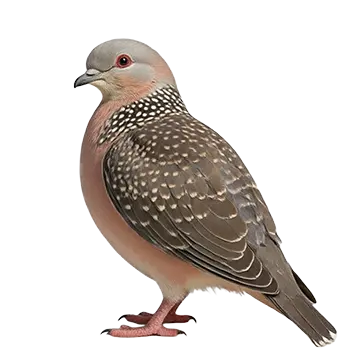

Spotted Dove squabs reach the fledging stage with remarkable speed, typically leaving the nest between 14 and 17 days of age. This rapid timeline reflects the species' evolutionary heritage as a ground-nesting columbid, where extended time in a vulnerable nest increases predation risk. For captive keepers, the fledging transition represents a pivotal shift in care strategy. The focus moves from passive support of parental care or intensive hand-feeding toward active management of a mobile, increasingly independent young bird that is exploring its environment but has not yet mastered the skills it needs to thrive.
A fledgling Spotted Dove looks strikingly different from the helpless squab of just two weeks earlier. The body is nearly fully feathered, with warm brown plumage on the upperparts and a paler, pinkish-buff wash on the underside. The tail, while present, is still noticeably shorter than that of an adult, and the flight feathers have not yet reached their full length. Critically, the distinctive black collar spangled with white spots that gives the species its common name is absent in juveniles. Young birds instead display a plain, unmarked neck that can cause inexperienced keepers to question whether they have correctly identified the species.
The first hours and days after leaving the nest are a period of high vulnerability. Fledgling doves are capable of short, somewhat clumsy flights, but they lack the stamina and aerial coordination of mature birds. In a captive setting, this means the bird may flutter from perch to floor and struggle to regain elevation. Prepare the environment before fledging by removing hazards at floor level, covering open water containers, securing windows and mirrors that the bird might fly into, and ensuring that no gaps exist where a small bird could become trapped. Ceiling fans should be switched off permanently in any room where doves are housed or exercised.
Parent-raised fledglings continue to receive supplemental feedings from the adults for approximately one to two weeks after leaving the nest. During this period, the fledgling follows the parents and solicits food with begging calls and wing-fluttering displays. The parents respond with decreasing frequency and eventually begin actively discouraging the fledgling's approaches, a natural weaning pressure that motivates the young bird to begin foraging independently. This behavioral dynamic is important to observe, as it guides the caregiver's decisions about when intervention is and is not appropriate.