
The First 24 Hours

Spotted Dove chicks hatch after an incubation period of approximately 13 to 14 days, which is notably short compared to larger psittacine species. The newly emerged squab is altricial, arriving blind with eyes sealed shut, virtually featherless except for sparse wisps of pale yellow down, and entirely dependent on its parents for warmth and nourishment. A healthy hatchling weighs between 5 and 8 grams and will appear disproportionately fragile, with translucent pinkish skin through which internal organs may be faintly visible. Both parents share incubation duties in Spotted Doves, and the transition from egg to hatchling typically triggers an immediate feeding response from whichever parent is on the nest at the time of hatching.

Within the first hours of life, the squab receives its inaugural meal of crop milk, a nutrient-dense secretion produced by the lining of both the male and female parent's crop. This substance, sometimes called pigeon milk despite being common across the Columbidae family, is rich in protein, fat, and immunoglobulins that provide passive immunity during the chick's most vulnerable period. Unlike many other bird families where only the hen feeds the young, both Spotted Dove parents produce crop milk and share feeding responsibilities equally, a behavioral trait that significantly improves hatchling survival rates.

If you are managing a captive breeding situation and the parents are attentive, the best course of action during the first 24 hours is minimal intervention. Spotted Doves are generally excellent parents, and unnecessary handling of the squab can cause the adults to abandon the nest. Limit your checks to brief visual observations from a distance, confirming that the parents are sitting on the chick and that the squab's crop appears slightly rounded after feedings. An empty, flat crop several hours after hatching may indicate that the parents have not begun feeding, which requires immediate assessment.

In the rare event that hand-rearing becomes necessary due to parental abandonment, egg death of one parent, or injury, the first feeding should not be attempted until the yolk sac has been fully absorbed, typically within six to ten hours of hatching. Premature feeding before yolk absorption can overwhelm the immature digestive system and cause fatal complications. Prepare a brooder set to 96 to 98 degrees Fahrenheit with humidity around 60 percent, and have an appropriate columbid hand-rearing formula ready before the chick arrives.

Feeding & Nutrition

The nutritional needs of a newborn Spotted Dove are met almost exclusively by crop milk during the first three to four days of life. This secretion is unlike any other food source in the avian world. It contains approximately 60 percent protein and 35 percent fat in its dry weight, along with growth factors and antibodies that seed the squab's developing immune system. The parents produce crop milk in response to hormonal changes triggered by prolactin, and its availability is not dependent on the adults' food intake during the first couple of days, though a well-nourished parent produces higher-quality crop milk for a longer period.

As the squab enters its fourth and fifth day, the parents gradually transition from pure crop milk to a mixture of crop milk and partially digested seeds. This blending process is gradual and mirrors the maturation of the chick's digestive tract. By the end of the first week, the proportion of seed material in the feeding mix increases substantially, and the squab's crop will appear more granular after feedings rather than the smooth, rounded appearance associated with pure crop milk. The parents regulate this transition instinctively, and it requires no intervention in a parent-raised scenario.

Hand-feeding a Spotted Dove squab requires a formula specifically designed for columbids or, at minimum, a high-quality hand-rearing formula for granivorous birds. Generic parrot hand-feeding formulas may have nutrient ratios unsuitable for doves, particularly in calcium-to-phosphorus balance and fat content. The formula should be mixed to a thin, watery consistency for the first two days and gradually thickened as the chick grows. Feeding temperatures must be maintained between 104 and 106 degrees Fahrenheit, measured with a thermometer rather than estimated by touch, as crop burns from overheated formula are a common and devastating hand-rearing injury.

Feeding frequency for hand-reared squabs follows a demanding schedule. During the first five days, feedings should occur every two to three hours from early morning through late evening. A single overnight gap of five to six hours is generally tolerable if the last evening feeding is generous, but younger or smaller squabs may need one middle-of-the-night feeding. By the end of the first week, the interval can typically extend to every three to four hours. Meticulous record-keeping of feeding times, volumes consumed, and daily weight is essential for detecting problems early. A healthy squab should gain weight steadily each day, and any plateau or decline lasting more than 24 hours warrants veterinary evaluation.

The feeding technique for dove squabs differs from that used for psittacine chicks. Doves feed by inserting their beak into the parent's mouth and pumping, so hand-fed squabs often respond best to a method that mimics this action. A small syringe fitted with a soft rubber tip or a purpose-made dove feeding nipple allows the squab to wrap its beak around the instrument and pump naturally. Forcing formula into the beak from above, as one might do with a parrot chick, carries a high aspiration risk in doves because their feeding reflex involves a different head and throat posture.

Developmental Milestones

Spotted Dove squabs develop rapidly compared to many companion bird species, reflecting their evolutionary strategy as ground-nesting columbids that face significant predation pressure. Understanding the normal developmental timeline allows caregivers to identify delays or abnormalities before they become critical. The pace of development in Spotted Doves means that changes occur almost daily during the first two weeks, and what looks like a helpless blob of skin on day one transforms into a recognizable bird in a remarkably short time.

During the first three days, the squab is essentially immobile, lying flat in the nest with its head tucked. Its primary activities are sleeping and feeding. By day four or five, the chick becomes slightly more animated, lifting its head more readily during feeding and showing the first faint traces of pin feathers emerging along the wing tracts. The eyes, which were sealed at hatching, begin to show a slit of opening around day three to four, and by day six or seven, the eyes are typically fully open, revealing dark irises.

The second week brings dramatic physical changes. Pin feathers erupt rapidly across the back, wings, and tail, and by day ten, the squab is substantially covered in emerging feather sheaths that give it a spiny, hedgehog-like appearance. The characteristic plumage pattern of the Spotted Dove begins to emerge, with warm brown tones visible through the feather sheaths on the upperparts. The legs strengthen considerably during this period, and the squab starts standing upright in the nest, gripping the nesting material or perch with increasingly coordinated toes.

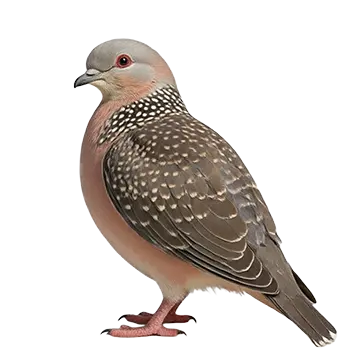
By the end of the second week and into the third, feather sheaths begin splitting open to reveal the mature feather structure beneath. The squab's body proportions start resembling those of an adult bird, though the tail remains short and the overall size is still noticeably smaller than a full-grown Spotted Dove. Importantly, the distinctive black neck patch adorned with white spots, the species' namesake feature, does not develop until the bird is several months old. Its absence in a young bird is entirely normal and should not cause concern.

Temperature & Environment

Thermoregulation is one of the most critical challenges facing a newborn Spotted Dove squab. Like all altricial hatchlings, the chick cannot maintain its own body temperature during the first week of life and relies entirely on the brooding parent or, in a hand-rearing situation, on a carefully managed brooder. The small body mass of a dove squab means it loses heat rapidly, and hypothermia can set in within minutes of exposure to ambient room temperature during the first few days.

In parent-raised situations, the adults provide thermal regulation by sitting on the squabs, a behavior known as brooding. Spotted Doves are attentive brooders, with both parents taking shifts to ensure continuous coverage during the first week. As the squabs grow and their downy insulation develops, the parents gradually reduce brooding time, allowing the chicks to begin experiencing ambient temperatures for brief periods. By the end of the second week, parent-raised squabs are typically brooded only at night and during particularly cool periods, as their emerging feather coverage provides increasing insulation.

For hand-reared squabs, the brooder is the lifeline. Set the temperature to 96 to 98 degrees Fahrenheit for the first three days, then gradually reduce by approximately two degrees every two to three days as the chick grows and develops down coverage. By two weeks of age, most squabs are comfortable at 82 to 85 degrees, and by three weeks, when feathering is well advanced, temperatures can approach a normal room range of 72 to 78 degrees. Monitor the squab's behavior as the most reliable indicator of comfort. A chick that sprawls flat with wings extended and beak open is too hot, while a chick that huddles tightly with feathers puffed and body trembling is too cold.

Humidity management is a secondary but important environmental concern. Maintain brooder humidity between 55 and 65 percent during the first two weeks. Dove squabs are prone to dehydration, which manifests as reddened skin, decreased skin turgor, and dark or concentrated urates. Low humidity exacerbates fluid loss through the skin and respiratory tract. Conversely, excessive humidity above 70 percent encourages the growth of aspergillus and other fungal organisms that can cause fatal respiratory infections in immunologically naive chicks. Line the brooder with paper towels or clean cloth that can be changed after every feeding to maintain hygiene, and avoid substrates like wood shavings that can harbor mold or be accidentally ingested.

Early Socialization

Spotted Doves are among the more naturally docile members of the Columbidae family, and their temperament lends itself well to gentle early socialization. However, the approach to socializing dove squabs differs significantly from the techniques used with parrots. Doves do not seek the same intensity of interactive engagement that psittacines crave. Instead, they respond best to calm, predictable, low-stimulus handling that builds trust through quiet repetition rather than playful interaction.

For parent-raised squabs in a captive setting, socialization involves brief daily handling sessions beginning around five to seven days of age, once the chick's eyes are open and it can perceive its handler. Remove the squab from the nest gently, cradling it in cupped hands close to your body for warmth, and hold it quietly for three to five minutes before returning it. Avoid handling immediately before or after a parental feeding, as the disturbance can interfere with the feeding response or cause regurgitation. Consistency in timing and handler identity during these early sessions is more beneficial than duration. A squab that is handled gently by the same person at the same time each day develops confidence more reliably than one subjected to longer but irregular or multi-person handling.

Hand-reared squabs naturally receive extensive human contact through the feeding process itself, and additional socialization sessions should complement rather than overwhelm this existing interaction. Between feedings, allow the squab to rest against your hand or on your lap while you sit quietly. Spotted Doves are particularly responsive to low, soft vocal tones, and speaking or humming gently during these resting periods helps the bird associate your presence with safety. Avoid high-pitched sounds, sudden movements, or attempts to stimulate the squab into activity. Unlike parrot chicks, which may enjoy gentle play, dove squabs are stress-sensitive and find overstimulation aversive.

Introduce environmental variety gradually as the squab matures through the second and third weeks. Allow it to experience different rooms, gentle household sounds, and the presence of other calm household members. The goal is to produce an adult Spotted Dove that is relaxed and unflappable in a domestic environment. Birds that are exposed to a reasonable range of stimuli during the socialization window are far less likely to develop the startle responses and chronic fearfulness that can plague doves raised in isolation or with insufficient human contact.

Health Screening & Vet Visits

Veterinary care for newborn Spotted Doves should ideally begin with a wellness check within the first few days of life, particularly for hand-reared squabs or chicks from a new breeding pair whose health history is not fully established. Locate an avian veterinarian with experience in columbid species before the breeding season begins, as not all avian practitioners are familiar with the specific health concerns of doves. Columbids are susceptible to a distinct set of pathogens that differ from those commonly encountered in psittacine practice, and species-appropriate knowledge is essential for accurate diagnosis and treatment.

The initial veterinary examination of a Spotted Dove squab typically includes a physical assessment evaluating body condition, hydration status, skin color, and the presence of any congenital abnormalities. A crop swab examined under microscopy can reveal the presence of Trichomonas gallinae, the causative organism of canker, which is one of the most significant diseases affecting young columbids. Trichomoniasis can cause yellow caseous lesions in the mouth, throat, and crop that interfere with feeding and can be rapidly fatal if untreated. Early detection through routine screening is far preferable to waiting for clinical signs to appear.

Fecal examination is another standard component of the initial health screen. The veterinarian will look for evidence of coccidiosis, which is caused by Eimeria species and is particularly common in young doves, as well as roundworms and other intestinal parasites. Capillaria, hairworm, is another parasite with particular relevance to columbids, and its eggs can be identified on fecal flotation. Depending on the veterinarian's assessment and the chick's origin, testing for Paramyxovirus-1, which causes Newcastle disease and its pigeon-specific variant, may also be recommended, especially if the breeding facility houses multiple birds or the local wild dove population is known to carry the virus.

Between professional veterinary visits, daily monitoring by the caregiver is the first line of defense against health problems. Weigh the squab at the same time each day using a gram scale accurate to at least one-tenth of a gram. Record the weight alongside feeding data and notes on droppings. Normal Spotted Dove squab droppings consist of a small, formed fecal component, a white urate portion, and a modest amount of clear urine. Any deviation from this pattern, including watery or discolored droppings, undigested seed material in the feces, or an unusual odor, should prompt a veterinary consultation. Similarly, watch for nasal discharge, labored breathing, a persistently empty or slow-emptying crop, and any reluctance to feed, all of which can indicate developing illness.

When to Worry

Even attentive caregivers can find it difficult to distinguish between normal variations in a Spotted Dove squab's development and genuine warning signs that require intervention. Because dove chicks develop so rapidly, a problem that seems minor in the morning can become life-threatening by evening. Developing a clear understanding of what constitutes a true emergency versus a normal developmental hiccup is an essential part of responsible squab care.

Weight loss or failure to gain weight is the single most reliable early indicator of trouble. A healthy Spotted Dove squab should gain weight every day during the first two weeks, with its body mass roughly doubling in the first four to five days and continuing to climb steadily thereafter. A single day of static weight is not necessarily cause for panic, particularly if the squab appears otherwise vigorous and is feeding normally. However, two consecutive days without weight gain, or any day showing a net weight loss, should be treated as a red flag. In very young squabs under five days old, even a single day of weight loss warrants an immediate call to your avian veterinarian, as the margin for error in these tiny birds is vanishingly small.

Crop function provides another critical window into the squab's health status. After a feeding, the crop should be visibly rounded and should empty progressively over the next two to four hours, depending on the chick's age and the formula consistency. A crop that remains distended and feels doughy or firm many hours after a feeding is exhibiting crop stasis, which can result from bacterial or yeast infection, formula prepared at incorrect temperature, dehydration, or an environmental temperature that is too low for proper digestion. Do not attempt to feed a squab whose crop has not emptied from the previous meal, as stacking fresh formula on top of stagnant crop contents dramatically increases the risk of sour crop and aspiration.

Respiratory symptoms in a newborn dove demand urgent attention. Listen for clicking, wheezing, or gurgling sounds during breathing, and watch for tail bobbing, open-mouth breathing, or nasal discharge. These symptoms can indicate aspiration pneumonia from a feeding accident, a respiratory infection such as aspergillosis, or air sac inflammation. In the warm, humid environment of a brooder, fungal spores thrive, and a chick with an immature immune system has little defense against respiratory pathogens. Prompt veterinary treatment with appropriate antifungal or antibiotic therapy based on culture and sensitivity testing offers the best prognosis.

Finally, be alert to behavioral changes that may seem subtle but carry significance. A squab that was previously eager to feed but suddenly becomes reluctant, a chick that ceases vocalizing when handled, or a bird that appears unusually limp or unresponsive to stimulation are all exhibiting signs of systemic illness. Spotted Dove squabs, like most prey species, are hardwired to mask signs of weakness, which means that by the time symptoms become obvious, the disease process may already be advanced. When in doubt, err on the side of caution and seek veterinary advice rather than adopting a wait-and-see approach.

Always consult a qualified professional before making any health-related decisions. This content is provided for informational reference only and should not replace professional guidance specific to your animal.