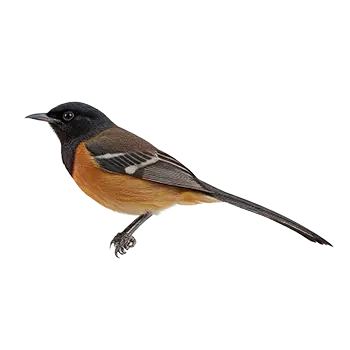

The Fledging Transition

The juvenile stage of the Shama Thrush begins with one of the most dramatic transitions in the bird's life: fledging. At approximately 12 to 15 days of age, the chick leaves the nest in a leap of faith that transforms it from a stationary, fully dependent nestling into a mobile, semi-independent fledgling. This transition happens with striking speed in the White-rumped Shama, often occurring over the course of a single morning, and it fundamentally changes the care dynamic whether the bird is parent-raised or hand-reared.

In a parent-raised scenario, the adults orchestrate the fledging process through a combination of reduced nest feeding and vocal encouragement. The parents may perch near the nest with food visible but withheld, calling to the chick in short, insistent contact notes that stimulate it to climb to the nest rim and take its first flight. The initial flight is typically a short, downward glide to a lower perch or the floor of the enclosure. The chick's flight feathers are not yet fully grown at this point, so sustained flight is impossible. The parents continue to feed the fledgling outside the nest, but the feeding locations and the degree of effort required to obtain food both shift, building the chick's mobility and confidence.

Hand-reared chicks fledge on a similar timeline but require a carefully prepared environment. Before the chick reaches fledging age, its brooder or rearing container should be placed inside or adjacent to a small, safe enclosure where the fledgling can make its first flights without risk of injury. Remove any hazards such as open water containers deep enough for drowning, gaps where the chick could become trapped, and hard surfaces at impact angles. Provide multiple low perches of varying diameters to encourage the chick to practice gripping and balancing. The first few days after fledging are characterized by clumsy landings, missed perches, and frequent resting on the floor, all of which are entirely normal.

The psychological transition that accompanies fledging is as significant as the physical one. The chick moves from a world defined by the nest cup to one that is three-dimensional and filled with novel stimuli. This can be overwhelming, and some fledglings exhibit a brief period of anxiety or regression, refusing food or calling persistently for the comfort of being hand-fed even when they are physically capable of self-feeding. Patience and consistency from the caregiver are essential during this adjustment. Continue offering hand-feedings while simultaneously presenting live insects and softbill food in shallow dishes placed at the chick's eye level to encourage exploration and independent feeding.

Weaning & Dietary Independence

Weaning a juvenile Shama Thrush is a gradual process that overlaps with the fledging transition and extends over roughly two to four weeks after the chick leaves the nest. The goal is a complete transition from hand-delivered or parent-delivered food to independent, self-directed feeding. Rushing this process risks nutritional deficits and behavioral stress, while extending it unnecessarily can create a bird that is overdependent on its caregiver and reluctant to forage on its own.

The weaning diet for a young Shama should mirror the insectivorous feeding profile that the species requires throughout life. Begin by offering small, live insects in a shallow, escape-proof dish placed where the fledgling spends most of its time. Small mealworms, waxworms, and fruit flies are good starting options because they are easy for an inexperienced bird to catch and consume. The movement of live prey triggers the chick's nascent hunting instincts, and most Shama fledglings will begin striking at and capturing insects within a few days of their first exposure.

Alongside live food, introduce a high-quality commercial insectivore or softbill diet in a separate dish. Moisten the food slightly to make it more palatable and easier for the chick to manipulate with its beak. Many Shama keepers also offer finely diced fruits such as papaya, mango, or banana in small quantities, as these provide additional vitamins and hydration. While fruit is not a dietary staple for Shamas, most juveniles accept it readily, and it can serve as a useful supplementary food source during the weaning period.

Track the chick's food intake carefully during weaning. As the fledgling begins eating independently, gradually reduce the frequency and volume of hand-feedings. A common approach is to eliminate one hand-feeding per day every two to three days, starting with the midday feedings and retaining the morning and evening feedings last. Continue weighing the chick daily. A stable or gently increasing weight during the weaning process confirms that independent intake is adequate. If the chick loses weight or appears lethargic, resume more frequent hand-feedings and slow the weaning pace.

Fresh, clean water must be available at all times once the chick is mobile. Use a shallow dish or a small fountain-style drinker that the chick cannot fall into and risk drowning. Many Shama Thrushes enjoy bathing from an early age, and providing a separate shallow bathing dish encourages this natural behavior while also helping to keep the plumage clean and well-maintained during the rapid feather growth of the juvenile period.

Song Development & Vocal Learning

The juvenile period is when the Shama Thrush's legendary vocal abilities begin to emerge, and it represents one of the most fascinating aspects of keeping this species. The White-rumped Shama is widely regarded as one of the finest songbirds in the world, capable of producing a rich, melodious, and highly varied song that incorporates both innate phrases and learned elements. The foundation for adult song quality is laid during the juvenile stage through a process of auditory learning and vocal practice that parallels language acquisition in young children.

Song learning in Shamas follows a well-documented pattern common to many oscine passerines. During the first weeks after fledging, the young bird enters a sensory phase during which it listens to and memorizes the songs of adult birds in its environment. In the wild, the primary tutor is usually the father, whose territorial song is heard frequently throughout the breeding season. In captivity, the tutor may be an adult male housed nearby, or recordings of high-quality Shama song played for the juvenile at regular intervals. The songs heard during this sensory phase form the template that the young bird will reference when it begins producing its own vocalizations.

The subsong phase begins when the juvenile is approximately three to six weeks old. Subsong is a quiet, amorphous vocalization that sounds nothing like the polished adult song. It is rambling, variable, and often produced while the bird is relaxed or drowsy, perched with slightly fluffed feathers and a soft, inward-focused expression. Subsong is the avian equivalent of babbling, and it serves a critical developmental function. Through subsong, the young Shama experiments with its syringeal muscles, learning to control pitch, volume, timing, and tonal quality. Caregivers should never discourage or interrupt subsong practice, as disruption can delay or impair vocal development.

As the juvenile matures, subsong gradually crystallizes into plastic song, a more structured but still variable form of singing that more closely resembles adult vocalizations. During the plastic song phase, which typically spans from approximately two to four months of age, the young Shama begins to produce recognizable phrases and motifs drawn from the songs it memorized during the sensory phase. The bird rehearses these phrases repeatedly, refining them over weeks until they become stable and consistent. Male juveniles are generally more vocally active than females during this period, though both sexes produce subsong and contact calls.

The quality of the auditory environment during the juvenile stage has a measurable impact on adult song complexity and beauty. Juveniles exposed to high-quality, varied tutor songs during the critical learning window tend to develop richer, more complex adult repertoires than those raised in acoustically impoverished environments. If a live adult male tutor is not available, play recordings of accomplished Shama singers for the juvenile for at least 30 to 60 minutes per day during the sensory and plastic song phases. Position the speaker so that the sound reaches the juvenile clearly but at a natural volume, avoiding distortion or excessive loudness that could cause auditory stress.

Flight Training & Physical Development

Physical development during the juvenile stage transforms the Shama Thrush from a clumsy fledgling into a agile, coordinated flier. The White-rumped Shama is a highly active species that relies on flight and rapid aerial maneuvers for foraging, territorial defense, and predator evasion in the wild. In captivity, supporting the development of strong flight muscles, precise motor control, and confident spatial navigation is essential for the bird's physical health and psychological wellbeing.

The first two weeks after fledging are characterized by rapid improvement in flight ability. The fledgling's initial flights are short, uncontrolled, and frequently end in awkward landings or collisions with enclosure walls. This is entirely normal and should not cause alarm unless the bird appears injured. Provide a flight space that is large enough to allow practice but not so large that the bird becomes disoriented or exhausted. A flight cage or aviary measuring at least three feet long, two feet wide, and two feet tall is appropriate for a single juvenile during this phase. Pad any hard surfaces at common impact points with soft cloth to reduce the risk of injury.

As flight skills improve, the juvenile should be given access to progressively larger spaces. Shama Thrushes are woodland birds that naturally navigate through dense vegetation, so an enclosure furnished with branches, leafy plants, and perches at varying heights encourages the development of the precise, maneuverable flight style that characterizes the species. Place food and water at locations that require short flights to reach, motivating the bird to use its developing abilities in a functional context.

The juvenile molt, which begins at approximately six to eight weeks of age, marks an important transition in physical development. During this molt, the bird replaces its juvenile plumage with its first set of adult-type feathers. In male Shamas, this is when the distinctive glossy blue-black upperparts and rich chestnut underparts begin to appear, replacing the duller, brownish juvenile plumage. The long, graduated tail feathers that are a hallmark of the species also grow in during this molt. The molt is nutritionally demanding, and the diet should be enriched with additional protein and calcium during this period to support feather synthesis.

Monitor the juvenile's physical condition throughout this stage by observing its body weight, feather quality, keel prominence, and activity level. A healthy juvenile Shama is alert, active, and maintains a smooth, well-groomed plumage. The keel bone should be palpable but well covered with pectoral muscle, not protruding sharply. Juveniles that appear thin, lethargic, or poorly feathered may be suffering from nutritional deficits, parasitic infection, or chronic low-grade illness and should be evaluated by a veterinarian experienced with passerine species.

Socialization & Behavioral Development

The juvenile period is the most influential window for shaping the Shama Thrush's long-term behavioral profile. During these weeks and months, the young bird forms its fundamental attitudes toward humans, other birds, novel objects, and environmental changes. A Shama that is thoughtfully socialized during the juvenile stage typically becomes a confident, interactive companion that adapts well to the routines and variations of domestic life. A bird that is neglected or mishandled during this period may develop entrenched fearfulness, aggression, or stress-related behaviors that are difficult to modify.

For hand-reared birds, the juvenile stage offers an opportunity to build on the trust established during the neonatal period. Handle the young Shama daily, but keep sessions relatively brief, typically 10 to 15 minutes, to avoid overstimulation. Allow the bird to perch on your hand or finger, and reward calm behavior with preferred food items such as live insects offered from tweezers. Avoid chasing or grabbing the bird, as these experiences are profoundly negative for a species that is prey in the wild and instinctively associates pursuit with mortal danger.

Introduce the juvenile to a variety of people, environments, and stimuli in a controlled and positive manner. Allow trusted visitors to offer food to the bird from a distance, gradually decreasing the distance as the bird's confidence grows. Expose the juvenile to different rooms in the house, varied lighting conditions, and the normal sounds of domestic life including television, music, cooking, and conversation. Each new experience should be paired with something positive, typically a food reward, to build pleasant associations.

Socialization with other birds requires careful management. Shama Thrushes are territorial by nature, and even juveniles may display aggressive posturing toward other birds, particularly other Shamas. If you house multiple birds, the juvenile should be able to see and hear other birds without being in direct physical contact until you are confident that interactions will be peaceful. Mixed-species housing is generally safer than same-species housing during the juvenile period, but monitor all interactions closely and separate birds immediately at any sign of aggression or excessive stress.

Behavioral development during the juvenile stage also includes the emergence of species-typical behaviors such as ground foraging, leaf-turning, tail fanning, and territorial display. Male juveniles begin practicing the characteristic tail-cocking and wing-drooping displays that adult males use during territorial encounters and courtship. These behaviors are innate rather than learned, but their frequency and intensity are influenced by the social environment. Providing the juvenile with opportunities to observe adult Shamas, either in person or through audio recordings, supports the natural unfolding of the species' behavioral repertoire.

Housing & Enclosure Requirements

Appropriate housing for a juvenile Shama Thrush must balance the bird's need for security and protection with its growing need for space, stimulation, and flight opportunity. The enclosure serves as the bird's territory, and its design has a direct impact on physical health, behavioral development, and psychological wellbeing. Getting the housing right during the juvenile stage establishes the framework for lifelong husbandry.

The minimum enclosure size for a single juvenile Shama should be approximately 36 inches long, 24 inches wide, and 30 inches tall, though larger is always better. Shamas are active, energetic birds that use both horizontal and vertical space, so height is nearly as important as length. The enclosure should be constructed of materials that provide good visibility and ventilation while preventing escape. Wire mesh with spacing no greater than half an inch is appropriate, and the cage should have a solid or partially solid back panel to give the bird a sense of security from behind.

Furnish the enclosure with natural branches of varying diameters to promote healthy foot development and provide varied perching options. Shamas prefer to perch at mid-height to upper levels of the enclosure, so place the primary perches at these levels. Include at least one perch positioned higher than the others, as this will become the bird's preferred roosting spot. Avoid placing perches directly above food and water dishes to prevent contamination from droppings. Add leafy artificial or live plants to create visual barriers and hiding spots, which help the bird feel secure and reduce stress.

The enclosure floor should be covered with an easily changed substrate such as newspaper, paper towels, or a commercial cage liner. Shama Thrushes forage extensively on the ground in the wild, flipping through leaf litter in search of insects, and replicating this behavior in captivity provides important physical and mental enrichment. Scatter a thin layer of dried leaves or leaf litter over the floor substrate and hide live insects within it to encourage natural foraging behavior. Replace the leaf litter every two to three days to maintain hygiene.

Placement of the enclosure within the home matters more than many keepers realize. Position the cage in a room where the family spends time, so the bird is included in household activity and receives ongoing auditory and visual socialization. Avoid placing the cage in direct sunlight, near heating or cooling vents, or in drafty locations. The cage should be elevated so that the bird's perching level is at or slightly above human eye level, as Shamas that are forced to look up at humans from below often feel threatened and insecure. A stable, quiet corner with good natural light and a solid wall behind the cage provides the ideal combination of social engagement and territorial security.

Health Monitoring & Common Juvenile Issues

The juvenile period introduces a new set of health considerations that differ from the neonatal stage. While the immediate fragility of the newly hatched chick has passed, the juvenile Shama Thrush faces its own vulnerabilities, including the metabolic demands of rapid growth and molt, the stress of the weaning transition, and increased exposure to environmental pathogens as the bird becomes mobile and begins exploring its surroundings.

The juvenile molt is one of the most nutritionally taxing events in a young Shama's life. Feather synthesis requires substantial amounts of protein, particularly the sulfur-containing amino acids methionine and cysteine, as well as calcium, zinc, and B vitamins. A diet that is adequate for maintenance may be insufficient during active molt, leading to stress bars, brittle or malformed feathers, and delayed molt completion. Increase the variety and quantity of live insects offered during the molt, and consider supplementing with a vitamin and mineral powder formulated for insectivorous birds. If feather quality appears poor despite adequate nutrition, consult a veterinarian to rule out underlying metabolic or infectious causes.

Respiratory infections are among the most common health problems in juvenile Shamas kept in captivity. The bacterium Mycoplasma is a frequent culprit, causing nasal discharge, sneezing, wheezing, and in severe cases, airsacculitis. Contributing factors include poor ventilation, high stocking density, exposure to drafts, and the stress of weaning and environmental change. Maintain clean, well-ventilated housing and minimize stress during the juvenile period to reduce the risk of respiratory illness. Any signs of respiratory compromise should be investigated promptly, as untreated infections can become chronic and difficult to resolve.

Gastrointestinal parasites, including coccidia, roundworms, and tapeworms, can affect juvenile Shamas, particularly those housed in outdoor aviaries or those that have been recently imported. A fecal examination should be performed as part of the initial veterinary workup and repeated periodically during the juvenile stage. Symptoms of parasitic infection include weight loss despite adequate food intake, diarrhea, lethargy, and ruffled plumage. Treatment protocols should be prescribed by a veterinarian, as over-the-counter dewormers may be ineffective against the specific parasite involved or may be dosed incorrectly for a small passerine.

Behavioral indicators of health are particularly useful in juvenile Shamas because the birds are naturally active and expressive at this age. A healthy juvenile is alert, curious, vocal, and physically active, spending much of its waking time flying, foraging, singing, and exploring. A bird that becomes withdrawn, silent, fluffed, or reluctant to move has likely undergone a significant change in health status. Similarly, changes in appetite, droppings, or feather condition should be noted and investigated. Keep a daily health log during the juvenile period, recording weight, appetite, droppings quality, activity level, and any behavioral changes. This record provides invaluable context for your veterinarian if a health concern arises.

Always consult a qualified professional before making any health-related decisions. This content is provided for informational reference only and should not replace professional guidance specific to your animal.