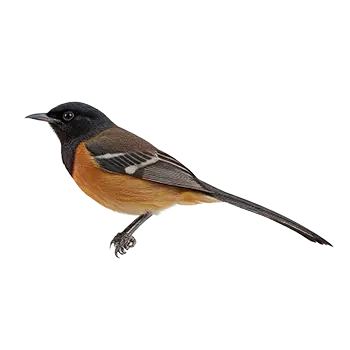

The Shama Thrush is scientifically classified as Copsychus malabaricus, belonging to the family Muscicapidae, which contains the Old World flycatchers and chats—a diverse family of over 300 species distributed across Europe, Africa, Asia, and Australasia. The genus name Copsychus derives from the Greek 'kopsychos,' an ancient name for a type of bird, while the specific epithet 'malabaricus' refers to the Malabar region of southwestern India where the species was first scientifically described. The genus Copsychus contains approximately 10-12 species (depending on taxonomic treatment) of shamas and related species distributed across South and Southeast Asia, all characterized by relatively long tails, striking plumage patterns, and notable vocal abilities, though the White-rumped Shama is generally considered the finest singer of the group.
The most widely used common name in English-speaking regions is White-rumped Shama, directly referencing the distinctive white rump patch that contrasts boldly with the bird's dark upperparts and represents one of the species' key field identification marks. This name emphasizes the diagnostic plumage feature and is the standard name used in ornithological literature, field guides, and scientific discussions. However, in avicultural contexts particularly in Asia where the species has been kept in captivity for centuries, the bird is more commonly called simply Shama or Shama Thrush. The name 'Shama' derives from Hindi/Urdu 'shama' and has been used for centuries in South Asian bird-keeping traditions. The addition of 'Thrush' is somewhat misleading, as true thrushes belong to the family Turdidae while Shamas belong to Muscicapidae, but the common name persists due to the bird's thrush-like appearance, behavior, and ecological niche, and the name 'Shama Thrush' remains widely understood and used in aviculture worldwide.
Alternate English names occasionally encountered include Malabar Whistling Thrush (though this can cause confusion with actual whistling thrushes of genus Myophonus), White-rumped Robin (emphasizing its relationship to robins and robin-chats in the Muscicapidae), and Indian Shama in older literature. Historical texts sometimes used Ceylon Shama or Malayan Shama when referring to specific geographic populations that are now generally treated as subspecies rather than distinct species.
In its native range across South and Southeast Asia, the bird has numerous regional names reflecting its wide distribution and cultural significance. In Hindi and Urdu-speaking regions of India and Pakistan, it is called Shama or Dhayal, names that have been used for centuries. In Bengali, it is known as Shyama. In Thai, it is called Nok Gring-gring or Nok Kradeung-ngern. In Malay and Indonesian, it is Murai Batu (stone thrush), a name also applied to related species and one of the most common names used in Southeast Asian aviculture where the species is extremely popular. In Chinese, it is called 鹊鸲 (què qú). These diverse names reflect the bird's widespread distribution and centuries-long popularity throughout Asia as a cage bird prized for singing ability.
The White-rumped Shama shows considerable geographic variation across its extensive range, with multiple recognized subspecies distinguished by differences in size, tail length, plumage intensity, and song characteristics. The exact number of subspecies varies depending on taxonomic authority, but approximately 7-10 subspecies are generally recognized including Copsychus malabaricus malabaricus (nominate subspecies from southwestern India), C. m. indicus (northern India through Southeast Asia), C. m. stricklandii (Malay Peninsula and Sumatra), C. m. suavis (Borneo), C. m. leggei (Sri Lanka), C. m. mirabilis (Hainan Island), and several others. These subspecies show variations particularly in tail length (with some populations having notably longer tails than others), overall size, intensity of rufous coloration in underparts, and extent of white in the tail. Aviculturists particularly prize long-tailed subspecies, and considerable selective breeding has occurred in captivity to enhance tail length beyond even the longest wild populations, creating exhibition strains with extraordinarily long tails. However, all subspecies share the fundamental characteristics of black or dark blue upperparts in males, rufous underparts, white rump, and exceptional singing ability.
The White-rumped Shama is closely related to other species in the genus Copsychus including the White-crowned Shama (C. stricklandii), sometimes considered conspecific with White-rumped Shama but now generally recognized as distinct, the Oriental Magpie-robin (C. saularis), common and widespread across Asia but with less refined song than Shama, the Seychelles Magpie-robin (C. sechellarum), a critically endangered island endemic, and several other species. These related species share similar general ecology and behavior, though the White-rumped Shama is universally regarded as producing the finest, most complex, and melodious songs of the genus, making it the most prized species in aviculture focused on song quality.
The cultural and historical significance of the White-rumped Shama in Asian bird-keeping traditions cannot be overstated. For centuries, these birds have been kept throughout South and Southeast Asia as prized singing birds, with elaborate traditions of competitive song contests, breeding for superior vocal ability, and sophisticated husbandry techniques passed down through generations. In countries including Malaysia, Indonesia, Thailand, and Singapore, Shama keeping represents a major hobby with thousands of enthusiasts, dedicated clubs and societies, regular competitions judging song quality, and substantial commercial breeding operations. The species' reputation as one of Asia's finest songbirds has led to centuries of selective breeding, though unlike canaries where distinct song breeds have emerged, Shama song remains largely based on wild-type vocalizations with quality depending on genetics, early acoustic exposure, and individual talent.