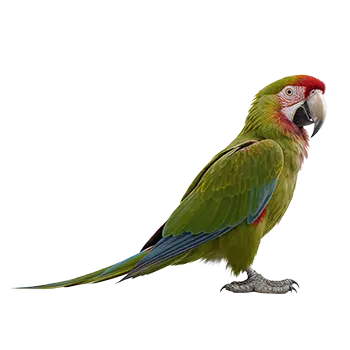

Red-Fronted Macaws reach full physical maturity between two and a half and four years of age, though behavioral and reproductive maturity may continue to develop beyond this point. The transition from juvenile to adult is not a single event but a gradual convergence of physical, hormonal, and behavioral markers that collectively signal the bird has entered its prime. Understanding when your macaw has crossed this threshold is important because adult birds have different nutritional requirements, behavioral tendencies, and health risks than juveniles, and care protocols should be adjusted accordingly.
The most visible indicator of maturity is the completion of the adult plumage. The red frontal patch that gives the species its name reaches its full extent and intensity, covering the forehead and extending above the cere. The red patches on the ear coverts, bend of the wing, thighs, and carpal edge are fully developed and vivid. The overall body plumage is a rich olive-green, and the tail feathers display their characteristic blue-tipped coloration at full adult length. The bare facial skin, a patch of pale pink to cream that surrounds the eye and extends toward the beak, is fully developed and may flush slightly during periods of excitement or arousal, a trait shared with several other macaw species.
The iris color completes its transition during this period, shifting from the dark brown of the juvenile to the amber or orange hue that characterizes adults. This change is gradual and can be used as a rough aging guide in birds of unknown history, though considerable individual variation exists. Body weight stabilizes within the adult range of 425 to 550 grams, and the muscular development of the chest, wings, and legs reaches its peak. The beak achieves its final adult proportions, with the upper mandible displaying the powerful, laterally compressed shape that allows macaws to crack hard seeds and nuts.
Behaviorally, the adult Red-Fronted Macaw exhibits a more settled temperament than the frenetic juvenile, though it remains an active, curious, and socially demanding bird. The bird's personality is largely established by this point, shaped by the genetics it inherited and the socialization and training it received during its formative months. Hormonal maturity brings the onset of breeding behaviors in both sexes, which can include increased vocalization, regurgitative feeding directed at favored people or objects, territorial behavior around the cage or nesting area, and heightened aggression during the spring breeding season. Understanding and managing these hormonally driven behaviors is a central challenge of adult macaw care.