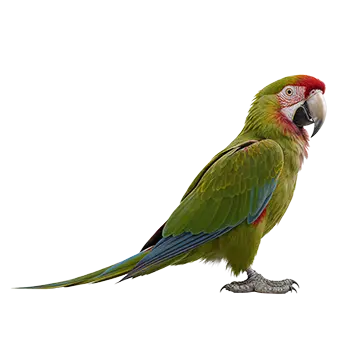

Determining when a Red-Fronted Macaw has entered the senior stage of its life is less straightforward than with many other companion animals, because parrots age gradually and lack the obvious external markers — graying muzzles, clouding eyes — that signal advancing age in mammals. Red-Fronted Macaws have a lifespan range of roughly 25 to 50 years in captivity, with the wide variation reflecting differences in genetics, diet, veterinary care, and environmental conditions. As a general guideline, a Red-Fronted Macaw can be considered to be entering its senior years at approximately 20 to 25 years of age, though some individuals remain vigorous well beyond this point while others show signs of aging earlier.
The earliest indicators of aging are often subtle and reveal themselves only through comparison with the bird's established behavioral baseline. A senior macaw may begin to show reduced activity levels, spending more time resting on a favored perch and less time climbing, playing, and foraging. Flight, if the bird is flighted, may become less frequent or cover shorter distances. The bird's response to novel stimuli may slow, and its interest in environmental enrichment may diminish compared to its prime years. These changes are gradual and can be easy to overlook if the caregiver is not actively monitoring for them.
Physical changes in the senior Red-Fronted Macaw include a gradual loss of muscle mass, particularly noticeable over the keel and along the legs. The beak and nails may grow more rapidly or more irregularly as the bird becomes less active in wearing them down through chewing and climbing. Feather quality may decline, with molts producing plumage that is less vibrant or less tightly organized than in the bird's prime. The skin may lose some of its suppleness, and the bare facial patch may appear drier or slightly roughened. None of these changes in isolation is cause for alarm, but collectively they paint a picture of a bird whose physiological reserves are diminishing and whose care needs are shifting.
Recognizing the transition to the senior stage is important because it triggers a series of adjustments to the bird's care program. Veterinary visits should increase in frequency, dietary composition may need to be modified, the physical environment should be evaluated for safety and accessibility, and the caregiver should begin thinking proactively about the bird's long-term care needs, including contingency planning for the bird's care in the event that the caregiver can no longer provide it. A Red-Fronted Macaw that reaches its senior years has likely been a companion for two or more decades, and the depth of the bond between bird and caregiver makes this stage both deeply meaningful and emotionally complex.