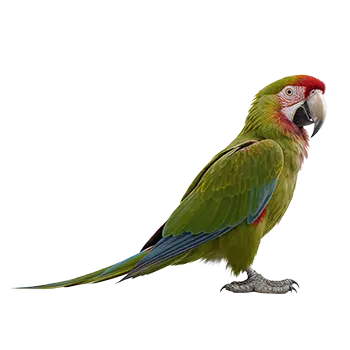

Breeding Readiness & Sexual Maturity

Red-Fronted Macaws reach sexual maturity between three and five years of age, though physiological readiness does not necessarily coincide with behavioral or psychological readiness to breed successfully. Young birds may exhibit courtship behaviors, copulatory attempts, and territorial displays well before they are capable of producing and raising viable offspring. For breeders, distinguishing between a bird that is hormonally active and one that is genuinely ready to contribute to a breeding program requires careful observation of both physical and behavioral indicators over an extended period.

Physical signs of sexual maturity include the full development of adult plumage, particularly the vivid red frontal patch, ear coverts, and shoulder markings that characterize mature Ara rubrogenys. The cere and facial skin reach their adult appearance, and body weight stabilizes within the species-appropriate range of 425 to 550 grams. In hens, the pelvic bones may widen slightly as the bird approaches reproductive maturity, though this is difficult to assess without veterinary palpation. Hormonal testing through blood work can confirm elevated sex hormone levels during the breeding season, providing laboratory evidence that the bird's reproductive endocrine system is functional.

Behavioral indicators of breeding readiness are often more conspicuous than physical ones. Mature males display increased vocalization during the breeding season, perform courtship feeding by regurgitating food for the hen, and may become territorial around the nest box area. Hens that are approaching breeding condition often become more reclusive, spending time investigating potential nest sites, shredding materials, and displaying a heightened interest in enclosed spaces. Both sexes may show increased aggression toward other birds and even toward familiar human caregivers during this period, a natural response driven by the hormonal imperative to defend territory and offspring.

Before pairing any Red-Fronted Macaw for breeding, a comprehensive health evaluation by an avian veterinarian is essential. Both prospective parents should be screened for Psittacine Beak and Feather Disease, Avian Polyomavirus, Chlamydia psittaci, and Avian Bornavirus. Birds that test positive for any of these conditions should not be bred, both because of the risk of vertical transmission to offspring and because the physiological demands of breeding can exacerbate underlying disease in the parent birds. A clean bill of health, optimal body condition, and a well-managed diet provide the foundation upon which successful breeding outcomes are built.

Pair Bonding & Compatibility

Red-Fronted Macaws are monogamous in the wild, forming pair bonds that can persist for the lifetime of both partners. In captivity, establishing a compatible pair requires patience and careful management, because not all introductions result in bonding, and forced pairings between incompatible birds can produce chronic stress, aggression, and physical injury. The process of pair formation may take months or even years, and breeders must be willing to accept that some pairings simply will not work, regardless of how genetically desirable they may appear on paper.

The introduction process should begin with the birds housed in adjacent enclosures where they can see and hear each other without physical contact. This visual and auditory introduction period allows both birds to assess the other without the risk of confrontation. Signs of mutual interest include synchronized movements, contact calling directed at the other bird, approach behaviors toward the shared cage wall, and relaxed body posture in each other's proximity. Signs of incompatibility include persistent aggression displays, stress behaviors such as feather plucking or pacing, and avoidance of the side of the enclosure nearest the prospective partner.

Once the birds demonstrate sustained positive interest in each other through the barrier, supervised physical introductions can begin in a neutral space that neither bird claims as territory. The introduction area should be large enough that both birds can retreat if the interaction becomes aggressive, and the caregiver must be prepared to intervene immediately if either bird attacks the other. Offering food rewards during the introduction creates positive associations and gives the birds a shared activity to focus on rather than each other. Successful introductions progress from cautious proximity to mutual preening, food sharing, and eventually physical closeness and copulatory behavior.

Genetic compatibility is a consideration that extends beyond behavioral compatibility for this endangered species. The captive population of Red-Fronted Macaws is relatively small, and maintaining genetic diversity within that population is essential for the long-term viability of captive breeding programs and any future reintroduction efforts. Responsible breeders participate in studbook programs and breeding cooperatives that track the lineage of captive birds and recommend pairings that maximize genetic diversity while minimizing inbreeding. Breeding birds solely for color variants, pet trade demand, or without consideration of genetic contribution to the population as a whole is a disservice to the species and to the individual birds involved.

Nest Box Setup & Breeding Environment

In the wild, Red-Fronted Macaws nest in cavities and crevices on the cliff faces of their semi-arid Bolivian habitat, a nesting strategy that provides protection from predators and the elements. In captivity, the nest box must approximate the key features of a natural nest site: enclosed darkness, appropriate dimensions, stable temperature, and a substrate that allows the hen to arrange her incubation position comfortably. The quality of the nest box setup has a direct impact on the pair's willingness to breed and on the success of incubation and chick rearing.

A suitable nest box for Red-Fronted Macaws should measure approximately 12 inches wide by 12 inches deep by 24 inches tall, constructed of hardwood or thick plywood that provides insulation and resists chewing. The entrance hole should be positioned near the top and sized at approximately four to five inches in diameter, large enough for the bird to enter comfortably but small enough to provide a sense of enclosure and security. A ladder or hardware cloth strip mounted inside the box below the entrance allows the hen to descend safely to the nest floor without dropping onto the eggs. An inspection door on the side or back of the box, secured with a latch, allows the caregiver to monitor the nest contents without disturbing the pair through the entrance.

Nest box substrate should consist of untreated wood shavings, preferably aspen, layered to a depth of three to four inches. Avoid cedar and pine shavings due to their volatile aromatic oils, and avoid substrates that compact and hold moisture, as excessive humidity within the nest box promotes bacterial and fungal growth. The hen will typically rearrange the substrate to create a depression for the eggs, and additional shavings should be available for her to add as she sees fit. Some hens strip wood from the box walls to supplement the substrate, which is a normal nesting behavior that should not be discouraged unless the structural integrity of the box is compromised.

The breeding enclosure should provide the pair with adequate space, privacy, and freedom from disturbance. Pairs housed in high-traffic areas or in close visual proximity to other breeding pairs may experience stress that inhibits reproductive behavior. A flight cage or suspended enclosure that allows the pair to fly short distances provides exercise that supports breeding condition, while solid or semi-solid panels on the sides facing neighboring enclosures or human activity areas provide the visual privacy that nesting macaws require. Access to natural daylight or full-spectrum lighting with a photoperiod of twelve to fourteen hours promotes the hormonal cycling that triggers breeding behavior.

The Egg-Laying Cycle

Red-Fronted Macaw hens typically lay a clutch of two to four eggs, with three being the most common clutch size. Eggs are laid at intervals of approximately two to three days, and the hen may begin incubation after the first or second egg is laid, which results in asynchronous hatching where chicks emerge at staggered intervals. Understanding the egg-laying cycle and monitoring each stage allows breeders to detect problems early and to support the hen through the physiologically demanding process of egg production.

Prior to the first egg, the hen's behavior changes in ways that signal the approach of laying. She may spend increasing time in the nest box, her droppings may become larger and less frequent as the developing egg occupies space in the abdominal cavity, and her appetite may shift, with increased interest in calcium-rich foods. Providing a supplemental calcium source such as cuttlebone, mineral block, or calcium-enriched soft food during this period is critical, as the formation of each eggshell requires substantial calcium mobilization from the hen's skeletal reserves. A hen that enters the laying cycle with inadequate calcium stores is at risk of egg binding, a potentially fatal condition in which the egg cannot be passed through the oviduct.

Each egg should be examined for shell quality as soon as it is accessible without disturbing the hen excessively. A healthy egg has a smooth, uniformly thick shell that is white or slightly off-white. Eggs with thin spots, rough patches, or soft shells indicate nutritional deficiencies or oviductal dysfunction and should be brought to the attention of the avian veterinarian. Candling the eggs at five to seven days after laying — holding them against a bright, focused light source in a dark room — reveals whether development is occurring. A fertile, developing egg will show a network of blood vessels radiating from a central embryonic disc, while an infertile egg will remain clear with a visible yolk shadow.

Egg binding is the most serious acute risk associated with the laying cycle. Signs include the hen straining on the nest floor, abdominal distension, fluffed feathers, lethargy, and the cessation of droppings. A hen suspected of being egg-bound requires immediate veterinary attention, as the condition can progress to fatal complications including oviductal rupture, peritonitis, and circulatory shock within hours. Providing a warm, humid environment while arranging emergency transport can help relax the oviductal muscles, but medical or surgical intervention is usually necessary. Prevention through adequate calcium supplementation, appropriate body condition, and veterinary pre-breeding evaluation is far preferable to treating this emergency.

Incubation & Monitoring

The incubation period for Red-Fronted Macaw eggs is approximately 26 days, though slight variation of one to two days in either direction is within normal limits. In a parent-incubated clutch, the hen assumes the primary incubation role, rarely leaving the nest except for brief periods to eat, drink, and defecate. The male typically stands guard near the nest entrance, alerts the hen to disturbances, and feeds her through regurgitation. This division of labor is instinctive, but its successful execution depends on the pair's compatibility, experience, and the absence of environmental stressors that disrupt normal nesting behavior.

Monitoring the incubation process requires a balance between vigilance and restraint. Excessive disturbance of the nesting pair — opening the inspection door too frequently, lingering near the nest, or making sudden noises — can cause the hen to abandon the clutch or become so stressed that she damages the eggs. A reasonable monitoring schedule involves checking the nest once daily, at the same time each day, when the hen has left briefly to eat. This check should confirm that the eggs are present and intact, that the nest substrate is clean and dry, and that there are no signs of problems such as cracked eggs, mold growth, or pest infestation.

Candling should be performed at intervals that provide meaningful developmental information without excessive handling. An initial candling at five to seven days identifies fertile eggs and allows infertile ones to be removed, reducing the energetic cost of incubation for the hen. A second candling at fourteen to sixteen days confirms continued development and can detect early embryonic death. At this stage, a viable egg shows a large, dark embryo with visible movement and an air cell at the blunt end that has expanded as the chick grows. A dead embryo appears as a dark, motionless mass often accompanied by a disrupted blood vessel pattern or a discolored ring around the embryo.

Artificial incubation may be necessary if the hen abandons the clutch, if the eggs are at risk of damage from inexperienced parents, or if the breeder is managing a large-scale program that requires maximizing hatch rates. Artificial incubation of macaw eggs requires precise control of temperature, humidity, and egg turning. Temperature should be maintained at 99.3 to 99.5 degrees Fahrenheit in a forced-air incubator, with relative humidity at 40 to 50 percent during the main incubation phase, rising to 65 to 70 percent during the final three days before hatching. Eggs must be turned a minimum of three times per day, ideally five to seven times, through an arc of 180 degrees to prevent the embryonic membranes from adhering to the shell. Automated incubators with reliable temperature control, humidity regulation, and turning mechanisms are strongly recommended, as even brief lapses in any of these parameters can result in embryonic death.

Post-Hatch Parental Care

When Red-Fronted Macaw chicks hatch in a parent-reared setting, the responsibilities of the breeder shift from incubation management to supporting the parents as they assume the intensive work of feeding and brooding their offspring. Parent-reared chicks benefit from the natural feeding rhythms, social learning, and behavioral modeling that no hand-rearing protocol can fully replicate. However, the breeder must remain actively involved in monitoring the health and development of the chicks, intervening only when necessary to prevent loss of life.

The first 48 hours after hatching are the most critical period. The hen should begin feeding the chick within the first several hours, providing crop milk and regurgitated food that delivers essential nutrients and establishes the beneficial microbial communities in the chick's gut. Monitor the chick's crop for evidence that feeding has occurred — a small, rounded fullness visible through the thin skin of the neck indicates that the hen has fed successfully. If the crop remains flat and empty twelve or more hours after hatching, supplemental hand-feeding may be necessary to prevent the chick from weakening to the point where it can no longer stimulate the hen to feed.

Daily weight checks of parent-reared chicks are essential but must be conducted with minimal disruption to the pair. Remove the chick from the nest box briefly each day, weigh it on a gram-accurate scale, and return it promptly. The entire process should take less than two minutes. Record each weight and track the trajectory over time. A healthy Red-Fronted Macaw chick should gain approximately two to five grams per day during the first two weeks, with the rate of gain accelerating as the chick grows. Stagnation or weight loss over two or more consecutive days warrants closer monitoring and potentially veterinary evaluation.

As the chicks grow and their demands on the parents increase, the nutritional support provided to the breeding pair must be increased accordingly. The hen and cock are now feeding not only themselves but one to four rapidly growing chicks, and their caloric, protein, and calcium requirements escalate substantially. Offer abundant fresh food, soaked or sprouted seeds and legumes for enhanced digestibility, and soft foods such as cooked grains and vegetables that the parents can easily process and regurgitate. Ensure that calcium supplementation is continuously available, as the hen's skeletal calcium stores may have been depleted during egg production and need to be replenished while she simultaneously provides calcium to her growing chicks.

The decision of whether to pull chicks for hand-rearing or to allow the parents to raise them to independence depends on the breeder's goals, experience, and the intended destination of the chicks. Chicks destined for companion homes benefit from being pulled for hand-rearing at three to four weeks of age, which allows them to imprint on humans while retaining some of the behavioral foundations established by the parents during the earliest weeks. Chicks being raised for breeding programs or conservation purposes should ideally be parent-reared entirely, as these birds need to develop the full repertoire of species-appropriate social behaviors that they will rely on when paired with mates of their own.

Conservation & Ethical Breeding Considerations

Breeding Red-Fronted Macaws carries responsibilities that extend well beyond the production of healthy chicks. Ara rubrogenys is classified as Endangered by the International Union for Conservation of Nature, with a wild population estimated at only 600 to 800 mature individuals confined to a small range in the dry inter-Andean valleys of central Bolivia. The species faces ongoing threats from habitat destruction driven by agricultural expansion, direct persecution by farmers who view the birds as crop pests, and illegal trapping for the pet trade. Every captive breeding decision has implications for the genetic health of the global captive population and, potentially, for the future of the species in the wild.

Responsible breeders participate in cooperative breeding programs that coordinate pairings across institutions and private collections to maximize genetic diversity and minimize inbreeding. Studbook programs, managed by zoological organizations, track the lineage, age, and reproductive history of captive individuals and issue pairing recommendations based on genetic analyses. Breeders who operate outside these cooperative structures risk producing offspring that are genetically redundant, inbred, or contribute nothing to the long-term viability of the captive population. Engagement with a studbook coordinator is not merely a best practice — for an endangered species, it is an ethical obligation.

The disposition of offspring must be considered before breeding is undertaken. Red-Fronted Macaws are not disposable commodities, and the production of chicks without secure, lifelong placement plans is irresponsible. Each chick produced will live for 25 to 50 years and will require skilled, committed care throughout its life. Breeders should have confirmed placements for every chick before pairing a couple, whether those placements are in qualified companion homes, accredited zoological facilities, or breeding programs that adhere to the standards described above. The production of surplus birds that end up in rescue organizations, passed from home to home, or euthanized because no appropriate placement exists is a failure of planning that every breeder has the power and the obligation to prevent.

Legal compliance is a non-negotiable aspect of breeding Red-Fronted Macaws. This species is listed under Appendix I of the Convention on International Trade in Endangered Species, which prohibits commercial international trade in wild-caught individuals and requires permits and documentation for the trade of captive-bred birds across international borders. Domestic regulations vary by jurisdiction and may include requirements for breeder licensing, record-keeping, leg banding, and reporting. Breeders must familiarize themselves with the laws and regulations applicable in their jurisdiction and maintain meticulous records that document the provenance, identity, and disposition of every bird in their care. Compliance with these legal frameworks is not bureaucratic overhead — it is the mechanism through which the trade in endangered species is regulated and the interests of the species are protected.

Always consult a qualified professional before making any health-related decisions. This content is provided for informational reference only and should not replace professional guidance specific to your animal.