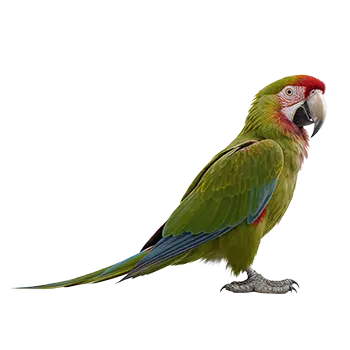

The Juvenile Transition

The juvenile period of a Red-Fronted Macaw begins when the chick is approximately eight to ten weeks old and extends through the months of rapid physical and behavioral maturation that precede adulthood. This is the stage where the bird transforms from a dependent nestling into an increasingly capable young parrot, developing the motor skills, dietary independence, and social competencies it will carry for the rest of its life. For caregivers, the juvenile period is simultaneously rewarding and demanding, as the bird's growing intelligence and energy require a significant investment of time and structured interaction.

Physically, the juvenile Red-Fronted Macaw is nearly full-sized by the time it enters this stage, though it lacks the fully developed plumage and muscular conditioning of an adult. The body is predominantly green, with the distinctive red forehead patch beginning to emerge but not yet reaching its adult intensity or extent. The tail and flight feathers are still maturing, and the overall plumage may appear somewhat duller or less tightly organized than that of a mature bird. The iris color during this period is typically dark, gradually lightening toward the amber or orange hue that characterizes adults as the bird approaches sexual maturity.

Behaviorally, the juvenile stage is marked by intense curiosity and a drive to explore. The bird will chew, climb, hang, and investigate every object within reach, and this exploratory behavior serves essential developmental functions. Through manipulation of objects, the macaw develops the fine motor control of its beak and feet that it will rely on for feeding, grooming, and social interaction throughout its life. Caregivers should view this destructive-seeming behavior not as a nuisance but as a critical developmental process that must be accommodated with appropriate enrichment materials.

The juvenile period is also the window during which the bird's relationship with its primary caregiver is most intensely shaped. Red-Fronted Macaws are deeply social and form strong pair bonds in the wild. In captivity, the juvenile bird is actively seeking a social anchor, and the quality of the bond formed during this period determines much of the bird's emotional stability and behavioral tractability for decades to come. Consistent, patient, positive interaction during these months pays dividends that compound over the bird's entire lifespan.

Weaning & Dietary Independence

Weaning is the defining nutritional event of the juvenile stage, and for Red-Fronted Macaws, it should be approached as a gradual, bird-driven process rather than a rigid schedule imposed by the caregiver. In the wild, macaw chicks continue to solicit food from their parents for weeks or even months after they begin sampling solid foods, and this extended weaning period allows the digestive system to adapt to a diverse diet at a pace dictated by the individual bird's readiness. Forced weaning — abruptly withdrawing hand-feeding formula to compel the bird to eat solid food — is stressful, can cause dangerous weight loss, and often produces long-term behavioral problems including food anxiety and regression.

The weaning process for a Red-Fronted Macaw typically begins around ten to twelve weeks of age, when the bird starts showing sustained interest in solid foods rather than merely mouthing them. Offer a wide variety of fresh foods at this stage: warm softened pellets, cooked grains such as quinoa and brown rice, steamed sweet potato and carrot, and small pieces of dark leafy greens. Fresh fruits should be included in moderation, as their high sugar content can skew the diet if offered in excess. The goal is to establish acceptance of as many healthy food items as possible during this window of dietary openness, because food preferences formed during weaning tend to persist throughout the bird's life.

As the juvenile consumes increasing volumes of solid food, hand-feeding formula is gradually reduced. Most breeders begin by eliminating the midday formula feedings first, retaining the morning and evening feedings as comfort anchors while the bird builds confidence in its ability to sustain itself on solid foods. The evening feeding is typically the last to be dropped, as the crop full of warm formula provides a sense of security that helps the bird settle for the night. Throughout this process, daily weighing remains essential. A weight loss of more than ten percent of the bird's peak weight is a red flag indicating that the weaning pace is too aggressive and formula feedings need to be reinstated temporarily.

Red-Fronted Macaws in the wild consume a diet that includes seeds from thorny Prosopis and Schinus trees, cactus fruits, peanuts from agricultural fields, and various other plant materials found in their semi-arid Bolivian habitat. While a captive diet cannot precisely replicate this, it should aim for similar nutritional diversity. A base of high-quality formulated pellets supplemented with a rotating selection of fresh vegetables, limited fruits, healthy grains, and a small amount of nuts provides the macronutrient and micronutrient profile that supports continued growth during the juvenile period. Seeds should comprise only a small fraction of the total diet, as an overreliance on seeds leads to nutritional deficiencies, particularly in vitamin A and calcium.

Fledging & Flight Development

Fledging is one of the most consequential milestones in a juvenile Red-Fronted Macaw's life, representing the convergence of muscular strength, neurological coordination, and confidence required for powered flight. In the wild, Red-Fronted Macaws inhabit steep, rocky cliff faces and fly over rugged terrain, making flight proficiency not merely useful but essential for survival. In captivity, the fledging process offers the young bird a suite of developmental benefits that extend far beyond locomotion, including improved spatial awareness, cardiovascular fitness, and psychological confidence.

The physical preparation for fledging begins during the late newborn period with wing-flapping exercises, but it is during the juvenile stage that these exercises intensify and translate into actual flight capability. The pectoral muscles, which power the downstroke, and the supracoracoideus muscles, which drive the upstroke, must develop sufficient mass and endurance to sustain flight. A juvenile Red-Fronted Macaw that has been provided adequate space to exercise will typically achieve its first sustained flight between ten and fourteen weeks of age, though considerable individual variation exists.

Allowing a juvenile macaw to fledge naturally before any wing clipping is performed has significant advantages for the bird's long-term development. The experience of flight teaches the bird how to navigate three-dimensional space, how to land accurately, and how to manage its body in the air — skills that contribute to physical coordination and self-assurance for the rest of its life. Birds that are clipped before ever fledging often exhibit chronic clumsiness, fearfulness, and a tendency toward excessive screaming, likely because they never developed the motor confidence that flight provides. If wing clipping is ultimately desired for safety reasons, it should be performed only after the bird has fully fledged and demonstrated competent flight.

The fledging environment must be managed with safety as a primary concern. The room in which the bird takes its first flights should be free of ceiling fans, open water sources, windows without coverings, hot surfaces, and other hazards. Mirrors and glass doors should be covered or marked to prevent collision injuries. Supervision during early flight sessions is essential, as juvenile macaws are enthusiastic but unskilled fliers and may crash-land into walls, furniture, or the floor. Provide multiple safe landing spots at varying heights, such as perches, play stands, and rope perches, so the bird has accessible targets as it practices. With time and repetition, the juvenile's flight accuracy and confidence improve rapidly.

Behavioral Development & Training Foundations

The juvenile period represents the optimal window for establishing the behavioral patterns and training foundations that will define the Red-Fronted Macaw's conduct for the remainder of its potentially decades-long life in captivity. The bird's brain is developing rapidly, its drive to learn and interact is at its peak, and its behavioral repertoire has not yet solidified into the fixed habits that characterize adulthood. Investing in structured, positive training during this stage is the single most effective way to prevent the behavioral problems — screaming, biting, feather destruction, phobias — that are the leading causes of macaw relinquishment.

Positive reinforcement is the only training methodology appropriate for Red-Fronted Macaws or any parrot species. Punishment-based techniques damage the trust bond, increase fear and aggression, and are ineffective at producing lasting behavioral change in birds. The fundamental principle is straightforward: behaviors that are followed by something the bird values — a food treat, verbal praise, a head scratch, or access to a desired toy — are more likely to be repeated. Behaviors that produce no reinforcement tend to diminish over time. Identifying what motivates your individual bird is the first step in any training program, and for most juvenile macaws, small pieces of preferred food are the most reliable reinforcers.

Begin with foundational behaviors that have practical value and build the bird's confidence simultaneously. Step-up, the behavior of stepping onto a presented hand or perch on cue, is the single most important trained behavior for any companion parrot. It provides a safe, reliable way to move the bird and establishes the caregiver's hand as a trusted platform rather than something to be feared or bitten. From step-up, you can progress to station training, target training, and recall, each of which reinforces the bird's responsiveness to cues and deepens the cooperative relationship between bird and caregiver.

Socialization during the juvenile period should extend beyond the primary caregiver. Red-Fronted Macaws can become excessively bonded to a single person, leading to aggression toward other household members and extreme distress when separated from the favored individual. Exposing the juvenile bird to multiple people who handle it positively, varied environments within the home, novel objects, and new experiences in a controlled and supportive way builds the behavioral flexibility that prevents one-person bonding from becoming a pathological dependency. The juvenile bird that learns to enjoy interaction with several people and to recover quickly from unfamiliar stimuli is the bird that will adapt successfully to the inevitable changes that occur over a multi-decade lifespan.

Feather Development & the First Molt

Feather development during the juvenile period is a dramatic and energy-intensive process that transforms the Red-Fronted Macaw from a scruffy, partially feathered youngster into a nearly fully plumed bird. Understanding the mechanics and nutritional demands of feather growth helps caregivers support this process and recognize abnormalities that may indicate health problems. Feathers are composed almost entirely of keratin, a protein that requires adequate dietary amino acids, particularly methionine and cysteine, for proper synthesis. A juvenile bird on a nutritionally inadequate diet will produce feathers that are brittle, poorly colored, or structurally flawed.

The juvenile plumage of the Red-Fronted Macaw differs from that of the adult in several notable ways. The overall green body color may be somewhat less vivid, the red frontal patch is smaller and less intensely colored, and the red markings on the shoulders and thighs may be muted or incomplete. The tail feathers are typically shorter than those of adults, and the overall feather condition may lack the tight, sleek appearance of a mature bird's plumage. These differences are entirely normal and will resolve progressively through successive molts as the bird matures.

The first major molt generally occurs between six and twelve months of age and represents a significant physiological event. During the molt, the bird systematically replaces its juvenile feathers with a fresh set that more closely approximates adult plumage. The process is gradual, with feathers replaced in a sequence that ensures the bird is never left without functional flight or insulation capacity. However, molting places heavy demands on the bird's protein, mineral, and caloric reserves. Increase the dietary proportion of protein-rich foods such as cooked legumes, sprouted seeds, and high-quality pellets during the molt, and ensure adequate calcium and vitamin A availability to support feather pigmentation and structural integrity.

During the molt, the bird may appear irritable, less active, or less willing to be handled than usual. Growing pin feathers are encased in waxy keratin sheaths that can be uncomfortable, particularly on the head and neck where the bird cannot reach to preen them itself. Gently rolling these sheaths between your fingers to help them open is a bonding activity that most macaws learn to enjoy, as it replicates the allopreening behavior that flock members perform for each other in the wild. Resist the urge to pull or break open sheaths prematurely, as this can damage the developing feather and cause pain or bleeding if the blood supply within the feather shaft is still active.

Socialization & Flock Integration

The juvenile period is the most critical time for shaping the social competencies that will determine how a Red-Fronted Macaw relates to other birds, other animals, and the full range of people it will encounter over its lifetime. In the wild, juvenile Red-Fronted Macaws remain with their family group and interact with the broader flock, learning through observation and participation the social norms that govern macaw society — vocal communication protocols, spatial boundaries, dominance hierarchies, and cooperative behaviors such as sentinel duty and mutual preening. In captivity, the caregiver must consciously provide social learning opportunities that approximate this natural education.

If other birds are present in the household, carefully supervised introductions can begin during the juvenile period. The juvenile macaw should be allowed to observe other birds from a safe distance before any direct interaction occurs. Visual barriers that can be gradually opened, or adjacent cages that allow auditory and visual contact without physical access, give both parties time to acclimate. Red-Fronted Macaws are generally less aggressive than some of the larger macaw species, but any introduction between birds must be closely monitored for signs of fear or aggression in either party. A juvenile macaw that is bullied or bitten during an introduction may develop a lasting aversion to other birds.

Exposure to household routines and environments is another essential dimension of juvenile socialization. The bird should experience being in different rooms of the house, encountering visitors, hearing normal household appliances, and observing everyday activities such as cooking, conversation, and cleaning. Each new experience should be introduced at a pace that allows the bird to observe and process without becoming overwhelmed. Signs of stress — rapid breathing, flattened feathers, dilated pupils, attempts to flee — indicate that the bird needs more distance or a slower introduction. Signs of curiosity — pin-pointing pupils, leaning forward, vocalizing — indicate the bird is engaged and coping well.

Travel socialization is an often-neglected aspect of juvenile development that pays significant dividends over the bird's lifetime. Red-Fronted Macaws that learn to ride calmly in a travel carrier during the juvenile period are far easier to transport to veterinary appointments, during evacuations, and for any other situation that requires leaving the home. Introduce the carrier as a positive space by feeding treats inside it and allowing the bird to explore it at its own pace before any actual travel occurs. Short car rides that end with a positive experience at the destination help the bird associate travel with reward rather than stress.

Health Monitoring During Growth

The juvenile period is a time of intense physiological activity, and the health monitoring protocols established during the newborn stage must be maintained and expanded to keep pace with the bird's changing needs. Growth-related nutritional deficiencies, infectious diseases, and behavioral health problems can all emerge during this stage, and early detection depends on the caregiver's vigilance and the maintenance of detailed health records that allow trends to be identified before they reach crisis points.

Weight monitoring remains one of the most valuable diagnostic tools available to the caregiver. While the dramatic daily weight gains of the newborn period slow during the juvenile stage, the bird should continue to gain weight gradually until it reaches its adult mass of approximately 425 to 550 grams. Plateaus are normal and expected, but sustained weight loss or a failure to approach species-appropriate adult weight warrants veterinary evaluation. Weigh the bird at the same time each day, ideally in the morning before the first feeding, to ensure consistency across measurements. Record all weights in a log that can be shared with the veterinarian.

Nutritional deficiencies can become clinically apparent during the juvenile period, even if the bird appeared healthy as a newborn. Hypocalcemia, often caused by a seed-heavy diet deficient in calcium or by inadequate exposure to ultraviolet B light needed for vitamin D3 synthesis, can manifest as tremors, seizures, or bone fractures. Vitamin A deficiency, another common consequence of seed-based diets, affects the integrity of mucosal surfaces throughout the respiratory and digestive tracts, predisposing the bird to secondary infections. A well-formulated pellet-based diet supplemented with fresh vegetables rich in beta-carotene and adequate access to either natural sunlight or a full-spectrum avian lamp significantly reduces the risk of these deficiencies.

Behavioral health is as important as physical health during the juvenile stage and requires the same attentive monitoring. Feather-destructive behavior, which includes plucking, barbering, and chewing feathers, can begin during the juvenile period and has both medical and psychological causes. Medical causes include skin infections, hormonal imbalances, heavy metal toxicity, and nutritional deficiencies, all of which should be ruled out through veterinary testing before assuming a purely behavioral etiology. Psychological causes include boredom, social isolation, anxiety, and environmental stress. A juvenile Red-Fronted Macaw that begins damaging its feathers should be evaluated comprehensively, because early intervention when the behavior is new is far more likely to succeed than attempting to extinguish an entrenched habit months or years later.

A comprehensive veterinary examination at six months of age is advisable for all juvenile Red-Fronted Macaws. This visit should include a complete physical examination, blood work to assess organ function and nutritional status, and repeat screening for Psittacine Beak and Feather Disease and Avian Polyomavirus if the bird's disease status was uncertain at birth. This mid-juvenile check-up establishes an updated health baseline and provides an opportunity to discuss the bird's diet, behavior, and environment with a knowledgeable avian practitioner.

Always consult a qualified professional before making any health-related decisions. This content is provided for informational reference only and should not replace professional guidance specific to your animal.