
The First 24 Hours

Green Rosella chicks hatch after an incubation period of approximately 19 to 21 days, emerging as small, virtually helpless creatures weighing roughly 5 to 7 grams. Like all rosellas, they are altricial at birth, meaning they arrive blind, mostly naked except for sparse wisps of pale down, and completely dependent on their parents or a human caregiver for warmth and nourishment. The first day of life is a critical transition from the protected environment of the egg to the demands of the outside world, and the care provided during these hours has an outsized influence on the chick's chances of survival.

In a parent-reared setting, the hen will typically begin feeding the chick within several hours of hatching. The initial feeds consist of crop secretions and partially digested food that deliver essential nutrients and beneficial gut flora to the chick's sterile digestive tract. If the chick is to be hand-raised, the first feeding should be delayed until the residual yolk sac has been fully absorbed, which generally occurs six to ten hours after emergence. Attempting to feed before yolk absorption is complete risks digestive complications and yolk sac infection, both of which can be fatal in such a small bird.

The brooder environment must be ready before the chick hatches. Temperature should be maintained between 96 and 99 degrees Fahrenheit, with relative humidity around 55 to 65 percent. Green Rosella chicks are notably small compared to larger parrot species, which means they lose body heat rapidly and are more vulnerable to temperature fluctuations. A reliable digital thermometer and hygrometer placed at chick level inside the brooder provide the continuous monitoring needed to catch dangerous drifts before they harm the chick.

During this first day, observe the chick closely without excessive handling. A healthy newborn Green Rosella will respond to gentle stimulation near the beak with a feeding response, its skin will appear pinkish and hydrated, and it will make faint vocalizations when hungry. Any signs of cyanotic discoloration, labored or open-mouth breathing, or a complete lack of feeding response should be treated as emergencies warranting immediate contact with an avian veterinarian experienced in neonatal care.

Feeding & Nutrition

Proper nutrition during the first weeks of a Green Rosella chick's life lays the foundation for healthy bone growth, feather development, and immune system function. Whether the chick is parent-raised or hand-fed, the quality and consistency of its early diet will influence its development well into adulthood. Green Rosellas are broadbill parakeets with relatively fast growth rates compared to larger psittacines, which means their nutritional demands per unit of body weight are substantial during the neonatal period.

Hand-fed chicks should be raised on a commercially formulated hand-feeding formula specifically designed for parrots. The formula must be freshly prepared for each feeding and brought to a temperature between 104 and 108 degrees Fahrenheit, verified with a thermometer every time. Formula that is too cool slows crop motility and can lead to crop stasis, a condition where food ferments in the crop and causes bacterial or fungal overgrowth. Formula that is too hot risks thermal burns to the delicate crop lining, an injury that may not become apparent until the tissue has already been severely damaged.

During the first week, feedings are required every two to three hours around the clock, including overnight sessions. The volume per feeding is small, typically one to two milliliters at first, gradually increasing as the chick grows and its crop capacity expands. By the second week, feeding intervals can usually be extended to every three to four hours, and overnight feedings may be dropped if the chick is maintaining a steady upward weight trajectory. Keeping a meticulous log of feeding times, volumes consumed, and daily weights is essential for detecting problems early.

The mechanics of hand-feeding require care and patience. A small syringe or bent spoon is used to deliver formula into the chick's beak, always from the bird's left side to direct food toward the right side of the oral cavity and into the crop, reducing the risk of aspiration. The chick should drive the pace of feeding with its natural pumping motion. If the chick stops pumping or pulls away, stop feeding immediately. Forcing formula risks aspiration pneumonia, one of the leading causes of death in hand-fed psittacine chicks.

Parent-raised Green Rosella chicks benefit from the hen's instinctive regulation of feeding frequency and volume. However, it is still important to monitor parent-raised clutches by weighing each chick daily at a consistent time. Steady weight gain of approximately 10 to 15 percent of body weight per day during the first two weeks indicates adequate parental feeding. A chick that plateaus or loses weight over two consecutive days should be examined by an avian veterinarian, and supplemental hand-feeding may need to be initiated.

Developmental Milestones

Understanding the normal developmental timeline of a Green Rosella chick helps caregivers recognize healthy progress and catch delays before they become serious problems. As a medium-sized parakeet, the Green Rosella develops somewhat faster than large parrots but still progresses through clearly defined stages during its first several weeks of life. Each milestone builds on the last, and significant deviation from the expected timeline may indicate nutritional deficiency, illness, or environmental stress.

During the first week, the chick's eyes remain sealed, and its movements are limited to basic feeding responses and slight shifting within the nest or brooder. The skin appears translucent, and the developing organs can sometimes be faintly visible beneath it. Sparse natal down covers parts of the body but provides almost no insulation. Weight gain during this period should be rapid and consistent, often doubling the hatch weight within the first five to seven days.

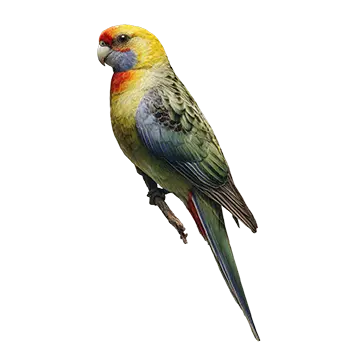
By the end of the second week, the eyes begin to slit open, and the chick becomes noticeably more responsive to light, sound, and movement around it. Pin feathers start emerging along the wings, back, and head, appearing as small, waxy sheaths that will eventually unfurl into the species' characteristic green, yellow, and blue plumage. The chick's legs gain strength, and it may begin bracing itself against the sides of the nest or brooder.

Between weeks three and five, feather development accelerates dramatically. The pin feathers open to reveal contour feathers, and the chick begins to look recognizably like a Green Rosella, though the juvenile plumage will be noticeably duller than that of an adult. The chick starts standing, gripping perch-like surfaces, and engaging in early wing-flapping exercises that build the pectoral muscles needed for flight. Vocalizations diversify from simple feeding begs into a wider repertoire of chirps and calls that signal growing neurological maturity.

Temperature & Environment

Maintaining precise environmental conditions in the brooder is the single most critical factor in keeping a neonatal Green Rosella alive during its first weeks. Chicks of this species are small-bodied and have a high surface-area-to-mass ratio, which means they dissipate heat quickly and are acutely sensitive to temperature changes. Until they develop sufficient feather coverage to thermoregulate on their own, the brooder must serve as a carefully controlled surrogate nest.

For the first week of life, the brooder temperature should be held between 96 and 99 degrees Fahrenheit. As pin feathers begin to emerge during the second week, the temperature can be reduced gradually, dropping by approximately one to two degrees every few days. By four to five weeks of age, when the chick is well covered in developing contour feathers, the ambient temperature in the brooder can typically be lowered to around 78 to 82 degrees. The chick's behavior is always the best guide to temperature adequacy. A chick that huddles, shivers, or vocalizes persistently is too cold. A chick that pants, holds its wings away from its body, or appears restless is too warm.

Humidity control is equally important and frequently neglected by first-time hand-rearers. Relative humidity should be maintained between 55 and 65 percent throughout the neonatal period. Insufficient humidity leads to dehydration and can cause retained feather sheaths that impede normal feather development. Excessive humidity encourages the growth of bacteria and fungi, particularly Aspergillus species, which pose a severe respiratory threat to young birds. A quality digital hygrometer placed at chick level provides the continuous feedback needed to keep humidity within the safe range.

The brooder enclosure itself should be constructed from smooth, non-porous materials that are easy to clean and disinfect. Bedding must be changed at minimum twice daily, and the entire unit should be thoroughly sanitized with an avian-safe disinfectant at least once a day. Avoid using wood shavings, particularly cedar or pine, as the aromatic compounds can irritate a chick's developing respiratory tract. Clean paper towels or soft cloth liners are preferable during the earliest weeks, though care must be taken to ensure the chick's toes do not become entangled in fabric threads.

Air quality in and around the brooder is an often-overlooked environmental factor. The brooder area should be well ventilated but free of drafts. Cooking fumes, aerosol sprays, scented candles, and cigarette smoke are all hazardous to young birds and must be eliminated from any room housing neonatal chicks. Even seemingly minor airborne irritants can cause disproportionate harm to the delicate, rapidly developing respiratory tissues of a Green Rosella chick.

Early Socialization

Green Rosellas have a reputation among aviculturists for being somewhat more reserved and independent than many commonly kept parrot species. This temperament makes early socialization especially important, as the window during which a chick is most receptive to forming positive associations with humans and environmental stimuli is relatively narrow. The groundwork laid during the neonatal period strongly influences whether the bird will grow into a confident, well-adjusted companion or a nervous, difficult-to-handle adult.

For hand-raised chicks, socialization begins with the first feeding. Every hand-feeding session is simultaneously a bonding opportunity, as the chick learns to associate human hands, voices, and scent with the comfort and security of being fed. Speak softly and consistently during feedings, using a calm and predictable tone. Avoid abrupt movements, loud noises, or allowing multiple unfamiliar people to handle the chick during its earliest days, as negative experiences during this critical imprinting phase can produce lasting fearfulness.

As the chick's eyes open and it begins to engage visually with its surroundings, gradually introduce a broader range of sensory experiences. Soft ambient music, the normal sounds of a household, and gentle variations in lighting all help the chick build a mental map of a safe, predictable world. Short handling sessions outside of feeding times, during which the chick rests in a cupped hand or against the caregiver's chest, promote secure attachment and help the bird become comfortable with physical contact that is not food-related.

Parent-raised Green Rosella chicks require a more deliberate socialization strategy. While the parents provide invaluable social learning about being a bird, including species-appropriate vocalizations and body language, chicks that receive no human contact during the neonatal period can become extremely wary of people. Brief, gentle handling sessions beginning around two weeks of age help bridge this gap. The goal is not to replace the parents' role but to ensure the chick develops a baseline comfort with human interaction that can be built upon during the juvenile weaning and fledging stages.

Health Screening & Vet Visits

Partnering with a qualified avian veterinarian from the earliest days of a Green Rosella chick's life is one of the most impactful decisions a breeder or hand-rearer can make. Not all veterinary practitioners have training in psittacine medicine, so it is important to identify a vet with specific experience in parrots and parakeets, ideally one who is board-certified in avian medicine or who maintains a predominantly avian caseload. The first veterinary examination should occur within the first few days after hatching, particularly for hand-raised chicks or birds acquired from a breeder whose flock health history is not fully documented.

The initial examination typically involves a physical assessment of the chick's body condition, hydration status, and any visible congenital abnormalities. A crop swab is usually performed to check for bacterial overgrowth or yeast infection, both of which are common in neonatal psittacines and can escalate rapidly if untreated. A fecal sample may be collected and examined for parasites or pathogenic organisms. Depending on the veterinarian's assessment and the chick's background, blood tests for Psittacine Beak and Feather Disease, Polyomavirus, and Chlamydia psittaci may be recommended, as these diseases can be transmitted vertically from parent to chick or horizontally through contaminated environments.

Maintaining thorough health records from hatch day forward gives both the caregiver and the veterinarian a detailed picture of the chick's trajectory. Record hatch weight, daily weights taken at the same time each day, feeding volumes and schedules, crop emptying times, and detailed notes on the appearance of droppings. This longitudinal data set is often the earliest and most reliable indicator of emerging health problems. A plateau or decline in weight gain, even in an otherwise apparently healthy chick, frequently precedes visible symptoms of illness by one to two days.

Between scheduled veterinary visits, daily health monitoring at home is essential. Normal droppings for a formula-fed chick consist of a soft but formed fecal component, a white urate portion, and a small amount of clear liquid urine. Significant changes in color, consistency, or volume of any component can indicate digestive upset, infection, or dehydration. Watch for nasal discharge, eye swelling, clicking or wheezing during respiration, and a crop that fails to empty within the expected timeframe. Any of these findings warrants prompt veterinary consultation rather than a wait-and-see approach.

When to Worry

Caring for a neonatal Green Rosella means developing the ability to distinguish between normal variation in chick development and genuine warning signs that demand intervention. Young chicks cannot communicate distress in overt ways, and by the time symptoms become unmistakable, the underlying condition may already be advanced. Learning to read the subtle early indicators of trouble is a skill that can mean the difference between a minor course correction and the loss of a chick.

Weight stagnation or loss is the single most reliable early warning sign in neonatal psittacines. A healthy Green Rosella chick should gain weight every day during its first several weeks of life. A single day without gain is worth noting and monitoring closely. Two consecutive days of flat or declining weight, even if the chick appears otherwise normal, should prompt immediate veterinary evaluation. Weight loss in a chick this small represents a proportionally enormous metabolic deficit and can signal infection, crop dysfunction, or inadequate nutrient absorption.

Changes in crop function are another critical area to monitor. After each feeding, the crop should feel comfortably full but not distended, and it should empty predictably within a timeframe that becomes consistent for each individual chick, usually three to four hours during the first two weeks. A crop that remains full or doughy well past the expected emptying time suggests crop stasis, which can result from bacterial or fungal infection, formula temperature errors, or motility problems. A crop that empties too rapidly may indicate that the chick is not retaining food adequately.

Respiratory distress in a neonatal chick can present as open-mouth breathing at rest, tail bobbing, audible clicking or wheezing, or visible effort during inhalation or exhalation. Respiratory infections, including aspergillosis, bacterial pneumonia, and aspiration pneumonia from feeding errors, progress rapidly in young birds. Any respiratory abnormality should be treated as urgent. Similarly, discharge from the nares or eyes, a persistently soiled or matted vent area, or skin that appears reddened, discolored, or unusually dry all warrant prompt veterinary attention.

Behavioral changes, though harder to interpret in very young chicks, also provide valuable diagnostic clues. A chick that was previously responsive to feeding cues but becomes lethargic and uninterested in food is likely unwell. Excessive vocalization or restlessness that is not explained by temperature or hunger may indicate pain or gastrointestinal discomfort. When any combination of these signs appears, err on the side of seeking professional guidance rather than waiting for the picture to clarify on its own. In neonatal avian medicine, early intervention almost always produces better outcomes than watchful waiting.

Always consult a qualified professional before making any health-related decisions. This content is provided for informational reference only and should not replace professional guidance specific to your animal.