Green Rosella Species Guide - Furry Critter Network

Green Rosella

Quick Facts

🔬 Scientific Name
Platycercus caledonicus
📊 Care Level
Intermediate
😊 Temperament
Gentle, Calm, Friendly
📏 Adult Size
14-16 inches
⏱️ Lifespan
15-20 years
🔊 Noise Level
Moderate
🗣️ Talking Ability
Limited
🍽️ Diet Type
Pellet-based
🌍 Origin
Tasmania, Australia
🏠 Min Cage Size
36x24x36 inches
📐 Size
Medium

Green Rosella - Names & Recognition

The Green Rosella (Platycercus caledonicus) is also commonly known as the Tasmanian Rosella, reflecting its endemic status to the island state of Tasmania and nearby Bass Strait islands. The species name 'caledonicus' references the historical name for Scotland, chosen due to Tasmania's Scottish heritage during the colonial period when the bird was first scientifically described.

Within the scientific community, this species has maintained its binomial nomenclature since its original description, showing taxonomic stability unlike some other rosella species that have undergone reclassification. The Green Rosella belongs to the genus Platycercus, which includes all rosella species, and is part of the broader family Psittaculidae, the Old World parrots.

Two subspecies are recognized: Platycercus caledonicus caledonicus, found throughout mainland Tasmania, and Platycercus caledonicus brownii, inhabiting King Island and other Bass Strait islands. The island subspecies shows slightly duller coloration and marginally smaller size compared to the Tasmanian mainland birds. In aviculture, color mutations are rare but include lutino and cinnamon variations, though these are seldom seen compared to mutations common in Eastern Rosellas. The species is sometimes referred to simply as the 'Green' or 'Tasmanian Green' in bird-keeping circles to distinguish it from other predominantly green Australian parrots.

Green Rosella Physical Description

The Green Rosella is the largest member of the rosella family, measuring 14-16 inches (36-41 cm) in total length and weighing between 4.2-6.3 ounces (120-180 grams). This substantial size, combined with their robust build and broad tail, gives them an impressive presence that distinguishes them from their mainland cousins. The species exhibits moderate sexual dimorphism, with males generally larger and showing more vibrant coloration than females.

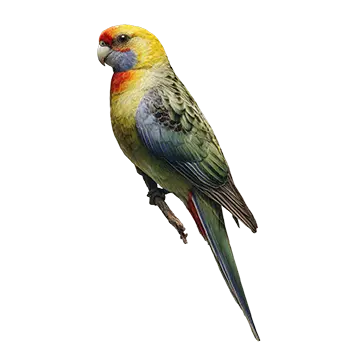
Adult Green Rosellas display stunning plumage dominated by rich yellow-green coloring across the head, breast, and underparts. The back, wings, and mantle feature darker olive-green feathering with black scalloping that creates a scaled appearance. The distinctive yellow head and cheeks are particularly vibrant in males, often showing golden-orange highlights in optimal lighting. The undertail coverts display brilliant yellow coloration, while the outer tail feathers show blue edging characteristic of the Platycercus genus.

The wings present a complex pattern of colors: flight feathers show blue-violet outer webs, creating a striking contrast during flight, while wing coverts display red and blue patches particularly visible when the bird is at rest or displaying. The rump shows bright yellow-green coloration that flashes during flight. The beak is pale gray to white, sturdy and perfectly adapted for their seed-cracking lifestyle. The legs and feet are gray-brown, equipped with strong zygodactyl toes ideal for climbing and manipulating food items.

Females generally show duller coloration overall, with less intense yellows and more subdued green tones. Juvenile birds appear considerably different from adults, displaying predominantly olive-green plumage with minimal yellow coloration and reduced wing markings. Young birds develop full adult coloration gradually over 12-16 months, with males developing brighter hues than females as they mature. The distinctive yellow breast and head coloring intensifies with each successive molt, reaching peak brilliance by the second or third year.

Affection Level
Green Rosellas form strong bonds with their owners and enjoy gentle interaction. Hand-raised birds are particularly affectionate, seeking head scratches and enjoying time perched near their human companions. They show loyalty to their primary caregiver while remaining friendly with other family members.
Sociability
These rosellas are moderately social birds that appreciate daily interaction but aren't as demanding as some parrot species. They do well as single pets with adequate attention or in bonded pairs. Green Rosellas enjoy observing household activities and being included in family routines without requiring constant engagement.
Vocalization
Green Rosellas produce pleasant melodic calls and whistles that are less piercing than many parrot species. They vocalize primarily in the morning and evening, with moderate volume suitable for apartment living. While they rarely learn to mimic words, they can learn whistled tunes and household sounds.
Intelligence
These intelligent birds demonstrate excellent problem-solving abilities and quick learning capacity. Green Rosellas enjoy puzzle toys, can master tricks with patient training, and show remarkable memory for routines. They exhibit curiosity about their environment and benefit from regular mental stimulation through varied enrichment activities.
Exercise Needs
Green Rosellas are active birds requiring substantial daily exercise and flight time. They need at least 3-4 hours outside their cage in a bird-proofed area for flying, climbing, and exploring. These athletic parrots enjoy foraging activities, swinging from perches, and investigating new toys to maintain physical fitness.
Maintenance Level
Green Rosellas require moderate maintenance including daily cage cleaning, regular bathing opportunities, and varied diet preparation. They produce moderate mess from food scatter and droppings. Nail and beak maintenance is typically needed every few months. Their larger size means more substantial cage cleaning than smaller birds.
Trainability
These rosellas respond exceptionally well to positive reinforcement training methods. They can learn to step up, recall on command, perform tricks, and participate in target training. Green Rosellas are food-motivated learners who enjoy training sessions as mental enrichment. Consistency and patience yield excellent results with this intelligent species.
Independence
Green Rosellas balance independence with social needs effectively. They can entertain themselves with toys and foraging activities for several hours but appreciate morning and evening interaction sessions. These birds are suitable for working owners who provide quality time daily. Bonded pairs become more self-sufficient while still enjoying human company.

Natural Habitat & Range

The Green Rosella is endemic to Tasmania, Australia, making it the only rosella species found exclusively on the island state and surrounding Bass Strait islands. The species occupies a wide range of habitats across Tasmania, from coastal heathlands and farmlands to wet sclerophyll forests and subalpine woodlands at elevations up to 4,900 feet (1,500 meters). This adaptability to diverse environments has contributed to their stable population status despite extensive habitat modification.

In their natural habitat, Green Rosellas prefer areas with a mix of open country and wooded regions, particularly favoring forest edges, clearings, and agricultural areas where feeding opportunities are abundant. They are commonly observed in eucalyptus forests, where they utilize tree hollows for nesting and roosting. The temperate climate of Tasmania, with its cool winters and mild summers, shapes their behavioral patterns and breeding cycles significantly different from mainland rosella species.

Wild Green Rosellas exhibit semi-nomadic behavior, moving in response to food availability and seasonal changes. During autumn and winter, they form flocks of 20-50 individuals, often gathering in agricultural areas where spilled grain and seeds provide reliable food sources. These flocks display strong social hierarchies and communal roosting behaviors in protected tree hollows or dense foliage. As spring approaches, pairs separate from flocks to establish breeding territories, defending nesting sites vigorously against intruders.

Their wild diet consists primarily of seeds from native grasses, eucalyptus, acacia, and introduced pasture species. They also consume fruits, berries, flowers, nectar, insects, and their larvae, showing remarkable dietary flexibility across seasons. Green Rosellas forage primarily on the ground in early morning and late afternoon, spending midday hours resting in tree canopies. Conservation status is classified as Least Concern by the IUCN, with stable population estimates between 20,000-50,000 individuals. While land clearing has reduced available nesting sites in some areas, their adaptability to modified landscapes and protection under Australian wildlife laws has maintained healthy populations. Climate change may pose future challenges to their specialized island ecosystem.

Temperament

Green Rosellas possess a notably gentle and calm temperament compared to many parrot species, making them appealing companions for experienced bird keepers seeking a less demanding pet. Hand-raised individuals develop into affectionate, loyal companions who form strong bonds with their primary caregiver while remaining friendly toward other household members. These birds typically show less aggression and territoriality than conures or larger parrots, though they maintain healthy boundaries and appreciate having personal space respected.

Their personality strikes a balance between engagement and independence. Green Rosellas enjoy spending time near their human family, observing activities and participating when invited, but they don't demand constant attention like some needier species. They appreciate structured interaction times, particularly morning and evening sessions that align with their natural activity peaks. During midday, they're content to rest quietly, preen, or engage with toys independently. This temperament suits working individuals or families who can provide quality interaction without being home all day.

Social interaction with Green Rosellas centers on gentle physical contact and shared activities rather than intense play sessions. They enjoy head scratches, will perch contentedly on shoulders or hands, and show affection through soft chirps and gentle nibbling. Unlike some parrots that become overstimulated easily, Green Rosellas maintain composure during handling and rarely display aggressive behaviors when properly socialized. They typically develop preferences for certain family members but rarely exhibit the extreme one-person bonding seen in cockatoos or some conures.

Vocalization patterns reflect their peaceful nature. Green Rosellas produce melodious whistles, soft chirps, and pleasant contact calls rather than harsh screaming. Morning and evening vocalizations mark their most active periods, but these sounds remain at moderate volumes unlikely to disturb neighbors or household members. They lack the talking ability of African Greys or Amazons but can learn to whistle tunes and mimic simple sounds. Their vocal repertoire serves primarily for communication rather than attention-seeking, making them suitable for apartment living.

Mood indicators in Green Rosellas include body language and vocalizations. Content birds exhibit smooth feathering, bright eyes, and engage readily with their environment through foraging and play. Stressed or unhappy rosellas may display fluffed feathers, reduced vocalizations, feather plucking, or withdrawn behavior. They communicate displeasure through warning calls and body posturing rather than biting, giving attentive owners clear signals. Common behavioral quirks include hanging upside down while playing, vigorous bathing behaviors that soak their surroundings, and methodical food manipulation where they carefully examine each item before consuming it. They often develop amusing individual habits like rearranging cage items or collecting specific toy types in preferred locations.

Care Requirements

Green Rosellas require spacious housing due to their medium-large size and active nature. The minimum cage dimensions should measure 36x24x36 inches for a single bird, though larger enclosures of 48x30x48 inches or more significantly improve quality of life by allowing more movement and flight. Horizontal space matters more than height for these birds who enjoy flying short distances within their enclosure. Bar spacing should range between 1/2 to 3/4 inch to prevent head entrapment while ensuring structural security against their powerful beaks.

Cage location significantly impacts bird health and behavior. Position the cage in a room with regular family activity but away from direct drafts, heating vents, air conditioning units, and kitchen areas where cooking fumes, especially from non-stick cookware, pose fatal risks. Place the cage against a wall to provide security while ensuring the bird can observe household activities. Avoid areas receiving direct sunlight during peak hours, as overheating threatens bird health, but ensure adequate natural light exposure for regulating circadian rhythms and supporting psychological wellbeing.

Perch variety promotes foot health and prevents arthritis or bumblefoot development. Provide natural wood branches of varying diameters (1/2 to 1 inch thick) from safe species like manzanita, java wood, or eucalyptus, positioned at different heights and angles throughout the cage. Include rope perches for texture variation and concrete or pumice perches strategically placed away from food and water to naturally maintain nail length. Avoid sandpaper perches entirely as they cause foot abrasions. Position perches to prevent droppings from contaminating food and water sources.

Toy requirements for Green Rosellas focus on destructible items satisfying their natural chewing instincts and providing mental stimulation. Rotate 6-8 toys weekly to maintain novelty and prevent boredom. Include foraging toys hiding treats inside various mechanisms, shredding toys made from paper or palm materials, puzzle toys requiring problem-solving, and swings or climbing structures for physical exercise. Avoid toys with small parts potentially causing crop impaction if swallowed, and inspect regularly for wear damage creating safety hazards.

Out-of-cage time requirements range from 3-4 hours daily minimum, allowing flight exercise in a bird-proofed room with closed windows, covered mirrors, secured ceiling fans, and removed toxic plants. Supervision during out-of-cage time prevents accidents and destructive behaviors toward furniture or household items. Create dedicated play areas with floor gyms or tabletop perches providing alternative spaces for interaction and exercise away from the cage environment.

Safety hazards demanding attention include toxic plants (particularly avocado, chocolate, caffeine, alcohol, salt, and many common houseplants), non-stick cookware fumes, aerosol products, strong cleaning chemicals, other pets without proper introduction, ceiling fans, open water containers posing drowning risks, and small objects potentially causing crop impaction. Bird-proof thoroughly before allowing flight time.

Enrichment strategies maintaining psychological health include daily training sessions teaching new tricks, rotating foraging opportunities hiding food in paper bags or cardboard boxes, providing fresh branches for chewing, playing music or nature sounds, offering bathing opportunities several times weekly through spray bottles or shallow dishes, and ensuring adequate social interaction through conversation and shared activities. Temperature preferences range from 65-80°F (18-27°C) with moderate humidity levels of 40-60%. Avoid extreme temperature fluctuations. Lighting requirements include 10-12 hours of light daily, achievable through natural daylight or full-spectrum bird lights providing necessary UV wavelengths supporting vitamin D synthesis and calcium metabolism essential for bone health.

Feeding & Nutrition

In their natural Tasmanian habitat, Green Rosellas consume a diverse diet primarily composed of seeds from native grasses, eucalyptus, acacia, and various wildflowers, supplemented with fruits, berries, nectar, flower blossoms, insects, and their larvae. This varied wild diet provides comprehensive nutrition supporting their active lifestyle and robust health. Captive diets should replicate this nutritional diversity while avoiding the pitfalls of seed-only feeding that leads to obesity and nutritional deficiencies.

High-quality pellets should form 60-70% of the captive Green Rosella diet, providing balanced nutrition formulated specifically for medium-sized parrots. Select pellets from reputable manufacturers like Harrison's, Roudybush, or TOPS, choosing appropriate sizes for rosella beaks. Introduce pellets gradually if transitioning from seed-based diets, mixing increasing pellet proportions with decreasing seed amounts over 4-6 weeks while monitoring food intake to prevent starvation from diet resistance.

The seeds versus pellets debate in avian nutrition strongly favors pellet-based diets for rosellas. While seeds formed their ancestral diet, the energy expenditure of wild foraging balanced high-fat seed consumption. Captive birds eating seed-exclusive diets develop obesity, fatty liver disease, and nutritional deficiencies particularly in vitamin A, calcium, and various amino acids. Limit seeds to 10-15% of total diet, offering small amounts of safflower, millet, canary grass seed, and limited sunflower seeds as training rewards rather than primary nutrition.

Fresh vegetables should comprise 20-30% of daily intake, offered in morning feedings when birds are hungriest. Excellent choices include dark leafy greens (kale, collard greens, dandelion greens), carrots, broccoli, bell peppers, sweet potato, squash, peas, and corn. Chop vegetables into appropriate sizes for easy consumption and remove uneaten portions within 2-4 hours to prevent bacterial growth. Introduce new vegetables gradually, as rosellas can be conservative with unfamiliar foods initially.

Fruits provide valuable vitamins and natural sugars but should be limited to 5-10% of diet due to high sugar content potentially contributing to obesity and health issues. Safe fruit options include apple slices (seeds removed), berries, melon, mango, papaya, and pomegranate. Avoid avocado entirely as it contains persin, which is highly toxic to birds, causing cardiac distress and death even in small amounts.

Foods requiring strict avoidance include chocolate (contains theobromine causing cardiac and nervous system toxicity), caffeine, alcohol, salt in significant quantities, onions and garlic (cause anemia), apple seeds (contain cyanide compounds), fruit pits, and many common houseplants. Never feed rosellas foods from human meals containing preservatives, artificial colors, high salt, sugar, or fat content.

Treats and supplements serve specific purposes in Green Rosella care. Use healthy treats like small pieces of nut (almond, walnut, limited amounts due to high fat), whole grain crackers, or favorite fruits for training rewards and bonding activities. Calcium supplementation proves especially critical for breeding females or birds on suboptimal diets, provided through cuttlebone, mineral blocks, or calcium supplements added to water under veterinary guidance. Vitamin supplementation may benefit birds refusing vegetables or showing deficiency signs, though high-quality pellet diets typically provide adequate vitamins.

Water requirements demand daily provision of fresh, clean water in multiple locations throughout the cage. Change water at least once daily, more frequently if contaminated by food or droppings. Stainless steel or ceramic bowls prove superior to plastic, which harbors bacteria in scratches. Provide water in both standard drinking bowls and occasionally in shallow bathing dishes, as rosellas enjoy vigorous bathing behavior supporting feather health.

Foraging opportunities enhance mental stimulation while encouraging natural feeding behaviors. Hide pellets or treats in paper bags, cardboard boxes, or commercial foraging toys requiring manipulation to access food. Hang vegetable kabobs from cage tops, encouraging climbing and effort during feeding. Scatter small amounts of seed in safe substrate encouraging ground foraging behaviors mimicking wild feeding patterns. These enrichment strategies prevent boredom while extending feeding duration, providing significant psychological benefits beyond basic nutrition.

Green Rosella Health & Lifespan

Green Rosellas are generally hardy birds when provided with proper care, nutrition, and housing conditions appropriate to their needs. Their robust constitution, developed through adaptation to Tasmania's variable climate, contributes to relatively good health outcomes in captivity when environmental requirements are met. However, like all parrots, they remain susceptible to various avian health conditions that require vigilant monitoring and preventive care strategies. Psittacosis, caused by Chlamydia psittaci bacteria, represents a significant health concern in rosellas and can transmit to humans, making diagnosis and treatment essential for both bird and owner safety. Respiratory infections commonly affect Green Rosellas, particularly when housed in drafty locations, exposed to temperature fluctuations, or kept in environments with poor air quality from cooking fumes, aerosols, or cigarette smoke. Aspergillosis, a fungal infection affecting the respiratory system, often develops in birds exposed to moldy food, damp bedding, or inadequate ventilation, requiring immediate veterinary intervention.

Cage cleanliness prevents bacterial and fungal growth that causes respiratory and systemic infections, requiring daily spot cleaning of food bowls and soiled areas plus weekly thorough disinfection of all cage surfaces and accessories. UV lighting benefits Green Rosellas by enabling vitamin D3 synthesis necessary for calcium absorption and bone health, particularly important for indoor birds lacking natural sunlight exposure. Annual wellness exams should include physical examination, weight monitoring, fecal testing for parasites, and blood work to assess organ function and nutritional status, establishing baseline health values for comparison if illness occurs. With attentive care meeting their physical and psychological needs, Green Rosellas typically enjoy lifespans of 15-20 years in captivity, with some individuals reaching 25 years or more. Quality of life throughout their lives depends on consistent provision of appropriate diet, spacious housing, mental stimulation, social interaction, and prompt veterinary care when health concerns arise. Owners committed to meeting these requirements can expect many years enjoying the companionship of these beautiful Tasmanian parrots.

Common Health Issues

  • Respiratory infections commonly affect Green Rosellas - Particularly when housed in drafty locations, exposed to temperature fluctuations, or kept in environments with poor air quality from cooking fumes, aerosols, or cigarette smoke.
  • Aspergillosis, a fungal infection affecting the respiratory system - Often develops in birds exposed to moldy food, damp bedding, or inadequate ventilation, requiring immediate veterinary intervention.\n\nPolyomavirus can affect young rosellas, causing sudden death in nestlings or young birds, though adult birds typically develop immunity after exposure.
  • PBFD (Psittacine Beak and Feather Disease) occasionally appears in rosella populations - Causing progressive feather loss, beak abnormalities, and immune system compromise with no current cure available.
  • Feather plucking in Green Rosellas typically stems from psychological stress - Boredom, or medical issues rather than being a primary behavioral problem, warranting thorough veterinary examination to determine underlying causes.\n\nFatty liver disease develops in rosellas fed seed-only diets lacking proper nutritional balance, manifesting through lethargy, difficulty breathing, and eventually liver failure if dietary corrections aren't implemented.
  • Egg binding poses serious risks to female Green Rosellas - Particularly those with calcium deficiencies or inadequate nesting conditions, requiring emergency veterinary care when suspected.

Preventive Care & Health Monitoring

  • Green Rosellas are generally hardy birds when provided with proper care - Nutrition, and housing conditions appropriate to their needs.
  • Feather plucking in Green Rosellas typically stems from psychological stress - Boredom, or medical issues rather than being a primary behavioral problem, warranting thorough veterinary examination to determine underlying causes.\n\nFatty liver disease develops in rosellas fed seed-only diets lacking proper nutritional balance, manifesting through lethargy, difficulty breathing, and eventually liver failure if dietary corrections aren't implemented.
  • Egg binding poses serious risks to female Green Rosellas - Particularly those with calcium deficiencies or inadequate nesting conditions, requiring emergency veterinary care when suspected.
  • Beak and nail overgrowth occurs in birds lacking appropriate surfaces for natural wearing - Necessitating regular trimming by experienced avian veterinarians or trained owners to maintain proper function.\n\nRegular veterinary checkups with an avian specialist provide essential preventive care, ideally scheduled annually for wellness exams even when birds appear healthy, allowing early detection of subtle health changes before they become critical.
  • Proper diet and nutrition form the foundation of disease prevention - With high-quality pellets, fresh vegetables, limited fruits, and appropriate supplements supporting robust immune function and organ health.
  • Environmental enrichment reduces stress-related illnesses and behavioral problems by providing mental stimulation through varied toys - Foraging opportunities, and social interaction that mimics natural behavioral patterns.\n\nCage cleanliness prevents bacterial and fungal growth that causes respiratory and systemic infections, requiring daily spot cleaning of food bowls and soiled areas plus weekly thorough disinfection of all cage surfaces and accessories.

Training & Vocalization

Green Rosellas demonstrate excellent training potential when approached with patience, consistency, and positive reinforcement methods aligned with their gentle, intelligent nature. Their food motivation combined with natural curiosity makes them responsive students eager to participate in training sessions that provide mental stimulation and strengthen bonds with their human companions. Begin training once the bird has settled into its new environment, typically 1-2 weeks after arrival, allowing time for initial trust building through gentle interaction and observation.

Basic training should start with fundamental behaviors essential for safe handling and veterinary care. Step-up training teaches birds to step onto an offered finger or perch on command, forming the foundation for all subsequent training. Use the command 'step up' consistently while positioning your finger slightly above foot level, rewarding compliance immediately with favored treats and verbal praise. Practice this essential behavior in short 5-10 minute sessions multiple times daily until it becomes automatic, gradually introducing step-ups from various locations and to different family members.

Recall training proves valuable for safety during out-of-cage time, teaching birds to fly to their owner on command. Begin in small spaces with minimal distractions, calling the bird's name followed by 'come' while offering a visible treat reward. Gradually increase distance and difficulty as reliability improves. Target training, where birds learn to touch a designated stick or object on command, provides foundation skills for complex trick training while serving practical purposes during veterinary examinations or movement between locations.

Trick training possibilities for Green Rosellas include waving, turning in circles, playing dead, retrieving small objects, basketball through miniature hoops, ringing bells, and navigating simple obstacle courses. Break complex tricks into small successive steps, rewarding approximations of desired behaviors before requiring full performance. Training sessions should remain brief (10-15 minutes) and end positively before frustration develops in either bird or trainer. Multiple short sessions throughout the day prove more effective than single lengthy sessions causing attention fatigue.

Talking ability in Green Rosellas remains limited compared to species like African Greys, Amazons, or Budgerigars specifically selected for vocal mimicry capabilities. While occasional individuals learn to mimic a few simple words or phrases with dedicated training, this should not be expected or considered a primary characteristic of the species. Their vocal strengths lie instead in whistling abilities, where they excel at learning melodies, tunes, and whistled phrases with remarkable accuracy and enthusiasm, particularly in male birds.

Noise levels throughout the day follow predictable patterns aligned with natural activity rhythms. Green Rosellas vocalize most prominently during dawn and dusk, producing melodious whistles, contact calls, and pleasant chirps marking their active feeding and social periods. Midday typically remains quiet as birds rest and preen. While not silent birds, their vocalizations remain at moderate volumes significantly less intense than conures, cockatoos, or macaws, making them suitable for apartment living or sound-sensitive households. Their calls carry pleasant, musical qualities rather than harsh screaming typical of some parrot species.

Socialization importance cannot be overstated for developing well-adjusted, confident adult birds comfortable with various people, situations, and experiences. Expose young Green Rosellas gradually to different family members, visitors, handling by multiple people, travel carriers, new environments, various toys and foods, gentle grooming procedures, and routine veterinary examinations. Proper early socialization prevents development of fearfulness, aggression, or excessive bonding to single individuals creating management challenges later.

Bonding techniques with Green Rosellas center on gentle, consistent interaction respecting their moderate need for attention without overwhelming their independent nature. Share meals together offering appropriate bird-safe foods, involve them in household activities through conversation and proximity, provide regular head scratches and physical affection when welcomed, engage in training sessions strengthening communication and trust, and establish predictable daily routines for feeding, out-of-cage time, and bedtime creating security through consistency.

Behavioral challenges in Green Rosellas typically prove less severe than in many parrot species but may include screaming (usually attention-seeking or environmental response), biting (generally from fear or overstimulation rather than aggression), feather plucking (indicating stress, boredom, or medical issues requiring investigation), and food throwing (natural foraging behavior requiring management rather than correction). Address behavioral issues by identifying and modifying triggering situations, ensuring adequate enrichment and exercise, maintaining consistent boundaries, and consulting avian behaviorists for persistent problems.

Positive reinforcement methods form the exclusive ethical approach to bird training, rewarding desired behaviors immediately with treats, praise, and attention while ignoring undesired behaviors to prevent reinforcement. Never use physical punishment, yelling, or negative reinforcement techniques damaging trust and potentially causing psychological trauma or increased aggression. Patience and consistency yield reliable results, though progress rates vary between individuals. Screaming prevention and management focuses on providing adequate enrichment reducing boredom-related vocalizations, ignoring attention-seeking screaming while rewarding quiet behaviors, establishing routines preventing anxiety, and identifying environmental triggers like inadequate sleep, hunger, or desire for social interaction requiring appropriate response rather than punishment.

Children & Other Pets

Green Rosellas can integrate successfully into households with children when proper precautions, education, and supervision ensure safety for both bird and child. Their generally gentle temperament and moderate size make them more suitable for family settings than aggressive or extremely large parrot species, though individual personality variations require consideration. Age appropriateness for child interaction begins around 8-10 years when children typically develop the maturity, gentle touch, and understanding necessary for respecting bird boundaries and following safety rules consistently.

Supervision requirements remain non-negotiable for all interactions between Green Rosellas and young children. Adults must actively oversee all contact, ready to intervene immediately if situations escalate toward stress for the bird or injury risk for the child. Even well-socialized, gentle rosellas may bite if startled, handled roughly, or feeling threatened, and their beaks can inflict painful injuries on small fingers. Never leave children under 12 unsupervised with birds regardless of perceived temperament or previous positive interactions.

Teaching children appropriate bird interaction begins with education about bird body language, stress signals, and proper handling techniques. Instruct children to approach slowly and calmly, speak in quiet tones, avoid sudden movements or loud noises, respect the bird's space when it shows signs of wanting distance, and always allow the bird to step up voluntarily rather than grabbing or forcing interaction. Demonstrate gentle petting techniques, typically limiting contact to head scratches while avoiding body handling that may trigger defensive behaviors.

Benefits of growing up with pet birds include developing empathy and respect for animals, learning responsibility through age-appropriate care tasks like refilling water or offering vegetables under supervision, understanding commitment required for long-lived pets, and experiencing the joy of interspecies relationships. However, realistic expectations must frame these benefits - rosellas form primary bonds with adults typically providing most care, and children's interest may wane as other priorities emerge during adolescence.

Potential challenges in households with children include noise sensitivity in both directions, as children's loud play may stress birds while bird vocalizations during homework or quiet time may frustrate families, competition for adult attention potentially causing jealousy-related behavioral issues in birds, and children's naturally grabby behavior triggering defensive biting if proper boundaries aren't maintained consistently. Address these challenges through clear household rules, designated quiet hours, and ensuring sufficient individual attention for both bird and child.

Interaction with other household pets requires extreme caution and often complete separation for safety. Dogs and cats retain predatory instincts regardless of training or apparent gentleness, and even playful interaction can result in fatal injuries to birds from bites, scratches, or simple stress responses. Never allow direct contact between Green Rosellas and mammals, and ensure cages have secure locks preventing access by curious pets. Supervise out-of-cage time carefully with other pets secured in separate rooms.

Other bird species can coexist successfully with Green Rosellas in some situations, though careful consideration of compatibility factors prevents tragedy. Similar-sized parrots like other rosellas, conures, or quakers may work well in separate cages placed for visual contact but not physical interaction, allowing social benefits without direct competition or fighting. Never house different species together regardless of apparent compatibility, as stress, disease transmission, and sudden aggression create unacceptable risks.

Safety protocols for multi-pet households include secure cage locks preventing other pets from opening enclosures, elevated cage placement beyond reach of jumping cats or dogs, separate rooms for bird out-of-cage time with doors securely closed, and immediate supervision any time birds and other pets occupy shared spaces. Create designated bird-safe zones in homes where cats and dogs cannot access, providing refuge areas ensuring bird security even if other pets gain unexpected access to bird areas.

Establishing household rules benefits all family members and pets through clear expectations and consistent enforcement. Designate primary bird caregivers responsible for daily feeding, cage maintenance, and interaction, assign age-appropriate tasks allowing children to participate in care while maintaining realistic expectations about their consistency, create schedules for out-of-cage time avoiding conflicts with other pet needs or family activities, and establish quiet hours ensuring birds receive adequate undisturbed sleep (10-12 hours) essential for health and behavioral stability. Consider whether family lifestyle, including activity levels, noise tolerance, long-term commitment capability, and ability to provide appropriate supervision, aligns with responsible Green Rosella ownership before adding these birds to homes with children or other pets.