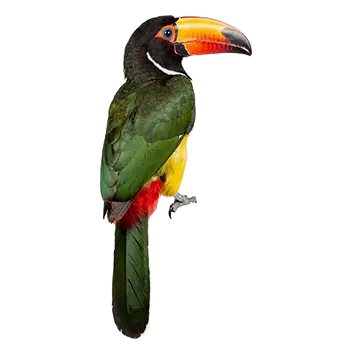

The First 24 Hours

Green Aracari chicks hatch after an incubation period of approximately 16 days, which is notably shorter than many psittacine species and reflects the ramphastid family's relatively rapid early development. The newly emerged chick is altricial, hatching blind, naked, and entirely helpless. Hatchlings typically weigh between 6 and 8 grams, making them exceptionally small and fragile. The skin is translucent and pinkish, with no visible down, and the oversized bill is soft and pliable, bearing little resemblance to the strikingly patterned adult bill that will develop over the coming months.

In a parent-raised setting, the adult pair will begin feeding the chick within the first few hours after hatching. Green Aracaris are cooperative breeders in the wild, and in captive breeding situations both the cock and hen typically share feeding duties from the outset. The first meals consist of regurgitated fruit pulp and partially digested insects, providing the chick with easily absorbed nutrients and the microbial flora necessary to establish a functional digestive tract. The parents instinctively regulate portion size based on the chick's tiny crop capacity.

For hand-raised chicks, the first feeding should be delayed until the yolk sac has been fully absorbed, generally within eight to twelve hours post-hatch. Attempting to feed before yolk absorption is complete can overwhelm the chick's immature digestive system and lead to crop stasis or bacterial infection. The initial hand-feeding should consist of a thin, well-hydrated preparation of a commercial low-iron softbill or toucan-specific hand-rearing formula, offered at a temperature between 102 and 106 degrees Fahrenheit.

During this critical first day, the brooder environment must be meticulously controlled. Temperatures should remain between 95 and 97 degrees Fahrenheit with humidity held at 60 to 65 percent. The chick should be placed on a soft, non-fibrous substrate such as paper towels layered over a padded surface. Observe the hatchling closely for steady respiration, a responsive feeding reflex when the bill margin is gently stimulated, and pinkish skin coloration. Any cyanotic tinge, gasping, or complete absence of feeding response warrants immediate contact with an avian veterinarian experienced with ramphastids.

Feeding & Nutrition

Nutrition for a newborn Green Aracari requires careful attention to the species' unique dietary physiology, particularly its sensitivity to dietary iron. Ramphastids are highly susceptible to iron storage disease, also known as hemochromatosis, which causes toxic accumulation of iron in the liver and other organs. This vulnerability is present from hatching, making formula selection and dietary composition critically important from the very first feeding. Using a standard parrot hand-feeding formula is not appropriate for this species and can cause long-term organ damage even before symptoms become apparent.

A commercially prepared low-iron softbill formula designed for toucans and aracaris is the foundation of a hand-fed chick's diet. The formula should be mixed fresh for every feeding session, prepared to a thin consistency during the first few days and gradually thickened as the chick matures and its crop capacity increases. Formula temperature must be checked with a thermometer before each feeding, maintained between 102 and 106 degrees Fahrenheit. Formula that is too cool slows crop motility and promotes bacterial proliferation, while overheated formula can cause severe thermal burns to the delicate crop lining.

Feeding frequency during the first week should be every two hours during daylight hours, with at least one overnight feeding to prevent prolonged fasting in such a small chick. By the second week, the interval can be extended to every three hours as the chick's crop volume increases and its metabolic efficiency improves. Detailed records of each feeding, including time, volume offered, volume consumed, and the chick's daily weight, are indispensable for tracking growth trends and catching problems early. Healthy Green Aracari chicks should show consistent daily weight gains during the first several weeks.

The feeding instrument, typically a small syringe or narrow-tipped spoon, must be sterilized between each use. Aspiration is a significant risk with ramphastid chicks because of their bill shape and feeding mechanics, which differ substantially from psittacine chicks. Feed slowly, allowing the chick to swallow at its own rhythm rather than forcing formula into the oral cavity. If the chick coughs, pulls away, or stops its swallowing response, halt feeding immediately and allow it to recover before continuing.

Parent-raised chicks benefit from the adults' instinctive ability to provide appropriately textured and portioned food. However, the keeper must ensure that the adults have access to a high-quality, low-iron diet rich in fresh tropical fruits such as papaya, banana, blueberries, and grapes, supplemented with gut-loaded insects for protein. Avoid offering citrus fruits and foods high in ascorbic acid in excess, as vitamin C dramatically increases iron absorption in the gut, compounding the hemochromatosis risk inherent to all ramphastids.

Developmental Milestones

Green Aracari chicks develop rapidly compared to many companion bird species, reflecting the shorter overall maturation timeline characteristic of ramphastids. Understanding the normal progression of milestones helps caregivers confirm that growth is on track and identify deviations that may indicate nutritional deficiency, illness, or environmental stress. Because each stage builds directly on the one before it, a delay at any point can have cascading effects on the chick's overall development.

During the first week, the chick remains essentially immobile aside from feeding responses and slight repositioning. The eyes are sealed shut, and the body is bare and entirely dependent on external heat. By day five to seven, faint traces of pin feathers may begin emerging along the dorsal tract and wing margins. Weight should roughly double from hatch weight by the end of the first week if nutrition and environmental conditions are adequate, serving as a reliable early benchmark.

The eyes typically begin to open between days eight and twelve, a milestone that marks a significant shift in the chick's awareness and responsiveness. Once the eyes are open, the chick begins tracking movement and responding to visual stimuli, which is the starting point for socialization and environmental acclimation. Pin feather development accelerates during the second and third weeks, with feather sheaths emerging densely across the back, wings, and head. The bill begins to harden and take on faint color patterning that hints at the adult's distinctive red-and-yellow mandible markings.

Between weeks three and five, feather growth becomes the dominant developmental process. Contour feathers emerge from their sheaths, revealing the rich green, yellow, and chestnut tones of the Green Aracari's plumage. The chick gains substantial strength in its legs and feet, progressing from wobbly shuffling to confident perching on flat surfaces and eventually on rounded dowels. Wing flapping exercises begin during this period, building the pectoral muscles necessary for eventual flight. By five to six weeks, the chick is nearly fully feathered, increasingly active, and beginning to show interest in solid foods placed within reach, signaling the approaching transition to the weaning process that will define the juvenile stage.

Temperature & Environment

Environmental management is the single most consequential factor in newborn Green Aracari survival. As naked, altricial hatchlings with virtually no insulative covering, chicks are entirely unable to thermoregulate during their first weeks of life. The brooder must function as a precisely controlled artificial nest cavity, replicating the stable warmth and humidity that parent birds would naturally provide in a tree hollow. Any lapse in environmental consistency, even for a short period, can trigger hypothermia, dehydration, or immune suppression in a very small chick.

Brooder temperature should be maintained at 95 to 97 degrees Fahrenheit during the first week. As pin feathers begin to emerge and the chick's surface area-to-mass ratio becomes slightly more favorable, temperature can be decreased by approximately one to two degrees every three to four days. By the time the chick is substantially feathered at around four weeks of age, the brooder temperature should have been gradually reduced to the low 80s. The chick's behavior is the most reliable guide to comfort: a chick that huddles tightly, shivers, or vocalizes persistently is too cold, while a chick that pants, holds its wings away from its body, or lies flat with legs splayed is overheating.

Humidity must be maintained between 55 and 65 percent throughout the brooding period. Green Aracaris originate from the humid tropical lowlands of northern South America, and their skin, developing feathers, and respiratory tissues are adapted to moist air. Low humidity accelerates dehydration through the skin, impairs normal feather sheath hydration, and can lead to constricted blood supply at the base of emerging feathers, resulting in malformed plumage. A calibrated digital hygrometer should be placed directly inside the brooder for continuous monitoring.

The brooder substrate should be smooth, non-abrasive, and easy to replace frequently. Paper towels changed at least twice daily are the safest option during the first two weeks. As the chick becomes mobile, a thin layer of clean cloth or fleece provides better traction for developing feet and toes without the aspiration risk posed by loose particulate bedding. The brooder must be positioned away from drafts, direct sunlight, and temperature fluctuations caused by heating and cooling systems. A secondary thermometer placed at chick level, separate from the brooder's own thermostat, provides a critical safety crosscheck.

Early Socialization

Green Aracaris are inherently social birds that live in small family groups in the wild, often roosting communally in tree cavities with multiple adults and juveniles packed closely together. This gregarious nature means that early socialization experiences profoundly shape the chick's comfort with human interaction, tolerance for handling, and overall behavioral resilience as it matures. A well-socialized Green Aracari is confident, curious, and adaptable, while a chick that misses this window may develop fearfulness, aggression, or chronic stress behaviors that are difficult to modify later.

For hand-raised chicks, socialization begins with the first feeding. Every interaction with the caregiver teaches the chick to associate human presence with warmth, food, and safety. Speak quietly and consistently during feedings and handling sessions, using a calm tone that the chick will learn to recognize. Gentle touch across the body, including the feet, wings, and bill, accustoms the chick to the types of handling it will experience throughout its life, from nail trimming to veterinary examinations. Keep initial sessions brief, no more than a few minutes beyond feeding time, and increase duration gradually as the chick's stamina and interest grow.

Once the eyes open, typically around days eight to twelve, environmental enrichment becomes an important component of socialization. Introduce a variety of textures, colors, and safe objects near the chick. Small pieces of soft fruit, smooth wooden beads, and crumpled paper all provide sensory stimulation that encourages exploration and problem-solving. Green Aracaris are naturally curious and playful, and this trait should be nurtured from the earliest opportunity. Exposure to normal household sounds, including conversation, gentle music, and kitchen activity, helps the chick acclimate to the domestic environment it will inhabit as an adult.

Parent-raised chicks require a deliberate but gentle approach to human socialization. The parents provide essential conspecific social learning, including species-appropriate vocalizations, body language, and feeding behaviors, but the chick also needs regular human contact to prevent it from becoming exclusively bonded to the adult birds. Beginning around two weeks of age, brief daily handling sessions of three to five minutes allow the chick to become comfortable with human hands and voices without disrupting the parental bond. The caregiver should approach the nest box calmly, handle the chick with slow, predictable movements, and return it promptly. Over time, the duration and complexity of these sessions can increase as the chick grows more confident.

Health Screening & Vet Visits

Locating an avian veterinarian with specific experience in ramphastid species is an essential preparatory step before a Green Aracari chick hatches or arrives in your care. Toucans and aracaris have physiological characteristics that differ significantly from parrots, including their iron metabolism, gastrointestinal transit speed, and susceptibility to certain fungal infections. A veterinarian unfamiliar with these distinctions may overlook species-specific risk factors or apply diagnostic and treatment protocols that are inappropriate for a softbill species.

The first veterinary examination should take place within the first few days of life for hand-raised chicks, or as soon as practical for parent-raised chicks without causing excessive disturbance to the nesting pair. The initial workup typically includes a thorough physical examination assessing body condition, hydration status, skin integrity, and nares and oral cavity health. A crop swab and gram stain allow the veterinarian to evaluate the chick's crop flora, checking for bacterial overgrowth or candidiasis, which is particularly common in hand-fed softbill chicks whose crop environment may lack the stabilizing microbial populations provided by parental feeding.

Blood work is advisable during the early weeks to establish baseline values, particularly serum iron levels. Because iron storage disease is the most significant health threat facing captive ramphastids throughout their lives, having a baseline measurement from early life enables more meaningful comparisons as the bird ages. Fecal analysis should also be performed to screen for internal parasites, especially if the chick originated from a multi-species collection or an outdoor aviary where exposure to environmental pathogens is possible.

Ongoing monitoring between veterinary visits falls to the caregiver. Daily weight measurements taken at the same time each morning provide the most sensitive early indicator of trouble. A healthy Green Aracari chick should gain weight consistently during the first five weeks, and any plateau lasting more than two days or any weight loss warrants immediate veterinary evaluation. Additionally, observe the chick's droppings at each substrate change. Normal droppings for a fruit-eating ramphastid chick are relatively loose and may vary in color based on the fruits consumed, but any dramatic shift toward mucoid, bloody, or unusually malodorous droppings signals a potential gastrointestinal infection or dietary problem requiring professional assessment.

When to Worry

Recognizing the difference between normal variation and genuine distress in a newborn Green Aracari requires familiarity with the species' baseline behaviors and developmental patterns. Because chicks cannot vocalize their discomfort in ways humans readily interpret, caregivers must rely on careful observation of physical appearance, feeding behavior, weight trends, and droppings quality to detect problems before they become critical. In ramphastid chicks, the margin between a treatable early illness and a life-threatening crisis can be alarmingly narrow, making vigilance and prompt action essential.

Crop stasis is one of the most common and dangerous complications in hand-fed chicks. If the crop fails to empty within the expected timeframe, typically three to four hours for a well-hydrated formula, it indicates that gut motility has slowed or stopped. Causes include formula prepared at incorrect temperatures, bacterial or fungal infection, foreign body ingestion, or environmental temperatures that are too low. A distended, doughy crop that does not reduce in size between feedings requires immediate intervention. Do not attempt to feed on top of a stagnant crop, as this compounds the problem and increases aspiration risk.

Respiratory distress is another urgent warning sign. Healthy Green Aracari chicks breathe silently and without visible effort. Tail bobbing, open-mouth breathing, audible clicking or wheezing, and nasal discharge all indicate respiratory compromise that could stem from aspiration of formula, fungal infection such as aspergillosis, or bacterial pneumonia. The warm, humid brooder environment that is essential for the chick's survival also creates conditions favorable to fungal growth, making scrupulous hygiene and adequate ventilation critical preventive measures.

Sudden behavioral changes also warrant concern. A chick that was previously responsive and eager to feed but becomes listless, refuses food, or fails to exhibit a normal feeding response when stimulated may be developing an infection or metabolic imbalance. Skin color changes are meaningful as well: a healthy chick's skin should appear pinkish and well-hydrated, while pallor, a yellowish tinge, or dark mottling can indicate circulatory problems, liver stress, or sepsis. Any of these findings, individually or in combination, should prompt an immediate call to your avian veterinarian rather than a wait-and-see approach.

Dehydration deserves particular mention because it develops rapidly in such small chicks and can be subtle in its early stages. Tenting of the skin, sunken eyes, dry or tacky oral membranes, and concentrated urates in the droppings all suggest dehydration. Contributing factors include insufficient formula hydration, brooder humidity that is too low, or underlying illness that increases fluid loss. Mild dehydration may be corrected by offering a warmed electrolyte solution between formula feedings, but moderate to severe dehydration requires subcutaneous or intraosseous fluid administration by a veterinarian.

Always consult a qualified professional before making any health-related decisions. This content is provided for informational reference only and should not replace professional guidance specific to your animal.