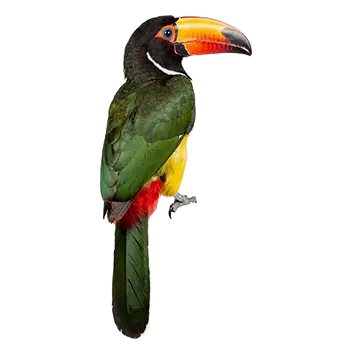

Daily Nutrition & Iron Management

Feeding the adult Green Aracari is an exercise in balancing nutritional completeness against the ever-present threat of iron storage disease. Hemochromatosis remains the leading cause of morbidity and premature death in captive ramphastids, and dietary management is the primary line of defense because there is no cure once significant iron accumulation has occurred in the liver and other organs. Every food item offered to the bird must be evaluated through the lens of its iron content and its effect on iron absorption.

Fresh, ripe fruit should constitute 60 to 70 percent of the adult diet. Papaya remains the foundational fruit due to its exceptionally low iron content, high water content, and the natural papain enzyme that supports digestive efficiency. Rotate through banana, blueberries, raspberries, cantaloupe, honeydew, watermelon, mango, and seedless grapes to provide variety and broad micronutrient coverage. Fruits should be offered fresh each morning in a clean dish, cut into pieces appropriate for the bird's toss-and-catch feeding motion. Remove uneaten fruit within a few hours to prevent bacterial growth, particularly in warm environments.

A low-iron commercial toucan or softbill pellet should make up approximately 25 to 30 percent of the daily diet. These formulations are specifically designed to meet ramphastid nutritional requirements while keeping iron levels below the threshold associated with hepatic accumulation. Standard parrot pellets, mynah bird pellets, and dog or cat kibble are never acceptable substitutes, regardless of how readily the bird may eat them. If the bird is reluctant to eat pellets, try soaking them briefly in fruit juice, mixing them into a fruit salad, or offering a different brand with a flavor profile the bird prefers.

Animal protein from gut-loaded insects such as crickets, mealworms, and dubia roaches should be offered daily in controlled quantities, approximately five to fifteen insects depending on the bird's body condition and activity level. Insects provide essential amino acids, fats, and micronutrients that support muscle maintenance, feather quality, and immune function. Hard-boiled egg white can be offered two to three times weekly as an additional protein source. Avoid red meat, organ meat, and iron-fortified foods entirely.

Foods high in vitamin C should be managed carefully because ascorbic acid dramatically increases iron absorption in the gastrointestinal tract. Citrus fruits, kiwi, strawberries, and bell peppers should be offered sparingly rather than as dietary staples. Tannin-rich foods such as tea-soaked pellets or small amounts of grape skins may help reduce iron absorption, though this strategy should complement rather than replace proper dietary selection. Fresh water must be available at all times and changed at least twice daily.

Housing & Environmental Design

The adult Green Aracari's enclosure is its primary living space for potentially two decades, making thoughtful design an investment in the bird's lifelong physical and psychological health. Unlike parrots, which are primarily climbers, aracaris are arboreal flyers that move through their environment with rapid, direct flight between perching stations. The enclosure must accommodate this flight-oriented locomotion to prevent the physical deterioration and behavioral frustration that develop when a flight-dependent species is confined to inadequate space.

The minimum recommended enclosure for a single adult Green Aracari is six feet in length, three feet in width, and four feet in height. Pairs require proportionally more space, and a dedicated bird room or walk-in flight aviary represents the ideal housing scenario for keepers who have the space to provide one. Length takes priority over height in enclosure design because the bird's primary movement pattern is horizontal. Bar spacing should not exceed one inch by half an inch to prevent bill and toe entrapment, and the cage material should be non-toxic, powder-coated steel rather than zinc-coated wire, which poses a toxicity risk if the bird chews on it.

Perching should replicate the diversity of natural substrates. Offer natural hardwood branches in diameters ranging from half an inch to two inches, positioned at multiple heights throughout the enclosure. Include at least one flat platform perch and one rope perch to provide variety in foot positioning. Green Aracaris are prone to pododermatitis if confined to uniform perch surfaces, so rotating perch types and positions regularly helps distribute pressure across different areas of the foot pad. Avoid sandpaper or concrete perch covers, which abrade the plantar surface.

The sleeping nest box remains essential throughout the adult years. Green Aracaris are obligate cavity roosters that experience measurable stress without access to an enclosed sleeping space. Provide a wooden box approximately eight inches square by twelve inches deep, with a three-inch entry hole, mounted at the highest available point in the enclosure. The bird will use this box nightly and may retreat to it during the day when it needs quiet or feels threatened. Pairs and family groups will share a single nest box, packing tightly together in the characteristic toucan roosting posture with tails folded forward over the back.

Ambient conditions in the housing area should mirror the bird's tropical origins. Maintain temperatures between 70 and 80 degrees Fahrenheit and humidity above 50 percent. Full-spectrum lighting on a 12-hour cycle supports circadian rhythm regulation, vitamin D synthesis, and plumage coloration. Provide a bathing dish or gentle misting system, as Green Aracaris bathe enthusiastically and require regular opportunities to wet their plumage for feather maintenance.

Enrichment & Mental Stimulation

Green Aracaris are among the most playful and inquisitive of the commonly kept ramphastid species, and their intelligence demands daily mental engagement to prevent the boredom-driven behavioral problems that erode quality of life in understimulated captive birds. A well-enriched adult Green Aracari is active, curious, and emotionally stable, while a bird that lacks adequate stimulation may develop stereotypic behaviors such as repetitive pacing, excessive preening or feather destruction, aggression, or apathy.

Foraging enrichment should be a daily priority. In the wild, Green Aracaris spend a significant portion of their waking hours searching for ripe fruit, probing bark crevices for insects, and investigating potential food sources throughout their territory. Captive birds that receive all their food in a single open dish are deprived of this foraging drive, one of the most fundamental motivational systems in their behavioral repertoire. Distribute food across multiple feeding stations, hide fruit pieces inside paper bags, woven palm balls, or commercially available foraging toys, and scatter insects in locations that require the bird to search and extract them.

Physical enrichment complements foraging opportunities by encouraging movement, climbing, and manipulation. Provide a rotating selection of bird-safe toys that the bird can carry, toss, shred, and disassemble. Wooden blocks, leather strips, paper-based shredding toys, and small woven baskets are all well-received. Green Aracaris are particularly fond of items they can toss and catch in the air, a behavior that mirrors their natural fruit-handling technique. Introduce new items regularly while cycling familiar ones in and out to maintain novelty without overwhelming the bird.

Social enrichment is equally critical. Green Aracaris are flock-oriented birds that thrive on regular interaction with their human companions or conspecific partners. For single birds, schedule at least two substantial interactive sessions daily, each lasting 20 to 30 minutes or longer. Play games that leverage the bird's natural behaviors: toss a lightweight ball or crumpled paper for the bird to catch, play hide and seek with treats, or set up obstacle courses with perches and tunnels that the bird navigates for food rewards. These sessions serve double duty as bonding opportunities and physical exercise.

Out-of-cage time in a bird-safe room is an important enrichment component that no in-cage setup can fully replace. Supervised flight time allows the bird to exercise at full capacity, practice aerial skills, and explore a larger environment. Designate a specific area of the home as the bird's free-flight zone, ensuring all hazards have been addressed. During out-of-cage time, the bird can interact more naturally with its human flock, observe household activities, and exercise the spatial cognition that underpins its intelligence.

Ongoing Training & Behavior Management

Training is not a phase that ends when the Green Aracari reaches adulthood but rather an ongoing component of the bird's daily routine that maintains cooperative behaviors, prevents regression, and deepens the bond between the bird and its caregiver. Adult Green Aracaris that receive consistent, positive reinforcement-based training are more confident, easier to manage during husbandry tasks, and less likely to develop fear-based or aggressive behaviors than birds whose training lapsed after the juvenile period.

Maintain all foundational behaviors through regular practice. Step-up, recall, station or target training, and voluntary entry into a carrier or travel cage should be rehearsed several times each week. Each successful repetition should be reinforced with a preferred food item, typically a small piece of favorite fruit or an insect. Green Aracaris are quick learners with excellent memories, and they readily understand the connection between a behavior and its consequence when the reinforcement is immediate and consistent.

Beyond foundational skills, adult Green Aracaris can learn a wide repertoire of cooperative behaviors that simplify health management. Training the bird to present its feet for inspection, allow gentle wing extension, open its bill for oral examination, and step onto a scale for voluntary weighing transforms routine health checks from stressful restraint events into cooperative exercises. These behaviors are trained incrementally using shaping techniques: reward successive approximations of the target behavior until the bird performs the complete action voluntarily.

Address behavioral challenges promptly and analytically. If the bird develops a new unwanted behavior, such as biting, screaming, or food throwing, investigate the underlying cause before attempting a correction. Behavioral changes often signal environmental stress, insufficient enrichment, a disrupted routine, hormonal shifts, or early illness. Modifying the antecedent conditions that trigger the behavior is almost always more effective than punishing the behavior itself, which risks damaging the trust relationship and typically worsens the problem. Consult with an avian behaviorist if a behavioral issue persists despite systematic environmental and management adjustments.

Annual Health Management

Proactive veterinary care is the cornerstone of long-term health management for the adult Green Aracari. Because ramphastids can mask signs of illness until a disease process is well advanced, relying on clinical symptoms as the trigger for veterinary attention means that many conditions are already difficult to treat by the time they are detected. An annual comprehensive examination, combined with targeted diagnostic testing, provides the best framework for early detection and intervention.

The annual veterinary visit should include a thorough physical examination, complete blood count, and plasma biochemistry panel. Particular attention should be given to serum iron and ferritin levels, as these markers track the bird's iron storage status over time. A rising trend in iron values across successive annual panels, even if individual readings remain within reference ranges, signals that dietary management needs to be tightened. The avian veterinarian should also assess liver function markers such as bile acids and AST, since the liver is the primary target organ for iron accumulation damage.

Fecal analysis for parasites and bacterial culture should be performed at each annual visit, especially for birds housed in outdoor aviaries or collections with other species. Aspergillosis screening is also recommended, as this fungal infection is a significant cause of respiratory disease in captive ramphastids. Radiographs or endoscopy may be recommended periodically to evaluate liver size and structure, which provides a more direct assessment of iron storage disease progression than blood work alone.

Between veterinary visits, the caregiver serves as the bird's daily health monitor. Weigh the bird weekly at the same time and under the same conditions, maintaining a running log that highlights trends. A healthy adult Green Aracari should maintain a stable weight within its individual normal range, typically between 110 and 160 grams depending on the bird's frame and body composition. Sustained weight loss or gain exceeding five percent warrants veterinary evaluation. Observe droppings quality daily, noting any persistent changes in consistency, color, or odor. Monitor feather condition, respiratory pattern, appetite, energy level, and behavioral stability as part of a routine assessment that becomes second nature over time.

Nail and bill maintenance are ongoing husbandry tasks. While natural wood perches help wear nails to some degree, most captive Green Aracaris require periodic nail trimming to prevent overgrowth that can snag on cage components or cause foot posture abnormalities. The bill is self-maintaining in most healthy individuals but should be assessed regularly for cracks, asymmetric growth, or discoloration that might indicate nutritional deficiency or trauma.

Social Dynamics & Companionship

Green Aracaris are inherently gregarious birds whose social needs run deeper than many keepers initially appreciate. In the wild, they live in cohesive family groups of up to six or more individuals, roosting together in shared tree cavities and foraging cooperatively through the canopy. Captive Green Aracaris retain this powerful drive for social contact, and fulfilling it, whether through human companionship, conspecific pairing, or a thoughtful combination of both, is one of the most impactful things a keeper can do for the bird's long-term psychological health.

A single Green Aracari bonded exclusively to its human caregiver can live a fulfilling life provided it receives substantial daily interaction. This means not merely being in the same room but active engagement: handling, play, training, and simply being physically close during the caregiver's daily routine. However, keepers must honestly assess whether their lifestyle can sustain this level of commitment over the bird's potential 15-to-20-year lifespan. Periods of reduced interaction, whether from travel, work schedule changes, family obligations, or other life events, can cause significant stress in a socially dependent single bird.

Keeping a pair of Green Aracaris addresses the social need more completely. Bonded pairs engage in mutual preening, synchronized roosting, cooperative foraging, and complex vocal exchanges that no amount of human interaction can fully replicate. A compatible pair provides each member with constant social access independent of the keeper's schedule. Same-sex pairs can form strong social bonds without the management considerations associated with breeding, though mixed-sex pairs are also rewarding when reproduction is either desired or effectively prevented.

Introducing a second Green Aracari to an established single bird requires careful management. Initial introductions should occur in neutral territory, a space that neither bird has claimed as its own. Visual access through adjacent enclosures allows the birds to acclimate to each other's presence before physical contact occurs. Monitor initial interactions closely for signs of aggression or territorial stress. Most Green Aracaris are socially receptive and will accept a compatible companion within a few weeks, but forced cohabitation before genuine acceptance has developed can result in injury, chronic stress, or entrenched aggression.

Regardless of social arrangement, respect the Green Aracari's individual personality. Some individuals are intensely social and demand constant companionship, while others maintain a more independent temperament and prefer periods of solitude punctuated by social interaction. A keeper who observes and adapts to the individual bird's social rhythms builds a more authentic and sustainable relationship than one who imposes a fixed interaction schedule without regard for the bird's behavioral cues.

Common Adult Health Concerns

Understanding the health conditions most likely to affect adult Green Aracaris enables caregivers to recognize early warning signs and seek veterinary attention before conditions become advanced. While iron storage disease dominates discussions of ramphastid health, several other conditions occur with sufficient frequency to warrant ongoing awareness and preventive management throughout the adult years.

Iron storage disease progresses insidiously in many affected birds, producing no visible symptoms until liver damage is substantial. By the time clinical signs appear, which may include lethargy, weight loss, labored breathing from abdominal fluid accumulation, or sudden death, the damage is often irreversible. This is precisely why annual serum iron monitoring and strict dietary management are so critical. In some cases, therapeutic phlebotomy, the controlled removal of small volumes of blood to reduce circulating iron, can slow disease progression if detected early. This procedure must be performed by an experienced avian veterinarian who can calibrate the volume and frequency of blood draws to the individual bird's size and iron burden.

Aspergillosis is a fungal infection caused by Aspergillus species that primarily affects the respiratory system. Ramphastids appear to have particular susceptibility to this pathogen, especially in environments where ventilation is poor, humidity is excessive, or organic substrates such as damp bedding and stale food create fungal growth opportunities. Symptoms include tail bobbing, open-mouth breathing, voice changes, nasal discharge, and exercise intolerance. Treatment requires prolonged antifungal therapy and can be challenging in advanced cases, making prevention through meticulous environmental hygiene the most effective approach.

Gastrointestinal problems, including bacterial enteritis, candidiasis, and megabacteriosis, occur periodically in captive Green Aracaris. The rapid gastrointestinal transit time characteristic of frugivorous birds means that pathogens can establish quickly and produce clinical disease within a short window. Changes in droppings consistency, volume, color, or odor should be investigated promptly with fecal analysis and gram stain. Dietary management, particularly avoiding spoiled fruit and maintaining clean water sources, prevents many gastrointestinal issues.

Pododermatitis, commonly known as bumblefoot, develops when pressure sores on the plantar surface of the feet become infected. This condition is strongly linked to inadequate perch variety, obesity, and reduced activity levels. Prevention centers on providing multiple perch diameters and textures, maintaining the bird at a healthy weight, and encouraging daily flight exercise. Early-stage pododermatitis is treatable with topical therapy and husbandry modifications, but advanced cases involving deep tissue infection may require systemic antibiotics and extended veterinary management.

Always consult a qualified professional before making any health-related decisions. This content is provided for informational reference only and should not replace professional guidance specific to your animal.