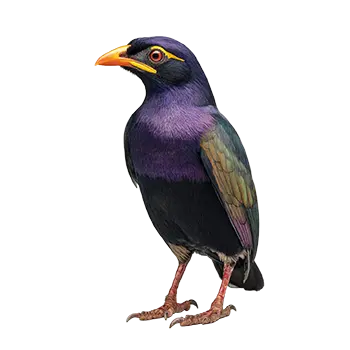

The Adult Hill Mynah in Profile

A mature Greater Hill Mynah is a heavy-bodied, short-tailed starling of about ten to twelve inches, its plumage a deep black that breaks into purple and green iridescence in direct light. A clean white patch flashes on each wing in flight, the bill is a bright orange fading to yellow at the tip, the legs are a strong yellow, and pendulous yellow wattles sweep back from behind the eye across the nape. The effect is far more striking in person than in most photographs.

The species reaches full physical and sexual maturity between roughly one and two years of age, and settles into a long prime that may run a decade or more. Well-kept captive birds commonly live twelve to twenty-five years. Sexes are visually identical, so a bird's sex is known only through DNA testing or, less reliably, through behavior in a breeding context.

Several subspecies are recognized across the native range, which extends through the hill forests of India, Sri Lanka, the Himalayan foothills, mainland Southeast Asia, and the Indonesian archipelago. They differ in body size and in the exact configuration of the nape wattles. Birds of uncertain subspecies are common in the pet population and should not be assumed interchangeable for breeding purposes.

Temperamentally, the adult is confident, curious, noisy, and highly social with its own household. It is an interactive companion rather than a decorative one, and it tends to be more emotionally direct than a parrot: pleased, annoyed, or alarmed, at volume, without much ambiguity. Owners who understand this and build their routine around it generally find the species enormously rewarding for its full lifespan.

Daily Diet and Portion Control

The adult diet rests on a guaranteed low-iron softbill pellet, ideally in the sixty to one hundred parts per million range, offered fresh every day as the nutritional backbone. Around that base, fresh fruit forms the larger visible portion of what the bird eats: papaya, mango, ripe banana, melon, blueberry, grape, fig, and soft pear are all readily taken. Chop to a size the bird can pick up and swallow whole, since mynahs gulp rather than chew.

What is excluded matters as much as what is included. Citrus and other high-ascorbate foods increase iron absorption and should not be routine. Muscle meat, organ meat, dog and cat food, iron-fortified cereals, and vitamin supplements containing iron are all inappropriate. Avocado, chocolate, caffeine, alcohol, onion, and salted or heavily processed human foods are toxic or harmful. Water should be filtered or bottled and low in mineral content, because iron carried in well water or old pipework adds up across two decades.

Insects retain a place in the adult diet in modest quantity. A few gut-loaded crickets, small roaches, or waxworms two or three times a week supply animal protein and give the bird something to hunt, which is enrichment as much as nutrition. Mealworms should be occasional rather than staple given their chitin and fat content.

Portion control is the discipline most often neglected. Sweet fruit is calorie dense, mynahs eat readily, and captivity offers a fraction of the flight distance of a forest canopy. Weigh the bird weekly on the same scale at the same time of day, keep the numbers, and adjust the fruit-to-pellet ratio and the flight opportunity when the trend rises. Obesity in a species already predisposed to hepatic disease is not a cosmetic issue.

Housing and Enclosure Requirements for Flight

Hill mynahs fly; they do not climb. That single fact should govern every housing decision. Bars are a barrier to them rather than a ladder, so cage height above the top perch is largely wasted while length is used constantly. A minimum footprint of about four feet long by two feet deep by two feet high suits one adult, and six feet or more of length is a meaningful upgrade rather than a luxury. Aviary housing, where climate permits, is better still.

Furnish sparsely and deliberately. Two or three well-placed perches of varying natural diameter at each end preserve a clear central flight lane; a cage packed with toys and swings prevents the exercise the bird most needs. Provide a heavy, shallow bathing dish, food and water dishes positioned so droppings cannot fall into them, and a few destructible or manipulable items rotated regularly.

Mess management is a structural part of housing this species rather than an afterthought. Liquid frugivore droppings travel, and a bathing mynah broadcasts water across several feet. Washable flooring, acrylic guards on the sides and back, a deep and easily removed tray, and a daily wipe-down keep the arrangement sustainable. Substrate should be a plain, replaceable liner rather than loose material that can be ingested or that traps moisture.

Air and temperature are the remaining essentials. Sixty-five to eighty degrees Fahrenheit is a comfortable range, with humidity that does not fall to desert levels, and no direct drafts on a wet bird. Keep the enclosure well away from the kitchen: fumes from overheated non-stick cookware kill birds quickly and without warning. Aerosol sprays, scented plug-ins, candles, incense, and tobacco smoke are all serious respiratory hazards for a bird whose air sac system extracts far more from each breath than a mammal's lungs do.

Vocal Repertoire and Mental Enrichment

An adult hill mynah maintains and slowly extends the repertoire it built in its first year. Acquisition is slower than it was in adolescence but does not stop, and birds continue to pick up new household sounds throughout life. Because the species reproduces the specific voice it learned from rather than translating it into a generic bird voice, a long-lived mynah can end up carrying a recognizable archive of the people it has lived with.

The natural vocal output beyond mimicry is loud, and prospective owners should be honest with themselves about it. Wild hill mynahs are among the noisiest birds of their forest, with piercing whistles and creaking calls delivered most intensely at dawn and dusk. Captive birds keep that rhythm. This is not a species suited to thin-walled apartments or households needing quiet early mornings, and no amount of training removes the behavior, because it is normal rather than problematic.

Enrichment should engage foraging and problem solving. Hide fruit pieces inside crumpled paper, in shallow dishes covered with leaves or shredded material, or in simple puzzle feeders that require flipping a lid or pulling a token. Live insects released into a foraging tray occupy a bird intensely. Rotate items weekly so that novelty persists, and place at least some food where the bird must fly to reach it.

Social engagement is the other half. Hill mynahs bond strongly with their people and become vocally and behaviorally flat when ignored for long periods. Talk to the bird during ordinary activity, keep the cage in a room the household actually uses, and give the bird supervised out-of-cage time in a bird-proofed space. A radio or television is a poor substitute for interaction and tends to add to the volume problem rather than solve the boredom one.

Grooming, Bathing, and Annual Molt Management

Hill mynahs handle most of their own grooming provided they have water. Offer a shallow bathing dish daily and expect it to be used with enthusiasm and considerable splashing, often first thing in the morning. Birds that also enjoy a light mist from a spray bottle can be offered one, though many prefer to bathe on their own terms. Never bathe a bird in cold conditions or where a draft can reach it while wet.

Nails and bill normally wear naturally on rough natural perches and firm foods. Overgrowth that requires frequent trimming is worth investigating rather than simply managing, because abnormally rapid or distorted growth of the bill and nails is a recognized external sign of underlying liver disease in birds, and liver disease is precisely what this species is prone to. Trimming itself is best done by an avian veterinarian or an experienced handler, since the blood supply extends well into a mynah's nail.

Wing clipping is generally inadvisable in this species. A hill mynah's entire mode of locomotion is flight; it cannot climb to compensate, and a clipped bird loses both its exercise and its escape response, becoming more prone to falls, weight gain, and injury. Where household safety is a concern, the better solution is a secure, bird-proofed room and reliable recall training rather than removing the bird's flight.

The annual molt is a demanding period. Feather replacement is metabolically expensive, appetite typically rises, and the bird may look ragged for several weeks with pin feathers erupting on the head and neck. Support it with adequate protein and a slightly increased insect allowance, maintain bathing opportunities to help sheaths break down, and avoid stress and handling around the head. Persistent feather abnormalities, symmetrical stress bars across new feathers, or a molt that stalls halfway all warrant a veterinary assessment.

Preventive Health Care and Annual Bloodwork

An adult Greater Hill Mynah should see an avian veterinarian with softbill experience at least once a year while apparently healthy. Birds conceal illness until they are seriously compromised, and in a species whose signature disease is silent for years, the annual examination on a well bird is the entire preventive strategy rather than a formality.

A reasonable annual workup includes a full physical examination, an accurate weight compared against your own records, a complete blood count, a plasma biochemistry panel with attention to liver values, and fecal cytology with a Gram stain. Where iron storage disease is a concern, which in this species means always, veterinarians may add serum iron studies, bile acid testing to assess liver function, and radiographs to look for hepatomegaly. It is worth understanding that these are supportive rather than definitive; liver biopsy remains the reference standard for diagnosing hemochromatosis, and the decision to pursue it is one to make with your veterinarian.

When iron overload is identified, the mainstays of treatment are dietary correction and therapeutic phlebotomy, in which small measured volumes of blood are removed on a schedule to draw down total body iron, sometimes supported by chelation therapy. Treatment is far less satisfactory than prevention, which is why the diet described earlier is not a preference but the core of this species' medicine.

Between visits, your own surveillance matters. Weigh weekly and log it. Watch droppings daily for changes in volume, color, or the proportion of urates. Note any change in vocal output, posture, appetite, or the amount of time spent sleeping. Quarantine any new bird entering the household for a minimum of thirty to forty-five days with veterinary screening before contact, since respiratory and enteric pathogens move readily between softbills.

Behavior, Territoriality, and Companion Compatibility

Adult hill mynahs are territorial about their own enclosure and often about the room containing it. A bird that is affable on a play stand may defend its cage doorway vigorously, lunging or calling at an approaching hand. This is normal resource guarding rather than aggression toward the person, and it is best managed by conducting handling and training away from the cage and by not reaching into the bird's space unannounced.

Housing multiple mynahs requires space and care. A compatible bonded pair can be kept together successfully in a large flight, but mismatched adults, and particularly two birds of the same sex confined together, may fight seriously. Introductions should happen in neutral, spacious housing with multiple perches, sight barriers, and duplicate food stations, and should be supervised. Mynahs also tend to dominate smaller softbills and finches and should not share an enclosure with them.

With other pets, supervision is absolute rather than conditional. A mynah on the floor is at the eye level of a dog or cat, and the bacteria in a cat's mouth can kill a bird from a puncture that looks trivial. Confident mynahs will often approach a much larger animal without any sense of danger, which makes them harder to protect than a more cautious species.

Behavioral problems in adults usually trace back to unmet needs rather than temperament. Excessive screaming that escalates beyond the normal dawn and dusk chorus commonly reflects boredom, isolation, or an accidental reward pattern in which shouting back reliably produces attention. Feather damaging behavior, though less common in mynahs than in parrots, warrants a medical workup first. In most cases the solution is more flight space, more foraging, a predictable routine, and consistent interaction rather than any form of correction.

Always consult a qualified professional before making any health-related decisions. This content is provided for informational reference only and should not replace professional guidance specific to your animal.