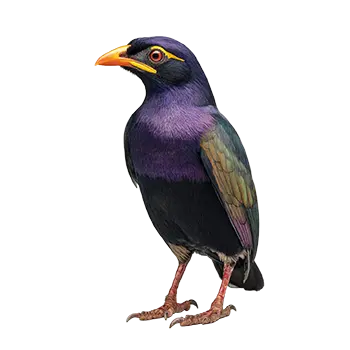

Fledging and the Move to a Flight Cage

A Greater Hill Mynah fledges at roughly twenty-five to twenty-eight days of age, leaving the nest cavity able to fly but distinctly unpolished about it. Early flights are strong in propulsion and poor in braking, and a newly fledged mynah will regularly overshoot a perch, hit a wall, or land on the floor and sit there looking affronted. This is normal, and it resolves over one to two weeks of practice.

The fledgling's first enclosure should therefore be wide rather than tall. Mynahs are not climbers; they have no zygodactyl grip on cage bars and no beak-over-foot ladder technique. They hop and they fly, which means horizontal distance is the dimension that matters. Set perches low and near opposite ends so the bird can make short flights without a long fall, and pad or cover any hard surface it is likely to strike in the first days.

Independence does not arrive with flight. Wild parents continue feeding fledglings for several weeks after they leave the nest, and a hand-reared bird follows the same schedule, begging with quivering wings and a raucous call long after it can technically feed itself. Continue offering hand feeds while introducing solid food, and let the bird refuse feeds rather than withdrawing them on a calendar.

Safety in the household changes at this point too. A fledgling mynah out of its cage will fly into windows, mirrors, open water, and cooking surfaces without hesitation. Cover glass, close toilet lids, remove standing water deeper than the bird's own height, and confirm every door before opening it. Most fledgling injuries in this species happen in the first fortnight out of the nest, when flight capability has arrived well ahead of judgement.

Weaning Onto a Low-Iron Softbill Diet

Weaning is best understood as a gradual handover rather than a cut-off. From the moment the bird fledges, offer a shallow dish of finely diced soft fruit and softened low-iron mynah pellet where the bird can reach it from a perch. Curiosity does most of the work: young mynahs mouth, throw, and eventually swallow novel items, and the messier the process looks, the better it is generally going.

Build the diet around a guaranteed low-iron softbill pellet as the nutritional base, with fresh fruit as the larger visible portion of the daily offering. Papaya, mango, ripe banana, blueberry, melon, grape, and fig are all well accepted. Keep citrus and other high-ascorbate foods out of the routine, since vitamin C markedly increases iron uptake in a species that cannot excrete the surplus. A few appropriately sized live insects several times a week supply the animal protein a growing bird still requires.

Most birds are eating enough independently to drop hand feeds between six and ten weeks of age, with the last feed of the day usually the final one to go. Weigh every morning throughout the transition. A modest weight dip during weaning is expected as begging behavior gives way to self-feeding, but a fall of more than about ten percent below the pre-weaning peak means the bird is not yet taking in enough and hand feeds should be resumed.

Establish habits now that will matter in fifteen years. Serve food in easily washed dishes at perch height, discard uneaten fresh food within a few hours in warm weather, offer filtered or bottled low-mineral water rather than iron-bearing well water, and avoid teaching the bird that table scraps arrive from human hands. Avocado, chocolate, caffeine, alcohol, salted foods, and onion are toxic or harmful and should never enter the cage.

The Vocal Learning Window

The Greater Hill Mynah's reputation as the most accurate mimic of human speech among all birds is earned in this stage. Unlike parrots, which reproduce words in a characteristically mechanical parrot voice, a hill mynah reproduces the timbre, pitch, and accent of the specific person it learned from, to the point that household members are routinely fooled by their own words played back from across a room.

The groundwork begins with subsong, a quiet, rambling babble of whistles and clicks that many young mynahs start producing within a few weeks of fledging. Recognizable imitations generally emerge somewhere between three and six months of age, and the first year is the period of most rapid acquisition. Birds continue adding material throughout life, but nothing later matches the speed and fidelity of this first year.

Teaching works best in short, calm, repetitive sessions. Choose a small number of phrases, deliver them live and in person rather than on an endless recorded loop, and use the same intonation each time. Sessions of five to ten minutes, two or three times a day, in a quiet room with few competing sounds, produce far better results than background noise all day. Reward attention with a favored fruit rather than with excitement, which tends to escalate volume rather than accuracy.

Be deliberate about what the bird hears, because the process is indiscriminate and largely irreversible. Smoke alarms, microwave beeps, phone ringtones, a dog's bark, a squeaking door, and any word said sharply in frustration are all learned exactly as readily as an intended phrase, and once established they can persist for the bird's entire life at full volume at six in the morning. This species is genuinely loud, and the adolescent months are when its permanent repertoire is being decided.

Handling, Taming, and Building Confidence

Hill mynahs are companionable but not cuddly. A well-socialized bird will land on a shoulder, follow its person from room to room, take food from a hand, and engage in long vocal exchanges, but most dislike sustained physical contact and few tolerate the restraint and petting that a hand-raised parrot may accept. Setting expectations correctly at this stage prevents a great deal of frustration later.

Build the relationship on choice. Sit near the cage and talk, offer fruit through the bars, and let the bird approach rather than reaching in after it. Grabbing a young mynah to force interaction produces a bird that flees the hand for years. Step-up training with a food reward, and simple target training toward a stick or a fingertip, both work well and give you a way to move the bird without a chase.

Adolescents also pass through a period of increased wariness as their flight ability and self-preservation instincts sharpen. A bird that was fearless at six weeks may become startled by hats, brooms, or a changed piece of furniture at four months. Introduce new objects at a distance, pair them with food, and give the bird time; forcing the encounter cements the fear rather than resolving it.

Night fright deserves specific mention. A startled mynah in a dark room will launch into full flight and can injure itself against bars or walls. A dim night light near the cage, a stable and predictable sleeping location, and a cage cover that leaves some visibility rather than total blackout all reduce the risk. Aim for ten to twelve hours of quiet, undisturbed dark each night, which supports both growth and temperament in a young bird.

The First Molt and Feather Quality

Juvenile plumage in a Greater Hill Mynah is duller and softer than the adult's, with less of the purple and green iridescence that plays across a mature bird's black feathering in direct light. The white wing patch is present but often smaller and less crisply defined. The bill and legs start paler and deepen toward the adult orange-yellow over the first months.

The most visible transformation is in the wattles. The yellow fleshy lappets that wrap behind the eye and across the nape are barely developed in a fledgling, appearing first as areas of thickened bare skin. They grow, pigment, and take on their characteristic pendulous folds gradually over the first year, and their final size and shape vary between subspecies as well as between individuals. A young bird with modest wattles is not defective, merely young.

The first substantial molt generally occurs within the first year, and the bird may look distinctly disreputable while it happens, with pin feathers pushing through the head and neck where the bird cannot preen them itself. Molting is metabolically expensive, and appetite often rises. Support it with adequate protein from insects and pellet rather than with iron-bearing supplements, and resist any product marketed as a general tonic without checking its mineral content.

Daily bathing is the best feather conditioner available. Hill mynahs bathe enthusiastically and often, and a bird with regular access to a shallow dish or a gentle mist will carry noticeably better plumage than one without. Poor feather quality that persists after a molt, with stress bars, retained sheaths, or dull broken edges, points to a nutritional or health problem rather than a grooming one and is worth investigating with an avian veterinarian.

Housing, Perching, and Bathing Habits

By the time it is fully independent, a Greater Hill Mynah needs its adult accommodation. Length is the priority dimension: an enclosure of at least four feet long by two feet deep and two feet high is a reasonable minimum for a single bird, and longer is genuinely better because the bird will use it for flight rather than climbing. Bar spacing of about three quarters of an inch prevents head entrapment while allowing good visibility.

Perching should vary in diameter and texture to exercise the feet and prevent pressure sores developing over the years. Natural hardwood branches with bark left on, in a range of thicknesses the bird can wrap most of its foot around, are ideal. Place perches so that droppings do not fall into food or water dishes, and leave the central flight path clear rather than filling the cage with obstacles.

Plan for mess honestly, because this is where many owners are caught out. A frugivorous diet produces copious, liquid droppings, and a hill mynah projects them a surprising distance beyond the cage. Combined with the bird's habit of flicking fruit while eating and soaking everything within range during its daily bath, this makes washable flooring, wall guards or acrylic panels on at least three sides, and a daily cleaning routine practical necessities rather than refinements.

Provide a shallow, heavy bathing dish of two to three inches of clean water and refresh it at least once a day, more if the bird bathes early and then drinks from the same dish. Room temperature between about sixty-five and eighty degrees Fahrenheit suits the species, with protection from drafts while feathers are wet. Keep the cage out of the kitchen entirely: fumes from overheated non-stick cookware are rapidly fatal to birds, and aerosols, scented candles, and smoke are all serious respiratory hazards.

Adolescent Health Watch Points

The juvenile period is when several of the conditions that shorten hill mynah lives quietly begin. Iron storage disease is the foremost of them. Accumulation is silent for years, produces no outward sign in an adolescent bird, and only declares itself in a mature adult as sudden collapse or death. Nothing about a young mynah's apparent good health indicates that its diet is safe; only the guaranteed iron content of what it eats does.

Atoxoplasmosis remains a real risk into the juvenile months. Caused by coccidian parasites of the genus Isospora, it is a recognized cause of illness and death in young starlings and mynahs, typically presenting as a bird that fluffs up, loses weight, becomes lethargic, and passes abnormal droppings. Any adolescent from a collection with a history of unexplained young-bird losses should be screened, and new arrivals should be quarantined from resident birds for at least thirty to forty-five days.

Obesity begins here as well. Young mynahs offered unlimited sweet fruit and little flight space gain condition quickly, and excess weight in a species already predisposed to hepatic disease compounds the problem substantially. Weigh weekly once daily weighing ends, keep the record, and adjust portions and flight opportunity rather than waiting for a veterinarian to point out the trend.

Schedule a wellness examination as the bird finishes weaning and another at around one year of age. A baseline physical, weight, fecal Gram stain, parasite screen, and in many cases a first set of bloodwork give you comparison values for the rest of the bird's life, which is the entire point of doing them in a healthy animal. If the bird is not already DNA sexed, this is a convenient time, since Greater Hill Mynahs are monomorphic and cannot be reliably sexed by appearance.

Always consult a qualified professional before making any health-related decisions. This content is provided for informational reference only and should not replace professional guidance specific to your animal.