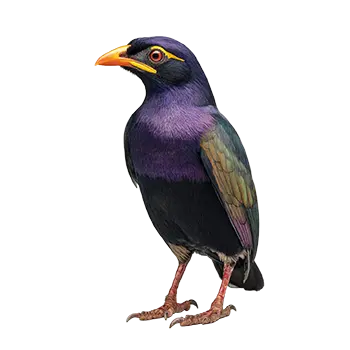

Greater Hill Mynahs are monomorphic, meaning males and females are visually indistinguishable. Claims that cocks have larger wattles or heavier bills do not hold up reliably across individuals or subspecies, and pairing on appearance alone is the most common reason a supposed pair produces years of infertile eggs or no eggs at all. DNA sexing from a blood or feather sample is inexpensive, definitive, and should be considered a prerequisite rather than an option.
Birds typically reach sexual maturity between about one and two years of age, though many pairs do not settle into productive breeding until their second or third year. There is no advantage in rushing a young hen into production, and a bird still completing its own growth and first full molts is poorly placed to support a clutch.
Compatibility is the second requirement and cannot be assumed from correct sexing. Hill mynahs form strong pair bonds and reject partners they have not chosen, sometimes violently. Introduce prospective pairs in a large neutral flight neither bird considers its own, with multiple perches, visual barriers, and duplicated food and water stations so a subordinate bird can eat without approaching the other. Supervise closely for the first days and be prepared to separate.
A bonded pair announces itself through behavior. The birds perch in contact or close proximity, allopreen around the head and nape, duet or answer one another's calls, and move around the enclosure together. The male may follow the female closely, present food, and display near the nest site. Aggressive chasing, one bird excluded from food, or feather damage inflicted by the other means the pairing has failed and should be ended before injury occurs; pairs that are merely tolerating each other rarely go on to rear young successfully.