
The First 24 Hours

Fantail Pigeon squabs hatch after an incubation period of roughly 17 to 19 days, emerging as small, nearly helpless creatures with closed eyes, sparse yellowish down, and oversized beaks relative to their tiny bodies. A healthy newly hatched squab typically weighs between 12 and 18 grams depending on the size and condition of the parent birds. Unlike precocial species that can move about soon after hatching, pigeon squabs are entirely altricial and rely completely on their parents for warmth, protection, and nourishment from the very first moments of life.

The first feeding is one of the most critical events in a Fantail Pigeon squab's life. Both the cock and the hen produce crop milk, a protein- and fat-rich secretion from the lining of the crop that serves as the squab's sole nutrition during its earliest days. Crop milk is not a true milk but a curd-like substance packed with immunoglobulins, growth factors, and beneficial microorganisms that colonize the squab's developing digestive tract. Parent birds typically begin feeding within the first six to ten hours after hatching, and the squab's instinct to push upward into the parent's beak drives the feeding response.

If you are managing a breeding loft, resist the urge to handle or inspect the squabs during these initial hours unless you suspect a problem. Fantail Pigeons are generally attentive parents, but excessive human interference can cause the adults to become agitated or temporarily abandon the nest. A quick visual check from a respectful distance is sufficient to confirm that the squab is alive, responsive, and being brooded. If the nest bowl has shifted or become soiled during hatching, a gentle repositioning or quick bedding change can be performed while the parents are off the nest for their brief exercise period.

In situations where the parents reject the squab or are unable to feed it, immediate intervention is necessary. Hand-raising a pigeon squab from day one is labor-intensive but achievable with the right tools and commitment. A thin, soft-tipped feeding syringe and a commercial pigeon hand-rearing formula provide the closest approximation to crop milk. The formula must be warmed to approximately 104 to 106 degrees Fahrenheit and delivered in very small amounts every two to three hours. Aspiration is a serious risk with such young squabs, so feeding must be performed slowly and carefully, allowing the squab to swallow at its own pace.

Feeding & Nutrition

Nutrition during the newborn period shapes the entire trajectory of a Fantail Pigeon's growth, feather quality, and long-term skeletal health. Under normal circumstances, both parent birds share feeding duties and provide crop milk exclusively for the first three to five days. This substance is remarkably nutrient-dense, containing roughly 60 percent protein and 35 percent fat on a dry-weight basis, along with essential antibodies that give the squab passive immunity during the vulnerable window before its own immune system matures.

As the squab enters its fourth or fifth day, the parents begin mixing partially digested seed and grain into the crop milk, creating a transitional slurry that gradually introduces solid-food components. This transition happens naturally and at a pace dictated by the squab's growing crop capacity and digestive maturity. The squab's crop will be visibly distended after each feeding, appearing as a rounded bulge at the base of the neck. A full crop that empties completely between feedings is the single best indicator that nutrition is proceeding normally.

For hand-reared squabs, the transition from liquid formula to a thicker consistency should mirror this natural progression. Around day four or five, begin increasing the concentration of the hand-rearing formula slightly so it forms a soft paste rather than a thin liquid. By the end of the first week, small quantities of finely ground pigeon pellets can be incorporated into the mixture. Commercial pigeon hand-rearing formulas are specifically formulated to support this gradual thickening, and the instructions on the packaging should be followed carefully with respect to mixing ratios at different ages.

Feeding frequency decreases as the squab's crop capacity grows. During the first three days, feedings every two to three hours are necessary, including at least one overnight feeding. By the end of the first week, intervals can extend to every three to four hours, and most squabs can go through the night without a feeding if the last evening meal is sufficiently generous. Accurate daily weighing is the cornerstone of monitoring adequate nutrition. A healthy Fantail Pigeon squab should roughly double its hatch weight by the end of the first week, and any stall or decline in weight gain lasting more than 24 hours warrants investigation.

Hydration is closely tied to nutrition during this stage. The high moisture content of crop milk and properly mixed formula ensures adequate hydration under normal circumstances. Dehydration in a newborn squab manifests as darkened or reddened skin, a sunken appearance around the eyes, and skin that tents when gently pinched. If dehydration is suspected, a small amount of warmed electrolyte solution designed for birds can be offered before the next formula feeding, but correcting the underlying cause, whether inadequate parental feeding or an improperly mixed formula, is essential.

Developmental Milestones

Fantail Pigeon squabs develop rapidly during their first weeks, progressing from helpless hatchlings to feathered birds that increasingly resemble their parents. Because Fantails are a fancy breed selected for their distinctive fan-shaped tail carriage, some developmental markers differ slightly from those of utility or feral pigeons, particularly around feather emergence and body proportions. Understanding the normal timeline for this breed helps caregivers identify delays or abnormalities early.

During the first three days, the squab is essentially a feeding and growing machine. Its eyes remain sealed, and its movements are limited to stretching its neck upward during feeding and shifting position under the parent's body for warmth. The sparse natal down provides almost no insulation, so the squab relies entirely on direct body contact with the brooding parent. By day four or five, the eyes begin to slit open, and the squab becomes noticeably more responsive to sound and light.

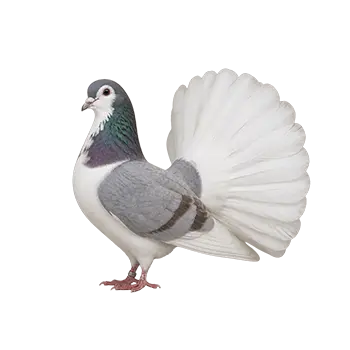
Pin feathers begin erupting through the skin between days five and eight, first along the wings and then across the back and flanks. In Fantail Pigeons, the tail feather tract is particularly noteworthy. Where most pigeon breeds develop 12 to 14 tail feathers, Fantails carry a genetic trait that produces 30 to 40 or more rectrices arranged in a broad, upright fan. The pin feathers that will eventually form this dramatic tail structure begin to appear slightly later than wing feathers and may not be clearly visible until the end of the second week.

By the end of the second week, the squab is substantially covered in emerging feather sheaths, giving it a spiky, somewhat disheveled appearance. Its legs have strengthened enough to support brief standing, though coordination remains limited. The squab will begin to preen at the feather sheaths, helping to release the emerging barbs. Weight gain remains rapid, and a healthy two-week-old Fantail Pigeon squab will typically weigh between 200 and 280 grams, a dramatic increase from its 12- to 18-gram hatch weight.

During the third week, feather development accelerates noticeably. The contour feathers break free of their sheaths across most of the body, and the characteristic Fantail plumage pattern becomes recognizable. The squab's thermoregulatory ability improves significantly with this feather coverage, and the parents will spend progressively less time directly brooding. The squab may begin to venture short distances from the nest bowl, exercising its legs and flapping its developing wings in small bursts.

Temperature & Environment

Environmental management is a life-or-death matter for newborn Fantail Pigeon squabs, particularly during the first ten days before meaningful feather coverage develops. In a parent-raised setting, the brooding adults provide the necessary warmth through direct body contact, tucking the squabs beneath their breast feathers and maintaining nearly constant coverage. The nest bowl itself plays an important supporting role by containing the squabs in a compact space where body heat is retained efficiently.

The nest bowl should be constructed or lined with materials that provide insulation without posing ingestion hazards. Clean pine needles, dried tobacco stems, or commercially available nesting pads made from compressed fiber work well. Avoid loose cotton, string, or any fibrous material that could wrap around the squab's toes or legs, causing constriction injuries. The bowl should be deep enough to prevent the squabs from rolling out but shallow enough for the parents to step in and out comfortably without crushing the young.

For hand-reared squabs or in situations where supplemental heat is needed, a brooder environment must replicate the warmth of parental brooding. Maintain temperatures between 95 and 100 degrees Fahrenheit during the first week, reducing gradually by two to three degrees every few days as feather coverage increases. By the third week, when the squab is substantially feathered, the ambient temperature can be reduced to around 80 to 85 degrees. A thermometer placed at squab level inside the brooder provides accurate readings, since temperature at the top of the enclosure can differ significantly from conditions at the floor.

Humidity matters more than many keepers realize. Low humidity causes dehydration and can impair the proper unfurling of emerging feather sheaths, while excessive moisture promotes bacterial and fungal growth on damp bedding. Aim for 50 to 60 percent relative humidity in the brooder or loft area. In dry climates or during winter months when indoor heating strips moisture from the air, a shallow pan of water placed near but not inside the brooding area can help stabilize humidity levels.

Ventilation must balance fresh air circulation against drafts. Newborn squabs are extremely sensitive to air currents, which can chill them rapidly even when the ambient temperature is adequate. The loft or brooder should provide gentle airflow without any direct drafts reaching the nest area. In loft settings, positioning the nest boxes away from windows, vents, and doorways helps protect squabs from sudden air movement while still allowing adequate air exchange for the adult birds.

Early Socialization

Fantail Pigeons have a well-earned reputation as one of the most gentle and tractable of all pigeon breeds, but this agreeable temperament still benefits enormously from thoughtful early socialization. Squabs that experience calm, positive human contact during their first weeks develop into adults that are steady in the hand, relaxed during health checks, and generally easier to manage throughout their lives. This is particularly important for Fantails destined for exhibition, where judges handle the birds closely to evaluate tail carriage, body type, and overall condition.

During the first week, socialization is minimal and should be limited to necessary husbandry tasks. The squabs are too fragile and too dependent on parental warmth for extended handling to be appropriate. Brief daily checks to confirm that both squabs in a clutch are being fed, that the nest bowl is clean, and that no injuries have occurred provide sufficient early human contact. Perform these checks calmly and efficiently, speaking softly to the parent birds so they associate your presence with routine rather than threat.

From the second week onward, as the squabs' eyes are fully open and they become more aware of their environment, gentle handling sessions of a few minutes each day help build positive associations with human contact. Cup the squab securely in both hands, supporting its body and legs, and hold it close to your chest where it can feel your warmth. Avoid sudden movements or loud voices. The goal at this stage is not training but simple habituation, teaching the squab that human hands mean safety rather than danger.

As the squabs enter their third week and beyond, handling sessions can become slightly longer and more varied. Gently spreading the tail to mimic the kind of examination that will occur at shows, turning the bird to inspect its feet and vent, and briefly extending each wing all help prepare the squab for future handling. If you keep multiple breeds, this is also the time to begin acclimating the squabs to the sounds and activities of the loft, including the cooing and wing clapping of other pigeons, the sound of feed being dispensed, and the routine of loft cleaning.

Socialization extends beyond human contact to include environmental enrichment. Placing safe, novel objects near the nest area, such as a small colored ball or a smooth stone, encourages the squab's developing curiosity. Varying the visual environment modestly, by occasionally changing the position of perches or feeders visible from the nest, helps the young bird develop adaptability. Fantails that grow up in an excessively static, unstimulating environment may become nervous or reactive when faced with the unfamiliar sights and sounds of a show hall or a new home.

Health Screening & Veterinary Care

Proactive health monitoring is essential for newborn Fantail Pigeon squabs, even in well-managed lofts with healthy breeding stock. Many of the diseases and conditions that threaten young pigeons are most treatable when caught early, and some, if missed during the critical first weeks, can cause permanent damage or become a source of ongoing infection for the rest of the flock. Establishing a relationship with a veterinarian experienced in avian or specifically columbid medicine is one of the best investments a Fantail keeper can make.

The first health assessment should occur within the first few days of life. In a loft setting, this is typically performed by the keeper rather than a veterinarian and involves a visual and tactile inspection of each squab. Check for normal body weight relative to clutch mates, a clean and intact navel area without signs of infection or incomplete yolk sac absorption, and a responsive feeding reflex. The skin should appear pinkish and hydrated, not darkened or dry. Any squab that feels noticeably lighter than its sibling, shows a distended or discolored abdomen, or fails to respond to feeding stimulation should be flagged for closer observation or veterinary evaluation.

Canker, caused by the protozoan Trichomonas gallinae, is one of the most common and dangerous diseases affecting young pigeons. It can be transmitted from parent to squab during feeding and manifests as yellowish-white cheesy plaques in the mouth, throat, or crop. In severe cases, the lesions can obstruct the airway or esophagus. Inspect the inside of each squab's beak gently during routine handling, looking for any abnormal growths or discoloration. Early treatment with an appropriate anti-protozoal medication prescribed by a veterinarian is usually effective, but advanced cases can be fatal.

Coccidiosis is another significant concern during the newborn period. Coccidia are intestinal parasites that thrive in warm, moist conditions, exactly the environment found in and around the nest bowl. Symptoms in squabs include watery or bloody droppings, poor weight gain, lethargy, and a generally unthrifty appearance. Maintaining strict nest hygiene, changing bedding frequently, and keeping the loft dry and well ventilated are the primary preventive measures. If coccidiosis is diagnosed through fecal analysis, treatment with sulfonamide-based medications is standard.

Record-keeping supports effective health management from the day the squab hatches. Log daily weights, feeding observations, dropping descriptions, and any abnormalities noted during handling. These records allow you to spot trends, such as a gradual decline in weight gain rate, that might not be apparent from a single observation. They also provide invaluable information to your veterinarian if a health issue does arise, enabling faster and more accurate diagnosis.

When to Worry

Caring for newborn Fantail Pigeon squabs means developing the ability to distinguish between normal variations in development and genuine warning signs that require intervention. Because squabs cannot vocalize distress in ways that are obvious to human caregivers, the keeper must rely on careful observation of physical appearance, behavior, feeding patterns, and droppings to assess the young bird's condition.

One of the most reliable early indicators of trouble is a change in weight gain trajectory. A healthy Fantail Pigeon squab gains weight steadily and rapidly during its first three weeks, roughly doubling its weight every two to three days during the first week and continuing to gain consistently thereafter. A squab that fails to gain weight for a full day, or that loses weight on consecutive weighings, is signaling that something is wrong. The cause may be as simple as a parent that is not feeding adequately or as serious as an infectious disease, but in either case the squab needs prompt attention.

Crop function provides another important diagnostic window. After a feeding, the crop should be visibly full and feel soft and pliable to gentle touch. A crop that remains distended and firm hours after feeding, known as crop stasis or sour crop, indicates that the contents are not moving through the digestive system normally. This can be caused by bacterial or fungal infection of the crop lining, formula that was mixed too thickly or fed at the wrong temperature in hand-reared squabs, or an underlying systemic illness. A squab with crop stasis should not be fed again until the crop has emptied, and veterinary guidance should be sought if the condition persists.

Respiratory distress in a newborn squab is always an emergency. Signs include open-mouth breathing, audible wheezing or clicking sounds, tail bobbing with each breath, and nasal discharge. These symptoms can indicate aspiration of formula during hand-feeding, a bacterial or fungal respiratory infection, or air sac disease. The squab's small body size and limited physiological reserves mean that respiratory compromise can become life-threatening within hours.

Abnormal droppings deserve close attention. Normal squab droppings during the crop-milk phase are relatively small, greenish-brown, and well formed, with a white urate cap. Watery, discolored, excessively foul-smelling, or bloody droppings all warrant investigation. Bright green or yellow urates may indicate liver dysfunction, while blood in the droppings can signal coccidiosis or another intestinal pathology. Photograph droppings if possible when seeking veterinary advice, as a visual reference is far more useful than a verbal description.

Finally, monitor the squab's general demeanor and responsiveness. A healthy newborn Fantail Pigeon squab, even with its eyes closed during the first days, responds to touch and warmth by lifting its head, rooting toward the source of contact, and displaying a vigorous feeding response when the beak area is stimulated. A squab that lies limp, fails to respond to stimulation, or feels cold to the touch despite adequate environmental temperature is in distress and needs immediate veterinary attention. In pigeon husbandry, the old adage holds true: if you think something might be wrong with a squab, it probably is, and acting quickly almost always yields better outcomes than waiting.

Always consult a qualified professional before making any health-related decisions. This content is provided for informational reference only and should not replace professional guidance specific to your animal.