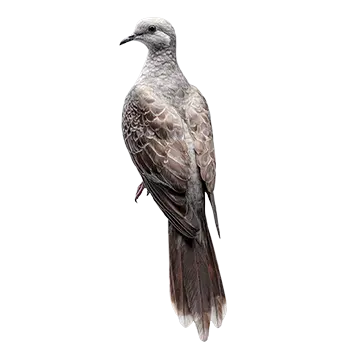

Cape Dove chicks, members of the species Oena capensis, hatch after a relatively brief incubation period of approximately 13 to 16 days. They emerge as altricial nestlings, blind and covered in sparse, pale down that offers almost no insulation. A freshly hatched Cape Dove chick typically weighs between 3 and 5 grams, making it one of the smallest dove hatchlings commonly encountered in aviculture. During these critical first hours, the chick's survival depends entirely on warmth and its first crop feeding, which establishes the digestive processes that will sustain rapid growth over the coming days.
In a parent-raised setting, both the cock and the hen participate in brooding and feeding duties almost immediately. Cape Doves produce crop milk, a protein-rich and fat-dense secretion from the lining of the crop, which forms the exclusive diet of the hatchling during its earliest days. This substance is essential not only for nutrition but also for seeding the chick's gut with beneficial microorganisms. The parents alternate brooding shifts, ensuring that the chick is almost never left unattended during this vulnerable window.
For breeders who must intervene with hand-feeding, the first feeding should be delayed until the yolk sac has been fully absorbed, which generally occurs within six to ten hours of hatching. Offering formula before absorption is complete risks overwhelming the chick's immature digestive tract. The initial feeding should consist of a very thin, well-mixed commercial hand-feeding formula formulated for doves or pigeons, delivered in extremely small volumes using a bent-tip syringe or a micropipette.
Close observation during the first day reveals much about the chick's viability. A healthy Cape Dove hatchling responds to gentle touch with a feeding reflex, holds its head upright when stimulated, and has skin that appears pinkish and well-hydrated. Any chick that feels cold to the touch, fails to gape when the beak area is stimulated, or shows a yellowish or grayish skin tone should be warmed immediately and evaluated by a veterinarian experienced with small passeriformes and columbiformes.