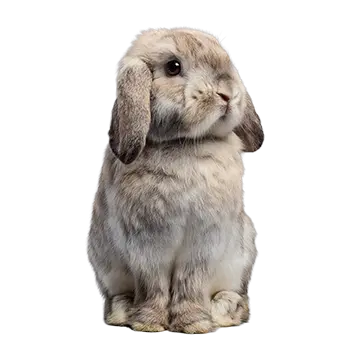
The American Fuzzy Lop presents an irresistible appearance combining the compact lop body type with wool coverage that creates an adorably fluffy visual effect. Maximum weight for show specimens is 4 pounds, with most adults ranging from 3 to 4 pounds, making them among the smaller rabbit breeds. Despite their diminutive size, well-developed American Fuzzy Lops should appear solid and well-muscled rather than frail or delicate.
The body type matches the Holland Lop standard: compact and massive, with a short, broad frame that creates a rounded appearance. When viewed from above, the body shows width throughout with no tapering toward the hindquarters. The chest is deep and full, the shoulders broad, and the hindquarters well-rounded with good depth. The short, heavily furred body sits close to the table, giving a cobby appearance that judges favor in show specimens.
The head is arguably the American Fuzzy Lop's most distinctive feature, combining bold roundness with characteristic lop ears. The skull should appear rounded from all angles, with good width between the eyes and a well-filled face. A wool cap, side trimmings, and beard furnishings frame the face with fluff while allowing the flat, bold muzzle to remain visible. The ears hang vertically alongside the head, thick, well-furred, and rounded at the tips. Ear length typically measures approximately one inch below the jaw when properly positioned.
The wool itself distinguishes American Fuzzy Lops from their Holland Lop cousins. Dense, fine fiber covers the body with guard hairs providing texture and structure to the coat. Wool should be uniform in density across the body, with good length developing between groomings. The texture is somewhat coarser than English Angora wool but remains fine enough for spinning. Facial wool creates the characteristic fuzzy appearance while leaving eyes and nose clear for comfort and function.
Color varieties in American Fuzzy Lops are extensive, grouped into categories including Agouti (chinchilla, chestnut, lynx, opal, squirrel), Pointed White, Self (black, blue, chocolate, lilac, white), Shaded (sable point, siamese sable, siamese smoke pearl, seal, smoke pearl), Wide Band (fawn, orange), and Broken (any recognized color with white). This color diversity provides options for breeders and pet owners seeking specific appearances.
Handling Tolerance
★★★★★
American Fuzzy Lops generally tolerate handling well, enjoying attention and interaction with their owners. Their small size makes them easy to handle safely, though their wool requires gentle technique to prevent pulling or matting. Most individuals accept grooming sessions necessary for coat maintenance.
Temperament
★★★★★
These charming rabbits possess playful, friendly temperaments that endear them to owners. Unlike some dwarf breeds, they rarely display aggression and typically enjoy human interaction. Their outgoing personalities and curious nature make them engaging companions who actively seek attention.
Energy Level
★★★★★
American Fuzzy Lops maintain moderate to high energy levels with playful, active personalities. They enjoy exploration, toys, and interaction, performing frequent binkies when happy. Daily exercise time allows expression of their natural enthusiasm while preventing obesity common in small breeds.
Space Requirements
★★★★★
Their compact size allows American Fuzzy Lops to thrive in moderately sized enclosures, with minimum dimensions of 24x36 inches for adults. Despite small housing needs, they still require daily exercise in larger spaces to maintain physical and mental health.
Grooming Needs
★★★★★
The wool coat of American Fuzzy Lops requires significant maintenance with brushing every 2-3 days minimum to prevent matting and wool block. Regular grooming sessions lasting 15-20 minutes keep coats manageable. While less demanding than larger Angoras, coat care exceeds normal rabbit requirements substantially.
Temperature Sensitivity
★★★★★
American Fuzzy Lops are heat-sensitive due to their wool coats, requiring climate control in warm weather. They tolerate cold well but struggle with temperatures above 75-80°F. Indoor housing with air conditioning is recommended, particularly in summer months when heat stroke risk increases.
Social Needs
★★★★★
These sociable rabbits thrive on regular human interaction and can become depressed without adequate attention. They bond closely with owners and often seek companionship actively. Daily interaction of at least 2-3 hours is recommended, with some individuals benefiting from rabbit companions.
Dietary Sensitivity
★★★★★
American Fuzzy Lops require careful dietary management due to wool block risk from ingested fiber. High-hay diets promote gut motility that helps move ingested wool through the digestive system. Any dietary changes should be made gradually to prevent GI issues common in wool breeds.