
Origins & Natural Habitat

The Yellow-Naped Amazon (Amazona auropalliata) is native to the Pacific slope of Central America, where its range extends from the southern Mexican states of Oaxaca and Chiapas southward through Guatemala, El Salvador, Honduras, Nicaragua, and into northwestern Costa Rica. The species occupies a relatively narrow ecological band compared to many of its Amazon relatives, favoring arid to semi-humid tropical deciduous forests, gallery woodlands along seasonal rivers, and edges of agricultural land at elevations generally below 600 meters. This association with the Pacific lowlands distinguishes the Yellow-Naped Amazon from other Central American parrots that tend toward the wetter Caribbean versant.

Within its range, the species has historically been found in loose flocks that gather at communal roost sites, often in tall ceiba, fig, or guanacaste trees that stand above the surrounding canopy. These roosts can hold dozens to hundreds of birds and serve as critical social hubs where pair bonds are reinforced, flock hierarchies are maintained, and young birds learn the vocalizations and behaviors of their group. The wild diet consists primarily of seeds, fruits, flowers, and bark from native trees, with seasonal shifts corresponding to the fruiting cycles of the dry tropical forest.

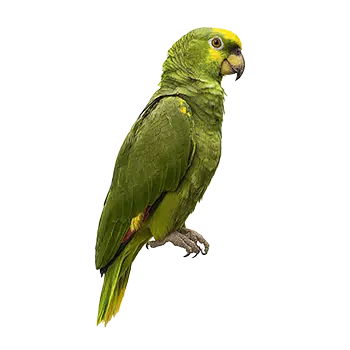
Taxonomically, the Yellow-Naped Amazon has been subject to periodic reclassification. It was long grouped as a subspecies of the Yellow-Crowned Amazon (Amazona ochrocephala) complex, alongside the Double Yellow-Headed Amazon and several other closely related forms. Molecular phylogenetic studies conducted in the late 20th and early 21st centuries supported its elevation to full species status, a designation now widely accepted by major ornithological authorities. The defining field mark is the prominent yellow patch on the nape, which develops as the bird matures and can vary considerably in extent among individuals and regional populations.

The species' preferred habitat has been under sustained pressure from deforestation, cattle ranching, and agricultural conversion, particularly in the seasonally dry forests that are among Central America's most threatened ecosystems. The combination of habitat loss and decades of capture for the pet trade has led to significant population declines across much of the Yellow-Naped Amazon's historic range, setting the stage for the conservation and legal challenges that define its modern story.

Early History with Humans

The Yellow-Naped Amazon's relationship with humans predates European contact by centuries. Indigenous peoples throughout Mesoamerica and Central America maintained complex relationships with parrots, and the Yellow-Naped Amazon's Pacific lowland range placed it squarely within the territories of cultures that valued these birds for their plumage, their vocalizations, and their roles in trade and ceremony. Archaeological evidence from pre-Columbian sites in Mexico and Guatemala has revealed parrot remains and parrot imagery associated with ritual contexts, and while specific identification to species is not always possible, the Amazon parrots of the region were clearly significant to the cultures that encountered them.

Among the Maya and other Mesoamerican civilizations, parrots held symbolic importance connected to the sun, fire, and speech. Brightly colored feathers were integral to ceremonial regalia, and the keeping of live parrots as household companions appears in colonial-era accounts of indigenous life. The Yellow-Naped Amazon, with its striking green plumage and developing yellow nape patch, would have been among the species available through local capture and regional trade networks that moved birds and feathers considerable distances across the isthmus.

Following the Spanish conquest in the 16th century, European colonists encountered the Yellow-Naped Amazon and recognized it as a particularly adept mimic. Spanish accounts from the colonial period describe parrots from the Pacific coast of Central America that could learn words and phrases with notable clarity, and these birds began to enter the European trade. Unlike the African Grey Parrot, which had already established a firm foothold in European courts by this period, the Yellow-Naped Amazon remained relatively obscure outside the Americas until the expansion of the international pet trade in the 20th century.

Through the 18th and 19th centuries, Yellow-Naped Amazons continued to be kept as companions in households throughout Central America and Mexico. They were often captured as nestlings from tree cavities and hand-raised by families who valued their companionship, vocal talent, and longevity. This tradition of local keeping established a deep cultural familiarity with the species that persists in many Central American communities to this day, even as wild populations have contracted.

Cultural Symbolism & Folklore

In the rural communities of Central America's Pacific lowlands, the Yellow-Naped Amazon occupies a place of genuine affection and cultural familiarity. The species is commonly known by regional names such as lora nuca amarilla or simply lora, and it features in local folklore as a clever, talkative companion. Stories about family parrots that learned to imitate household members, call the dog by name, or greet visitors with startling accuracy are a staple of community storytelling throughout Honduras, Nicaragua, and Costa Rica.

The parrot's gift for mimicry has given it a symbolic association with communication, memory, and social connection. In some traditions, a parrot that speaks clearly is considered a sign of a harmonious household, while a parrot that falls silent may be interpreted as an omen of disruption. These folk beliefs reflect the close observation that comes from generations of living alongside the species and speak to the emotional bond that communities have developed with their resident parrots.

In broader Latin American culture, the loro or parrot figure appears frequently in proverbs, jokes, and popular sayings. While these references are not always specific to the Yellow-Naped Amazon, the species' prominence as a household companion in the region means it is often the bird that people picture when such expressions are invoked. The image of a bright green parrot perched on a veranda railing, chattering in the afternoon heat, is deeply embedded in the cultural landscape of Pacific Central America.

The Yellow-Naped Amazon has also taken on a more contemporary symbolic role as a flagship for regional conservation efforts. As awareness of the species' declining wild populations has grown, it has become an emblem of the broader struggle to protect Central America's dry tropical forests. Conservation organizations have leveraged the parrot's charisma and cultural resonance to build support for habitat preservation and anti-poaching initiatives, transforming a beloved household companion into a rallying point for environmental stewardship.

Scientific Study & Recognition

The formal scientific description of the Yellow-Naped Amazon dates to 1842, when the species was described by the French naturalist Rene Primevere Lesson based on specimens collected from the Pacific coast of Central America. The taxonomic history that followed was complex, as ornithologists debated the boundaries between the Yellow-Naped Amazon and the other members of the Amazona ochrocephala superspecies complex. For much of the 20th century, the Yellow-Naped Amazon was treated as a subspecies of the Yellow-Crowned Amazon, a classification that obscured its distinctiveness and may have delayed conservation attention.

Molecular studies beginning in the 1990s and continuing into the 2000s clarified the phylogenetic relationships within the ochrocephala complex and provided strong support for recognizing Amazona auropalliata as a full species. This reclassification had practical consequences: as a distinct species with a more restricted range than the broader complex, the Yellow-Naped Amazon's declining population numbers became more visible and more alarming to conservation biologists. The taxonomic revision thus served as a catalyst for increased research and protective action.

Field studies of wild Yellow-Naped Amazon populations have yielded significant insights into parrot behavior, vocal learning, and social ecology. Research conducted at sites in Costa Rica and Nicaragua has documented regional vocal dialects among different populations, demonstrating that Yellow-Naped Amazons learn their contact calls from their social group rather than inheriting them genetically. This finding placed the species among a small number of non-human animals known to exhibit culturally transmitted vocal traditions, drawing parallels to human language acquisition and contributing to broader discussions of animal culture.

The species has also been the subject of long-term population monitoring studies that have tracked reproductive success, nest-site availability, and the impact of poaching on wild flocks. These demographic studies have painted a sobering picture of population decline driven by the synergistic effects of habitat destruction and nest raiding. The data generated by field researchers have been instrumental in shaping conservation policy and informing the legal protections now applied to the species across its range.

The Species Today

The Yellow-Naped Amazon is widely recognized as one of the finest talking parrots available in aviculture, a reputation that has made it consistently popular among experienced bird keepers in North America and Europe. Captive-bred Yellow-Naped Amazons are produced by established breeders, and the species is a regular presence at avian expos, bird fairs, and in the inventories of specialty bird stores. Among Amazon parrot enthusiasts, the Yellow-Naped is often ranked alongside the Double Yellow-Headed Amazon and the Blue-Fronted Amazon as the most desirable species in the genus for its vocal clarity, expressive personality, and capacity for forming deep bonds with human companions.

Living with a Yellow-Naped Amazon, however, demands a substantial commitment. These are large, long-lived parrots with powerful beaks, strong wills, and complex emotional lives. They are known for going through hormonal behavioral changes during breeding season that can include increased aggression, territorial behavior, and heightened vocalization. Experienced keepers understand these cycles as natural aspects of the species' biology and manage them through environmental adjustments, behavioral strategies, and patience rather than punishment.

The captive care community has developed a sophisticated body of knowledge around Yellow-Naped Amazon husbandry. Dietary recommendations emphasize high-quality pellets supplemented with fresh vegetables, fruits, and limited seeds, moving away from the seed-heavy diets that once contributed to obesity, fatty liver disease, and vitamin A deficiency in captive Amazons. Enrichment protocols stress the importance of foraging opportunities, destructible toys, and social interaction to meet the bird's cognitive and emotional needs.

Despite the species' popularity in aviculture, the wild population continues to face serious threats. The International Union for Conservation of Nature lists the Yellow-Naped Amazon as Vulnerable, with population trends assessed as decreasing. In several parts of its range, particularly in Honduras and Nicaragua, wild flocks have been reduced to small, fragmented groups. Conservation breeding programs, habitat restoration projects, and community-based protection initiatives represent the primary strategies for securing the species' future in the wild, while the captive population in aviculture continues to thrive under the care of dedicated keepers and breeders.

Notable Individuals & Legacy

While the Yellow-Naped Amazon has not produced a single individual as universally famous as the African Grey's Alex, the species has been represented by numerous birds whose vocal talents and personalities have attracted public attention and advanced awareness of Amazon parrot capabilities. Among aviculturists and parrot enthusiasts, stories of individual Yellow-Naped Amazons with extensive vocabularies, operatic singing abilities, and uncanny timing in their verbal interactions are common and contribute to the species' elite reputation among talking birds.

Several Yellow-Naped Amazons have gained recognition through viral video clips and social media posts that showcase the species' vocal range. These birds have demonstrated abilities including singing entire songs with recognizable melody and rhythm, engaging in what appear to be contextual conversations with their owners, and reproducing environmental sounds such as telephone rings, microwave beeps, and laughter with startling fidelity. While individual birds vary in their aptitude and motivation to talk, the Yellow-Naped Amazon's best performers rival any parrot species for vocal clarity and expressiveness.

In the field of parrot rescue and adoption, Yellow-Naped Amazons are among the most commonly surrendered Amazon species, a reflection of both their popularity and the challenges of living with a large, long-lived, and emotionally complex parrot. Rescue organizations and sanctuaries have become important advocates for the species, educating the public about the realities of Amazon parrot ownership and providing permanent homes for birds whose original keepers could no longer care for them. The stories of rescued Yellow-Naped Amazons that have recovered from neglect or behavioral issues and formed new bonds with caregivers are powerful testaments to the species' resilience and emotional capacity.

The Yellow-Naped Amazon's legacy is one of a species that bridges the wild and the domestic in ways that illuminate both the wonders and the responsibilities of keeping intelligent animals as companions. Its vocal gifts have brought joy to countless households, its declining wild populations have galvanized conservation efforts across Central America, and its complex behavioral needs have pushed aviculture toward higher standards of care. Whether perched in a ceiba tree on the Nicaraguan coast or on a play stand in a suburban home, the Yellow-Naped Amazon continues to command attention, affection, and respect.

Always consult a qualified professional before making any health-related decisions. This content is provided for informational reference only and should not replace professional guidance specific to your animal.