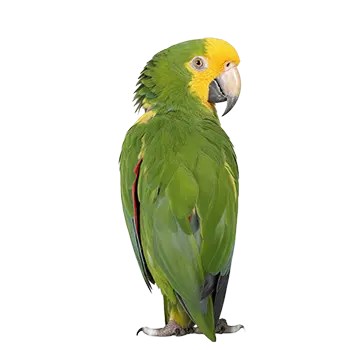

The Yellow-Crowned Amazon (Amazona ochrocephala) is a medium-sized parrot native to a vast swath of the Neotropical lowlands, ranging from southern Mexico through Central America and across much of northern South America, including Panama, Colombia, Venezuela, Trinidad, the Guianas, Ecuador, Peru, Bolivia, and Brazil. The species inhabits a variety of forested and semi-open landscapes, from humid tropical forests and gallery woodlands along rivers to savanna edges, mangrove fringes, and cultivated areas where scattered tall trees provide roosting and nesting sites. This ecological flexibility has made the Yellow-Crowned Amazon one of the more adaptable members of its genus, allowing it to persist in landscapes that have been substantially altered by human activity.
Taxonomically, the Yellow-Crowned Amazon has been the subject of considerable debate among ornithologists. Historically treated as a single wide-ranging species with numerous subspecies, recent molecular and morphological analyses have led several authorities to split the complex into multiple species. The Yellow-Naped Amazon (Amazona auropalliata) and the Yellow-Headed Amazon (Amazona oratrix), both formerly considered subspecies or close relatives within the ochrocephala group, are now widely recognized as distinct species. The taxonomy remains fluid, and ongoing genetic studies continue to refine the boundaries within this complex. For the purposes of cultural and historical discussion, the Yellow-Crowned Amazon is understood here in its more traditional sense, encompassing the populations centered on the nominate form.
In the wild, Yellow-Crowned Amazons are gregarious birds that form flocks ranging from small family groups to large communal assemblies, particularly at favored roosting sites. Their diet consists primarily of seeds, fruits, nuts, berries, and blossoms gathered from the forest canopy and adjacent agricultural lands. Nesting typically occurs in natural tree cavities, often in tall, mature trees that provide protection from predators. Pairs are monogamous and often remain bonded for many years, a trait that has long been noted by indigenous observers and later by European naturalists.
The species' broad range and relative abundance historically shielded it from the most acute pressures of habitat loss and capture, though localized declines have been documented in regions where deforestation and trapping have been particularly intense. In some parts of Central America, wild populations have diminished noticeably over the past several decades, prompting conservation attention. The Yellow-Crowned Amazon's ecological story is one of resilience tempered by vulnerability, a pattern that has shaped its interactions with human societies for centuries.