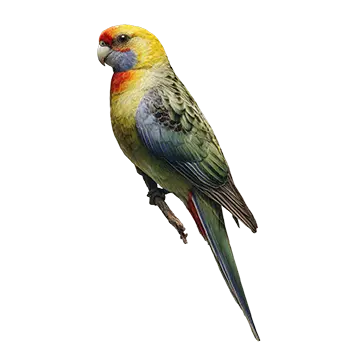

The Green Rosella (Platycercus caledonicus) is the largest member of the rosella genus and is endemic to Tasmania, the island state situated off the southeastern coast of the Australian mainland. The species also inhabits several islands in the Bass Strait, including King Island and the Furneaux Group, though its stronghold remains the Tasmanian mainland itself. Its range encompasses a remarkable variety of habitats, from dense temperate rainforest and wet eucalypt forest at higher elevations to drier woodland, farmland edges, orchards, and suburban parks at lower altitudes.
Tasmania's long geological separation from the Australian continent, which became definitive as rising sea levels flooded the Bass Strait land bridge roughly 10,000 to 12,000 years ago, played a decisive role in the Green Rosella's evolutionary trajectory. Isolated from the mainland rosella populations, the species diverged along its own path, developing the distinctive combination of vivid yellow underparts, green-washed back and wings, blue cheek patches, and a red frontal band that distinguish it from all other rosellas. Its larger body size relative to its mainland relatives is consistent with patterns observed in other Tasmanian fauna and may reflect adaptation to the island's cooler, more temperate climate.
The species thrives across a broad elevational range, from coastal lowlands to montane forests above 1,200 meters. It feeds on a varied diet that includes native seeds, berries, blossoms, and insects, and it readily exploits agricultural crops and garden plantings where its range overlaps with human settlement. This dietary flexibility has helped the Green Rosella maintain relatively stable populations even as land use patterns across Tasmania have shifted over the past two centuries.
Ecologically, the Green Rosella occupies a niche similar to that of Eastern and Crimson Rosellas on the mainland, filling the role of a medium-large seed-and-fruit-eating parakeet in Tasmania's forest and woodland ecosystems. Its nesting habits are typical of the genus, with pairs selecting hollows in mature eucalyptus trees for breeding. The availability of suitable tree hollows remains an important factor in the species' long-term population health, particularly in areas where old-growth forests have been logged or cleared.