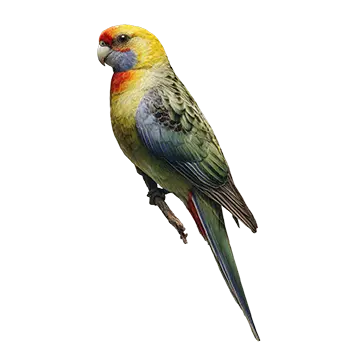

Natural History Illustration

The Green Rosella's striking combination of yellow, green, and blue plumage made it an irresistible subject for the natural history artists of the 18th and 19th centuries. Among the earliest European depictions of the species were illustrations produced by artists attached to French and British expeditions to the southern seas. These early works, often rendered in watercolor and later engraved for publication, served as the primary means by which European audiences encountered Tasmania's unique birdlife at a time when photography did not yet exist.

The most celebrated depiction of the Green Rosella from this era is the plate produced by John Gould for his monumental The Birds of Australia, published in the 1840s. Gould, working in collaboration with his wife Elizabeth and other skilled lithographers, created an image of the Green Rosella that combined scientific accuracy with artistic elegance, capturing the species' distinctive plumage pattern and posture in a composition that remains widely reproduced to this day. Gould's plate established a visual template for the species that influenced subsequent illustrators for generations.

Other significant contributions to the artistic record of the Green Rosella came from colonial-era Australian naturalists and artists who documented the island's wildlife in field notebooks, museum collections, and published volumes. These works, though less famous than Gould's, collectively built a rich visual archive that historians and ornithologists continue to consult. The tradition of painting and illustrating Australian parrots, of which the Green Rosella is a distinctive part, remains vibrant today, with contemporary wildlife artists working in both traditional and digital media.

The Green Rosella's prominence in the history of natural history illustration reflects both its visual appeal and the broader significance of Tasmania as a destination for scientific exploration. The island's geographic isolation and ecological uniqueness drew naturalists who recognized the importance of documenting species found nowhere else, and the Green Rosella, as one of the most conspicuous and colorful of those species, received a disproportionate share of artistic attention.

Wildlife Documentary & Photography

The Green Rosella has featured in numerous wildlife documentaries and photographic projects focused on Tasmanian and Australian fauna. Television programs exploring the natural history of Tasmania routinely include footage of the species, often filmed in the island's temperate rainforests, eucalypt woodlands, or suburban gardens where the birds are most easily observed. The species' approachable nature in habituated settings makes it a cooperative subject for filmmakers seeking vivid footage of Australian birdlife.

Australian and international natural history series have showcased the Green Rosella as part of broader narratives about island evolution and endemism. Programs that examine Tasmania's unique ecological character frequently use the Green Rosella alongside other island endemics such as the Tasmanian Devil and the Forty-spotted Pardalote to illustrate the concept of species found nowhere else on earth. In these contexts, the Green Rosella serves as a colorful and accessible example of the evolutionary processes that produce distinct island fauna.

Wildlife photography has been another important medium through which the Green Rosella has reached wider audiences. Professional and amateur photographers visiting Tasmania consistently rank the species among the most photogenic birds on the island, and images of Green Rosellas appear frequently in birdwatching field guides, nature magazines, and online galleries. The rise of digital photography and social media platforms has amplified this visibility, with birdwatchers and tourists sharing images of Green Rosellas in settings ranging from Cradle Mountain to suburban Hobart.

The species also appears in photographic identification resources and mobile birding applications used by the growing community of Australian birdwatchers. These digital tools, which combine images, range maps, and audio recordings, have made the Green Rosella recognizable to a much broader audience than traditional field guides alone could reach, contributing to the species' increasing profile in recreational birding culture.

Literature & Print Media

The Green Rosella has appeared in Australian literature and print media in a variety of contexts, from scientific treatises and field guides to travel writing, nature essays, and children's educational materials. Early colonial accounts of Tasmania, written by settlers, explorers, and administrators, frequently mentioned the island's colorful parrots, and the Green Rosella was often singled out for its beauty and its habit of raiding orchards. These descriptions, though sometimes tinged with the agricultural frustrations of their authors, helped establish the species in the literary record of European Australia.

In the 20th century, the Green Rosella appeared in the growing body of Australian natural history writing aimed at general audiences. Authors such as Alec Chisholm, whose works on Australian birdlife reached wide readership, included the Green Rosella in their accounts of the country's parrot diversity. More recently, nature writers exploring Tasmania's wilderness have used the Green Rosella as a touchstone species, its presence in the forest canopy serving as a marker of ecological health and a connection to the island's ancient landscapes.

Children's books and educational publications produced in Australia have also featured the Green Rosella as part of efforts to teach young readers about the country's unique wildlife. These materials typically emphasize the species' Tasmanian endemism and its colorful appearance, making it an effective vehicle for introducing concepts such as island biogeography and species conservation to younger audiences.

In print journalism, the Green Rosella surfaces periodically in articles about Tasmanian wildlife, conservation issues, and birdwatching tourism. Feature stories in Australian newspapers and magazines have profiled the species as part of broader coverage of Tasmania's natural attractions, and the bird appears in tourism-oriented publications that promote the island as a destination for nature lovers. While not the subject of a dedicated literary tradition, the Green Rosella maintains a steady and meaningful presence across Australian print culture.

Tourism & Branding

The Green Rosella occupies a notable place in the branding and marketing of Tasmania as a nature tourism destination. Tourism Tasmania and various regional tourism bodies have used images of the species in promotional campaigns, brochures, and digital content designed to showcase the island's unique wildlife. The bird's vivid plumage photographs well and communicates the idea of Tasmania as a place of distinctive and unspoiled natural beauty, making it a practical choice for visual marketing.

Birdwatching tourism, which has grown significantly in Tasmania over the past two decades, has elevated the Green Rosella's profile as a target species for visiting birders. The species regularly appears on lists of must-see Tasmanian birds published by birdwatching tour operators and guide services. For international birdwatchers compiling Australian species lists, the Green Rosella represents a bird that can only be ticked in Tasmania, giving it an outsized appeal relative to its ecological rarity. This dynamic has made the species a minor but real driver of ecotourism revenue for the island.

Local businesses in Tasmania have also adopted the Green Rosella as a branding element. The bird's image appears on the signage, packaging, and marketing materials of enterprises ranging from bed-and-breakfasts and nature lodges to artisanal food producers and craft breweries. In these contexts, the Green Rosella functions as a shorthand for Tasmanian identity, local authenticity, and a connection to the natural environment that many island businesses seek to emphasize.

The species' role in tourism branding extends to the digital sphere, where tourism websites, social media accounts, and travel review platforms feature Green Rosella imagery contributed by both professional marketers and visiting tourists. This organic accumulation of visual content has reinforced the bird's status as one of Tasmania's most recognizable wildlife ambassadors, bridging the gap between formal marketing campaigns and the personal experiences of individual travelers.

Online Communities & Citizen Science

The rise of online birdwatching communities and citizen science platforms has given the Green Rosella a significant digital presence that extends well beyond Tasmania. Platforms such as eBird, iNaturalist, and various regional birding forums host thousands of sighting records, photographs, and audio recordings of the species contributed by amateur and professional observers. These data have proven valuable not only for recreational birders tracking their sightings but also for researchers monitoring the species' distribution and population trends over time.

Social media has further amplified the Green Rosella's visibility. Birdwatching groups on platforms such as Facebook and Instagram regularly feature images and videos of the species, often accompanied by observations about behavior, plumage variation, and habitat use. These posts generate engagement from birders around the world, many of whom express aspirations to visit Tasmania and see the species in person. The Green Rosella's photogenic qualities make it well suited to the visual culture of social media, and images of the bird feeding in garden settings or perched in flowering eucalyptus trees are consistent sources of high engagement.

Citizen science projects focused on Australian birdlife have specifically benefited from data contributed on the Green Rosella. The Birdata platform, managed by BirdLife Australia, and the annual Aussie Backyard Bird Count both collect sighting data that include the Green Rosella as a regularly reported species in Tasmania. These programs engage thousands of participants and provide researchers with a broad geographic and temporal dataset that complements formal survey efforts.

Online forums dedicated to aviculture and parrot keeping also discuss the Green Rosella, though the species' relative rarity in captivity outside Australia means that these discussions are less voluminous than those focused on more common pet parrot species. Nevertheless, aviculture enthusiasts share information about the species' dietary needs, breeding behavior, and housing requirements, contributing to a modest but dedicated body of online knowledge about the Green Rosella in captive settings.

Stamps, Currency & Collectibles

Like many distinctive Australian bird species, the Green Rosella has appeared on postage stamps, contributing to a long tradition of featuring native fauna on philatelic material. Australia Post has periodically issued stamp series celebrating the country's parrot diversity, and the Green Rosella has been included in these collections as the representative of Tasmania's endemic avifauna. These stamps, which circulate domestically and internationally, serve as miniature ambassadors for the species, introducing it to audiences who may never visit the island.

Beyond official postage, the Green Rosella has appeared on collectible items produced by wildlife conservation organizations, nature societies, and commercial enterprises. Pins, patches, and enamel badges depicting the species are available through birdwatching organizations and nature-themed retailers, and they are popular among birders and wildlife enthusiasts who collect such items as mementos of species observed in the field. The species' distinctive color palette makes it particularly well suited to these small-format reproductions.

Australian coinage and currency have featured native wildlife extensively over the decades, and while the Green Rosella has not appeared on circulating currency, commemorative and collector coins celebrating Australian birdlife have occasionally included rosella species. The broader rosella genus, with its vivid plumage and widespread public recognition, is a natural choice for such programs, and the Green Rosella's Tasmanian exclusivity gives it particular appeal for limited-edition or state-themed issues.

The species also features in the growing market for wildlife-themed art prints, calendars, and home decor products. Tasmanian artists and photographers sell Green Rosella imagery through galleries, markets, and online platforms, reaching consumers who appreciate the bird's visual appeal and its connection to Tasmania's natural identity. Collectively, these appearances across stamps, collectibles, and consumer products ensure that the Green Rosella maintains a cultural presence that extends well beyond the boundaries of its island home.

Always consult a qualified professional before making any health-related decisions. This content is provided for informational reference only and should not replace professional guidance specific to your animal.