
Origins & Natural Habitat

The Eastern Rosella (Platycercus eximius) is a broad-tailed parrot native to the open woodlands, grasslands, and forest margins of southeastern Australia, including Tasmania. Its range extends from southeastern Queensland through New South Wales and Victoria and into the southeastern corner of South Australia. Three subspecies are generally recognized: the nominate P. e. eximius of southeastern New South Wales and northeastern Victoria, P. e. elecica of northeastern New South Wales and southeastern Queensland, and the Tasmanian subspecies P. e. diemenensis, which is slightly larger and displays more vivid plumage than its mainland relatives.

The species favors lightly timbered country, particularly eucalypt woodlands interspersed with open grassy areas where it forages on the ground for seeds, grasses, and herbaceous plants. Eastern Rosellas are also frequent visitors to cultivated farmland, orchards, and suburban parks and gardens, a habit that has brought them into close contact with human populations for centuries. They nest in natural tree hollows, a requirement that ties their breeding success directly to the availability of mature trees in the landscape.

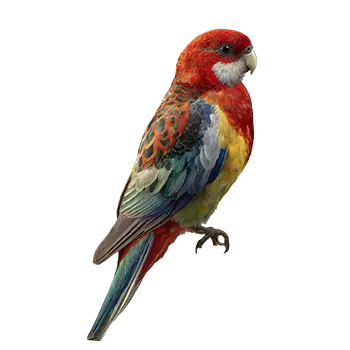
Unlike many parrots that congregate in large flocks, Eastern Rosellas are typically seen in pairs or small family groups, occasionally gathering in larger numbers at productive feeding sites or water sources. This relatively dispersed social structure, combined with the species' vivid patchwork of red, yellow, green, blue, and black plumage, makes individual birds conspicuous and memorable in the Australian bush. The striking coloration has been central to the bird's cultural identity since long before European settlement.

The Eastern Rosella's ecological flexibility has served it well in the face of landscape change. While land clearing has reduced the availability of nesting hollows in some areas, the species has adapted readily to modified environments, including agricultural land and urban fringes. This adaptability, combined with its natural beauty, positioned it as one of the first Australian parrots to attract the sustained attention of both Indigenous Australians and European colonists.

Early History with Humans

Aboriginal Australians have lived alongside the Eastern Rosella for tens of thousands of years, and the bird features in the ecological knowledge and oral traditions of many southeastern Aboriginal communities. Indigenous Australians possessed an intimate understanding of the rosella's seasonal movements, breeding habits, and dietary preferences, knowledge embedded in broader systems of land management that shaped the very woodlands the bird inhabits. Fire-stick farming, practiced by Aboriginal groups to manage grasslands and promote new growth, indirectly maintained the mosaic of open and wooded habitats that Eastern Rosellas depend on.

The species entered the European record during the earliest years of British colonization. The name "rosella" itself is believed to derive from "Rose Hill" or "Rosehill," a settlement near what is now the Sydney suburb of Parramatta, where colonists first encountered these colorful parrots in the late 18th century. The birds were initially referred to as "Rose Hillers" or "Rosehillers," a name that was gradually shortened and softened to "rosella" over the following decades. This etymological origin ties the Eastern Rosella's common name directly to the geography and history of early colonial New South Wales.

European naturalists were quick to take notice of the Eastern Rosella's spectacular plumage. George Shaw, the English zoologist, formally described the species in 1792, making it one of the first Australian parrots to receive a scientific name. Specimens and live birds were shipped to Britain and continental Europe throughout the late 18th and early 19th centuries, where they generated considerable excitement among ornithologists and the aristocratic collectors who maintained private menageries. The Eastern Rosella became a symbol of the exotic natural wealth of the Australian continent.

By the mid-19th century, Eastern Rosellas were being bred in captivity in Europe, and the species had established itself as a desirable aviary bird among the growing community of aviculturists. The combination of manageable size, hardy constitution, and breathtaking coloration made it accessible to a broader range of keepers than the larger and more demanding cockatoos and macaws. This early popularity laid the groundwork for the Eastern Rosella's enduring presence in aviculture worldwide.

Cultural Symbolism & Folklore

In the cultural traditions of Aboriginal Australians, the Eastern Rosella occupies a place within a broader web of meaning that connects animals, landscape, and spiritual practice. Among some southeastern Aboriginal groups, brightly colored parrots are associated with particular Dreamtime narratives that explain the origins of their plumage. While specific stories vary between communities and many have not been widely published out of respect for cultural ownership, the rosella's vibrant colors have long been understood as carrying symbolic weight, representing themes of beauty, transformation, and the interconnectedness of living things.

For European settlers in Australia, the Eastern Rosella quickly became an emblem of the new land's natural splendor. Its image appeared on colonial-era natural history illustrations, postcards, and decorative objects, serving as a visual shorthand for the beauty and strangeness of the Australian bush. The bird's bold red, yellow, and blue plumage made it a favorite subject for artists and illustrators, and its likeness was reproduced on everything from porcelain to postage stamps throughout the 19th and 20th centuries.

The Eastern Rosella also became woven into the everyday language and culture of rural Australia. Farmers and bushmen developed a pragmatic but often affectionate relationship with the species, even as rosellas raided orchards and grain crops. The bird's familiar call and flash of color became part of the sensory fabric of the Australian countryside, and its presence was regarded by many as a reliable sign of healthy woodland habitat. In suburban areas, the Eastern Rosella's willingness to visit garden feeders brought it into the domestic sphere in a way that few other native parrots matched.

In modern Australia, the Eastern Rosella retains its symbolic association with the natural landscape. It features in regional branding, conservation messaging, and environmental education materials, often serving as an accessible representative of the broader diversity of Australian birdlife. The species' cultural resonance is not dramatic or mythologized in the way of some larger parrots, but it is deeply rooted in the lived experience of Australians who encounter it daily in parks, gardens, and rural properties.

Scientific Study & Classification

The Eastern Rosella holds an early place in the scientific documentation of Australian birdlife. George Shaw's 1792 description established the species within the framework of European taxonomy, and subsequent ornithologists refined its classification as knowledge of Australian parrots expanded throughout the 19th century. The genus name Platycercus, meaning "flat-tailed" or "broad-tailed," reflects the distinctive fan-shaped tail that characterizes all rosellas and distinguishes them from other Australian parakeets. The specific epithet eximius, meaning "excellent" or "extraordinary," speaks to the immediate impression the bird's plumage made on early European naturalists.

Taxonomic work on the rosella group has a long and sometimes contentious history. The genus Platycercus encompasses several closely related species, including the Crimson Rosella, the Western Rosella, the Pale-headed Rosella, and the Northern Rosella, among others. Determining species boundaries within this group has been complicated by zones of hybridization where the ranges of different rosellas overlap, particularly between the Eastern and Pale-headed Rosellas in southeastern Queensland. Genetic studies conducted in recent decades have helped clarify these relationships, generally supporting the treatment of the Eastern Rosella as a distinct species while revealing the relatively recent evolutionary divergence among rosella taxa.

Behavioral and ecological research on Eastern Rosellas has contributed to broader understandings of parrots as a group. Studies of the species' breeding biology have documented its dependence on tree hollows and the competitive dynamics that arise when hollows are scarce, a concern that extends across many Australian cavity-nesting birds. Research into the rosella's diet, movement patterns, and responses to habitat modification has informed conservation and land management strategies in southeastern Australia, particularly in peri-urban landscapes where native woodland and suburban development intersect.

While the Eastern Rosella has not attracted the intensity of cognitive research directed at species like the African Grey Parrot or the kea, aviculturists and researchers have documented a range of problem-solving behaviors and social learning in captive populations. The species' intelligence, though less celebrated than that of some parrots, is sufficient to make it an engaging companion and a responsive subject in aviary-based behavioral studies. Ongoing research into rosella vocalizations and social structure continues to add depth to the scientific understanding of this familiar Australian parrot.

The Breed Today

The Eastern Rosella is one of the most widely kept and readily available parrots in aviculture today. Captive breeding programs spanning Europe, North America, Asia, and of course Australia produce large numbers of birds annually, and the species is a common sight at bird shows, avian expos, and in the inventories of specialty breeders. Several color mutations have been established in captivity, including lutino, cinnamon, blue, and pied varieties, expanding the palette of an already spectacularly colored bird and adding to its appeal among aviculturists who enjoy selective breeding.

In Australia, the Eastern Rosella occupies a unique position as both a wild native species and a popular aviary bird. Wild populations remain robust across much of the species' historical range, and the bird is a familiar presence in suburban gardens, public parks, and agricultural districts. The provision of nest boxes by conservation groups and private landholders has helped offset the loss of natural tree hollows in some areas, supporting breeding success in modified landscapes. Introduced populations of Eastern Rosellas have also become established in New Zealand, where the species was released or escaped from captivity in the 19th and early 20th centuries and now breeds freely in parts of the North Island.

As a companion bird, the Eastern Rosella is valued for its beauty, its relatively manageable size, and its active, inquisitive temperament. It is not typically a strong talker, but many individuals learn to whistle tunes and some acquire a small vocabulary of words or phrases. The species does best in spacious aviaries or large flight cages where it can exercise and forage, and keepers prize its hardiness and adaptability to a range of climatic conditions. Its dietary needs are well understood, centering on a mix of quality seed, fresh fruits and vegetables, and supplementary pellets.

The Eastern Rosella's accessibility and forgiving nature have made it a popular choice for both novice and experienced bird keepers. Unlike some of the larger, more emotionally demanding parrots, the Eastern Rosella can thrive with regular but not constant human interaction, making it suitable for keepers who may not be able to provide the intensive socialization required by species like cockatoos or African Greys. This combination of beauty, hardiness, and temperamental practicality has secured the Eastern Rosella's place as a staple of the global aviculture community.

Notable Individuals & Legacy

The Eastern Rosella, unlike some of the more flamboyant talking parrots, has not produced individual celebrities in the mold of Alex the African Grey or Snowball the dancing cockatoo. Its cultural legacy is built instead on a collective presence: the millions of wild rosellas that populate the Australian landscape and the countless captive birds that have brought color and life to aviaries and homes on every inhabited continent. This distributed legacy is in many ways more representative of the species' true significance than any single famous individual could be.

Historical specimens of Eastern Rosellas held in the natural history museums of London, Paris, and Leiden stand as tangible links to the earliest days of European engagement with Australian wildlife. Some of these specimens date to the late 18th and early 19th centuries and were collected during the voyages and expeditions that first brought Australian birds to the attention of the scientific world. They remain valuable reference material for taxonomists and serve as reminders of the pivotal role the Eastern Rosella played in shaping European perceptions of the Australian avifauna.

In the world of aviculture, particular breeding lines of Eastern Rosellas have achieved recognition for their contribution to the development of color mutations and the refinement of captive husbandry practices. Breeders who pioneered the lutino and blue mutations in the mid-20th century are remembered within avicultural circles for their patience and skill, and their work established standards that continue to guide selective breeding today. These contributions, though not widely known outside the hobby, represent a significant chapter in the Eastern Rosella's relationship with humans.

The Eastern Rosella's legacy ultimately rests on its enduring presence in the Australian landscape and its ability to adapt to a changing world. It is a bird that has survived the upheaval of European colonization, the clearing of its native woodlands, and the pressures of the modern pet trade, emerging as one of the most familiar and accessible representatives of Australia's extraordinary parrot diversity. For millions of Australians, the flash of red, yellow, and blue in a backyard tree remains one of the most immediate and personal connections to the country's native wildlife.

Always consult a qualified professional before making any health-related decisions. This content is provided for informational reference only and should not replace professional guidance specific to your animal.