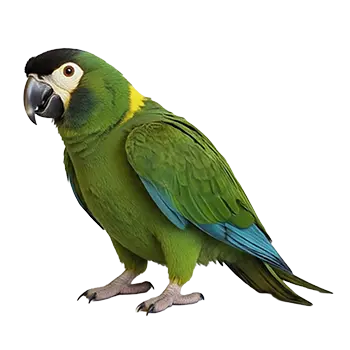

The Yellow-Collared Macaw is a compact but remarkably active bird that requires considerably more cage space than its fifteen-inch body length might suggest. While this species is classified among the mini macaws, its energy level, wing-flapping habits, and acrobatic play style demand an enclosure that allows genuine movement rather than merely enough room to turn around and stretch. The minimum recommended cage size for a single Yellow-Collared Macaw is thirty inches wide by twenty-four inches deep by thirty-six inches tall, but experienced keepers consistently recommend going larger whenever space and budget allow.
Width and depth matter more than height for this species. Yellow-Collared Macaws are horizontal movers and climbers rather than primarily vertical birds, and they use cage width to hop, swing, and traverse between perches and toys. A cage that is tall but narrow forces the bird into a cramped lateral space and limits the variety of perch placements and toy stations that can be installed without creating an obstacle course. A flight cage or double-wide configuration provides the most functional living space, especially for birds that spend significant portions of the day in their enclosure while their owners are at work.
Door design is a practical consideration that many first-time owners overlook. Yellow-Collared Macaws are intelligent and dexterous, and they quickly learn to manipulate simple latches, spring-loaded doors, and slide-up openings. A cage with doors that the bird can open unsupervised creates obvious safety hazards in the home. Look for cages with locking mechanisms that require a deliberate two-step action to open, such as a push-and-slide or a clasp that folds over a pin. Some owners retrofit standard cage doors with small padlocks or carabiner clips as an additional security measure.
The cage bottom should be a removable tray that slides out for daily cleaning without requiring the owner to reach inside the cage or disturb the bird. Grated bottoms that elevate the bird above its droppings and discarded food are hygienic in principle, but the grate must be sturdy enough to support the bird comfortably if it climbs down, and the spacing must be narrow enough that toes cannot become trapped. Some owners prefer to remove the grate entirely and line the tray with paper or a bird-safe substrate, which simplifies cleaning and allows the bird to forage safely on the cage floor.