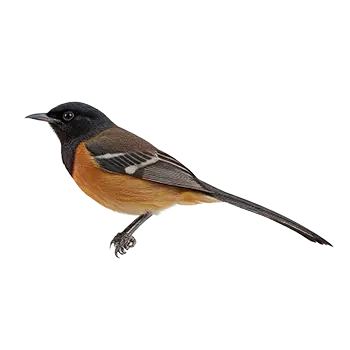

The Shama Thrush is an active, territorial bird that demands considerably more enclosure space than its modest body size might suggest. In the wild, male White-rumped Shamas defend territories that span significant stretches of forest understory, moving through dense vegetation with rapid, agile flight and frequent ground-level foraging. A captive enclosure must accommodate this behavioral profile by providing enough vertical and horizontal space for sustained flight, ground-level activity, and territorial display. Housing that restricts these natural behaviors leads to feather damage, chronic stress, vocal suppression, and a bird that never achieves its full physical or behavioral potential.
Unlike parrots, which often adapt to relatively compact cages by climbing and occupying perches for extended periods, the Shama is a bird of movement. It hops rapidly along the ground, launches into short darting flights between perches, and fans its long tail in elaborate display postures that require clearance on all sides. The enclosure must be long enough for the bird to fly from one end to the other in a sustained glide, tall enough for it to perch at varying heights, and deep enough that the tail does not contact the rear wall during turning movements. These spatial requirements make the Shama a poor candidate for standard small-bird cages and push housing choices toward flight cages or small aviaries.
Territoriality is another factor that shapes housing decisions. Male Shamas in particular are intolerant of other males within their visual and auditory range, and even females may be harassed outside of the breeding season. This means that each adult bird generally requires its own enclosure, and if multiple Shamas are kept in the same room, visual barriers between cages may be necessary to prevent stress-related behavior. Breeding pairs can be housed together during the breeding season in a sufficiently large enclosure, but the keeper must be prepared to separate them if aggression becomes problematic.
The enclosure's location within the home or bird room matters as much as its dimensions. Shamas are sensitive to disturbance and perform best in quiet areas with consistent routines. Placement away from high-traffic zones, loud appliances, and direct drafts allows the bird to settle into a predictable daily rhythm of singing, feeding, and rest. A room with natural light exposure, supplemented by full-spectrum artificial lighting if necessary, supports normal circadian rhythms and hormonal regulation.