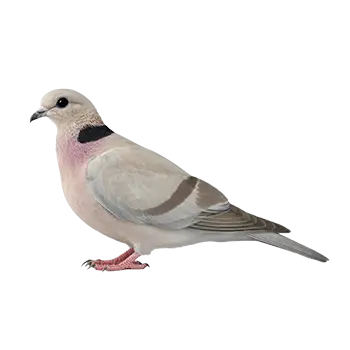

Ring-Necked Doves are horizontal fliers that navigate their environment in level, sweeping flight paths rather than the vertical climbing and acrobatic maneuvering typical of parrots. This fundamental behavioral difference dictates the shape and proportions of appropriate housing. A tall, narrow cage that would suit a climbing parrot is functionally inadequate for a dove, which needs unobstructed horizontal space to move from perch to perch with short glides. Every housing decision for this species should be evaluated through the lens of how it supports or restricts this natural flight pattern.
Space requirements for Ring-Necked Doves are often underestimated by first-time owners. While doves are not large birds, their flight-oriented locomotion means they require more floor area and width than a comparably sized parrot would. A single dove should be housed in an enclosure no smaller than thirty-two inches wide, twenty inches deep, and twenty inches tall, though larger is always better. A pair of doves needs proportionally more space, and breeding pairs require additional room for nesting. These minimums assume the bird receives regular out-of-cage time; permanently caged birds need significantly larger enclosures.
The social nature of Ring-Necked Doves adds another dimension to housing planning. These birds form strong pair bonds and generally thrive in the company of another dove. Housing a single dove means the owner must provide substantial daily interaction to compensate for the absence of a companion, and even attentive owners may find that a lone dove displays signs of loneliness over time. Planning housing for a pair from the outset is often the wiser long-term investment, both for the birds' welfare and for the practical reality that many owners eventually acquire a second dove.
Ventilation and air quality within and around the enclosure are critical health considerations. Doves produce a fine powder down that can accumulate in enclosed spaces and contribute to respiratory issues in both the birds and their human housemates. The enclosure should be positioned where air circulates freely but without direct drafts, which can cause chilling. Proximity to kitchens, where cooking fumes and nonstick cookware off-gassing present toxic hazards, should be avoided entirely.