Ring-Necked Dove Species Guide - Furry Critter Network

Ring-Necked Dove

Quick Facts

๐Ÿ”ฌ Scientific Name
Streptopelia risoria
๐Ÿ“Š Care Level
Beginner
๐Ÿ˜Š Temperament
Gentle, Docile, Social
๐Ÿ“ Adult Size
11-12 inches
โฑ๏ธ Lifespan
10-15 years (up to 25+ years)
๐Ÿ”Š Noise Level
Low to Moderate
๐Ÿ—ฃ๏ธ Talking Ability
None
๐Ÿฝ๏ธ Diet Type
Seed-based
๐ŸŒ Origin
Domesticated (derived from African Collared Dove)
๐Ÿ  Min Cage Size
24x18x30 inches for a pair
๐Ÿ“ Size
Medium

Ring-Necked Dove - Names & Recognition

The Ring-Necked Dove carries several common names that reflect its long history in human care and its distinctive physical features. Most frequently called the Ring-Necked Dove or Ringneck Dove in North America, this species is also widely known as the Barbary Dove, a name that references its presumed North African origins. Other regional names include Barbary Turtle Dove, Cape Turtle Dove, and Java Dove, though the latter name can cause confusion with other species. In scientific literature, it may occasionally be referred to as the Collared Dove, though this name more properly belongs to its wild relatives.

The scientific name Streptopelia risoria was assigned by Carl Linnaeus in 1758, with the species name risoria derived from the Latin word meaning \"laugh,\" referencing the bird's distinctive cooing sounds that can resemble soft laughter. However, the taxonomic status of this dove has been subject to considerable debate among ornithologists. The Ring-Necked Dove is now widely recognized as a domesticated form rather than a true wild species, though Linnaeus originally granted it species status based on its consistent domestic form.

The exact wild ancestry of the Ring-Necked Dove has been disputed for centuries. In the 18th and 19th centuries, many authorities believed the Eurasian Collared Dove (Streptopelia decaocto) was the wild ancestor. However, the majority of modern evidence points to the African Collared Dove (Streptopelia roseogrisea) as the primary ancestor, with possible contributions from other Streptopelia species through historic hybridization. The Ring-Necked Dove can hybridize freely with both S. decaocto and S. roseogrisea, which has contributed to the taxonomic uncertainty and the remarkable diversity of color mutations seen in modern domestic stock.

Because of thousands of years of selective breeding and domestication, the Ring-Necked Dove has diverged significantly from its wild ancestors in appearance, behavior, and adaptability to captive life. Some ornithologists argue it should not be considered a valid species but rather a domestic form. However, due to the widespread use of both common and scientific names and its distinct characteristics, it is most practical to consider it separately from either of its putative parent species. The dove's popularity in the pet trade, biological research, and cultural symbolism has ensured that its common names remain well-established in avicultural literature worldwide.

Ring-Necked Dove Physical Description

The Ring-Necked Dove is a small to medium-sized dove measuring approximately 11 to 12 inches from head to tail, with a body weight typically ranging from 140 to 215 grams (4.9 to 7.6 ounces). These doves present a graceful, streamlined appearance with a proportionately small head, slender neck, and moderately long tail that gives them an elegant profile whether perched or in flight. Their body structure is typical of the turtle dove family, with smooth, flowing lines and a gentle demeanor reflected in their physical form.

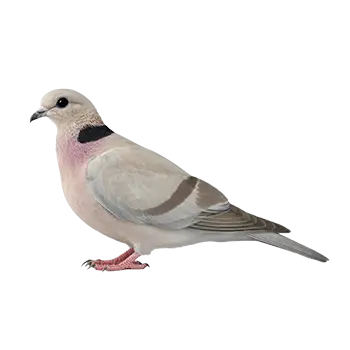
The wild-type or standard Ring-Necked Dove displays a warm, creamy buff or soft fawn coloration across most of its body. The head and upper body are a pale brownish-gray to buff color that transitions smoothly to whitish or cream on the chin, belly, and undertail coverts. The most distinctive feature, which gives the species its common name, is the black semi-collar or ring around the back of the neck. This marking is present in all birds, though it may be difficult to see in pure white individuals and appears as a white ring in some of the newer color mutations rather than the traditional black.

The wings show subtle but beautiful coloring, with the primary flight feathers and proximal wing coverts displaying light gray tones. The wing edges are even lighter gray, creating a delicate contrast during flight. The tail feathers exhibit a somewhat patterned appearance underneath, with black and white coloring that becomes visible when the tail is fanned or during flight displays. The eyes are a striking ruby red or deep red-orange color in birds kept outdoors with access to natural sunlight or UV lighting, though they may appear less vibrant in birds housed exclusively indoors without proper lighting.

The beak is relatively small and delicate, colored dark purplish-black with distinctive silvery edging that creates an attractive contrast. The feet are purplish-red to pink, proportionate to the bird's size and well-suited to perching and ground foraging. Until 1960, only two color forms were available in the United States: the wild-type fawn and pure white. However, thanks to dedicated breeding programs beginning in the 1960s and accelerated by outcrossing with African Collared Doves, the number of recognized color mutations has exploded to over 40 distinct varieties, with new mutations continuing to emerge.

Today's Ring-Necked Doves come in an astounding array of colors including white, fawn (blond), tangerine, orange, rosy, ivory, pied, silky, albino, and numerous combinations thereof. Some mutations affect only body color, while others modify the neck ring, create pearlescent effects, or produce lacy, flowing feather textures as seen in the popular silky mutation. The silky variety, characterized by feathers with reduced barbule structure, produces a soft, lacy appearance and reduced flight capability, making these birds particularly well-suited as indoor companions. Male and female Ring-Necked Doves are nearly identical in appearance, with minimal sexual dimorphism. Experienced breeders may note that males tend to be slightly larger with somewhat more prominent head features and more intense coloring, but these differences are subtle and unreliable for sexing. Behavioral cues, particularly the male's distinctive three-phase courtship cooing, provide the most reliable method of sex determination in this species.

Affection Level
Ring-Necked Doves are notably affectionate and gentle birds that bond well with their owners. They become hand-tame easily with patient handling and enjoy perching quietly on their caretaker's shoulder or hand. These doves thrive on companionship and regular interaction, making them wonderful lap birds for those seeking a calm, loving avian friend.
Sociability
These doves are exceptionally social creatures that strongly prefer companionship. They do best in pairs or small colonies and can coexist peacefully with other gentle bird species. Ring-Necked Doves bond strongly with mates for life and enjoy being part of family activities, making them ideal community birds for multi-bird households.
Vocalization
Ring-Necked Doves produce persistent but soft, soothing cooing sounds throughout the day. Males coo more frequently than females with a distinctive three-phase courtship call. While not loud, their cooing is nearly constant and can be heard throughout the home. Some find this peaceful, while others may find it repetitive.
Intelligence
Ring-Necked Doves demonstrate basic intelligence typical of dove species. They learn routines, recognize their caretakers, and can be conditioned to respond to simple cues. While not problem-solvers like parrots, they show awareness of their environment and retain instinctive behaviors like freezing when hawk-like shadows pass overhead.
Exercise Needs
These moderately active birds require daily flight time outside their cage to maintain physical health. They prefer horizontal flight patterns and ground foraging rather than climbing. Providing 1-2 hours of supervised out-of-cage time daily allows them to stretch their wings, explore, and engage in natural behaviors like sunbathing.
Maintenance Level
Ring-Necked Doves are low-maintenance birds ideal for beginners. They require basic cage cleaning, fresh seed and water daily, and weekly bathing opportunities. They produce some loose feathers and dander but far less mess than parrots. Their hardy nature and simple care requirements make them one of the easiest pet birds to maintain.
Trainability
Ring-Necked Doves can be easily hand-tamed with gentle, consistent handling. They learn to step up, perch on fingers, and become comfortable with routine handling. While not capable of trick training like parrots, they respond well to positive reinforcement and can be conditioned to basic behaviors through patient, reward-based training approaches.
Independence
These doves have moderate independence needs and strongly prefer not to be alone. Single birds require regular human interaction to prevent loneliness, while pairs become more self-sufficient but still enjoy human companionship. They are social birds that need to feel connected to their flock, whether avian or human.

Natural Habitat & Range

The Ring-Necked Dove as it exists today is entirely a domestic species, having been bred in captivity for between 2,000 and 3,000 years according to extensive research by avian geneticists. Unlike most pet bird species that have wild populations, the Ring-Necked Dove has no natural habitat in the true sense, as it exists only through human management and selective breeding. However, understanding the habitat preferences of its wild ancestors provides insight into the conditions these birds prefer and helps explain their care requirements in captivity.

The most widely accepted theory identifies the African Collared Dove (Streptopelia roseogrisea) as the primary wild ancestor of the domestic Ring-Necked Dove. This species is native to the arid and semi-arid regions of Sub-Saharan Africa, ranging from Senegal and Ethiopia in the north to parts of southern Africa. African Collared Doves inhabit dry savannas, scrublands, acacia woodlands, and farmlands, showing a preference for open or semi-open environments with scattered trees and bushes. They thrive in hot, dry climates and are commonly found around human settlements, agricultural areas, and villages where food and water are readily available.

Historical records suggest that Ring-Necked Doves were first domesticated somewhere in North Africa or the Middle East, possibly in Egypt or surrounding regions, and were brought to Europe via Italy in the late 16th century, though some sources suggest even earlier introduction. Ancient Romans kept these doves for multiple purposes: as pets, as subjects for ritual sacrifices, and for practical food production. Because doves could be kept in rooftop cotes, bred prolifically with minimal space and resources, and produced less mess than livestock, they became valuable urban animals in ancient cities.

Biblical references to doves almost certainly refer to the ancestors of modern Ring-Necked Doves, which were kept in cages for religious purposes and as symbols of peace and purity for thousands of years. The species has been used in magicians' acts since ancient times, with pure white mutations particularly prized for their symbolic significance and visual appeal in performances. This long association with human culture has shaped the Ring-Necked Dove into an entirely domestic animal, unlike its wild relatives.

Feral populations of Ring-Necked Doves have occasionally established themselves as a result of escapes from captivity or intentional releases. Small colonies have been documented in various locations including Los Angeles, California; parts of southern Florida; various regions of Illinois; the Caribbean islands; and scattered locations worldwide. However, these feral populations remain limited and often struggle to persist without human support. Released Ring-Necked Doves rarely survive well in the wild because they lack natural fear of predators, have never learned to distinguish natural food sources effectively, and are not physically equipped to handle extreme weather or avoid predation.

Interestingly, in areas where feral Ring-Necked Doves overlap with wild Eurasian Collared Doves (Streptopelia decaocto), the two species readily hybridize, creating birds with intermediate characteristics. This hybridization has likely contributed to the increasing number of Eurasian Collared Doves with aberrant pale coloration in regions where the species overlap. The Ring-Necked Dove's inability to establish successful, independent wild populations despite numerous release events worldwide demonstrates how thoroughly domestication has altered this species, making it dependent on human care for survival. Their domestic nature means they are most comfortable in controlled environments that mimic the warm, dry, resource-rich conditions their ancestors enjoyed near human settlements in Africa.

Temperament

The Ring-Necked Dove is universally celebrated for its exceptionally gentle, peaceful, and docile temperament, making it one of the most beginner-friendly and family-appropriate bird species available. These birds truly embody the qualities we associate with doves: calmness, gentleness, and an easy-going nature that makes them delightful companions for people of all ages and experience levels. Unlike many parrot species that can be demanding, loud, or aggressive, Ring-Necked Doves offer a serene presence that fits comfortably into most households.

Ring-Necked Doves are remarkably easy to hand-tame, particularly when acquired young or when given patient, consistent, gentle attention over time. They respond beautifully to calm handling and gradually learn to trust their caretakers, eventually stepping onto hands willingly and perching contentedly on shoulders or laps. Most owners find that their doves become comfortable with handling within just a few weeks of consistent positive interaction. These birds will not bite or attack in the aggressive manner that some parrot species might, though a startled or frightened dove may peck defensively or attempt to escape through frantic wing-flapping.

The social nature of Ring-Necked Doves is one of their most endearing characteristics. These birds are highly gregarious and prefer to live with companions, whether avian or human. They thrive in pairs and form strong, lifelong pair bonds with their chosen mates. Mated pairs display touching affection toward each other, preening one another, cooing softly, and sitting pressed close together. Single doves require substantial human interaction to substitute for avian companionship and can become lonely and depressed if neglected or isolated. They genuinely enjoy being part of the family and will observe household activities with interest from their cage or favorite perch.

In colony or aviary settings with other birds, Ring-Necked Doves generally prove peaceful and non-aggressive toward different species, particularly small finches, canaries, and other gentle birds. They can coexist successfully in mixed aviaries provided adequate space and resources are available. However, caretakers should note that Ring-Necked Doves can display surprising territoriality and aggression when new doves are introduced to an established group. They may violently attack newcomers, potentially causing serious injury or death if introductions are not managed carefully with separation, gradual visual contact, and supervised meetings in neutral territory.

Housing multiple male Ring-Necked Doves together typically results in fighting and should be avoided. Males establish territories and compete for females, leading to aggressive encounters that can cause injury. Females generally coexist more peacefully, though they may squabble over preferred nest sites during breeding season. Pairs should be provided with their own territories in aviaries to minimize conflict. Despite their generally peaceful demeanor, Ring-Necked Doves are sensitive birds that startle easily and are prone to panic flight responses. Sudden loud noises, rapid movements, fast-approaching people or pets, and unexpected environmental changes can cause them to flush wildly in their cage, potentially shedding feathers or even injuring themselves through collision with cage bars or walls. This nervous tendency means they require a calm, predictable environment and gentle handling.

The vocalization pattern of Ring-Necked Doves is characteristic and persistent. Males coo almost incessantly throughout the day with a soft, melodious sound that many people find soothing and pleasant. The typical advertising coo follows a distinctive three-phase pattern described as \"koo, krroo\" or \"koo, kooroo-wa.\" Males also produce a display coo during courtship, accompanied by bowing displays, and an excitement call described as a high-pitched, jeering laugh uttered when greeting females or other doves. Females also vocalize but typically with softer, more rolling sounds. While these vocalizations are not loud compared to parrot screaming, they are persistent and nearly constant, which some people find delightful while others may find wearing over time.

Ring-Necked Doves display fascinating instinctive behaviors that persist despite thousands of years of domestication. They will freeze in place if a hawk-like shadow passes overhead, demonstrating ancestral anti-predator responses. They are fond of water bathing and perform an amusing ritual of laying on one side in shallow water with the opposite wing extended upward. These doves also engage in energetic sunbathing sessions, fluffing their feathers and spreading their wings to absorb warmth. The breeding ritual of Ring-Necked Doves is both fascinating and endearing, with males performing elaborate courtship displays involving bowing, cooing, and presenting nesting materials to females. Both parents share incubation duties and work together to raise their young, with males typically sitting on eggs during the day while females take the night shift. Their attentive parenting and strong pair bonding make them wonderful subjects for observation and study of avian family dynamics.

Care Requirements

Proper housing for Ring-Necked Doves focuses on providing adequate horizontal space for flight rather than vertical climbing space, as these birds are primarily fliers rather than climbers like parrots. For a single dove or pair, the minimum cage dimensions should be 24 inches wide by 18 inches deep by 30 to 36 inches tall, though larger cages are always preferable. A cage measuring 2 feet tall by 18 inches deep by 30 to 36 inches wide is considered ideal for a pair. The key consideration is cage width, as doves need room to fly back and forth between perches rather than climbing up and down.

Cage bar spacing should be appropriate to prevent escape or injury, typically no more than 1/2 inch apart for Ring-Necked Doves. Horizontal bars on at least some cage walls facilitate occasional climbing if desired, though doves do not climb extensively. The cage door should be large enough to allow easy removal of the dove without causing stress or risking injury. Multiple access doors can be beneficial for placing food, water, and nest bowls. Select cages made from bird-safe materials like stainless steel, powder-coated metal, or appropriate wrought iron, avoiding zinc or lead-based finishes that could cause toxicity.

Cage placement is critical for dove wellbeing and family integration. Position the cage in a location where the doves can observe family activities and feel included in household life, but not in high-traffic areas where constant movement causes stress. Avoid placing cages in kitchens where cooking fumes, particularly from nonstick cookware, can be lethal to birds. Keep cages away from drafty windows, doors, heating vents, and air conditioning units, as Ring-Necked Doves are sensitive to temperature fluctuations and drafts. The cage location should receive indirect natural sunlight for several hours daily to support vitamin D synthesis and psychological wellbeing, but ensure the birds can retreat to shaded areas if needed.

Perch selection should provide variety to promote good foot health. Provide at least two perches of different diameters and materials, positioned at different heights and at opposite ends of the cage to encourage flight between them. Natural wood branches make excellent perches, offering varied gripping surfaces that exercise foot muscles. Place perches strategically so birds can fly between them without obstruction, and never position perches directly over food or water dishes where droppings will contaminate them. Avoid sandpaper-covered perches, which can cause foot injuries and do not actually help with nail trimming as sometimes advertised.

Substrate selection for the cage bottom affects both cleanliness and dove behavior. Many keepers use newspaper, paper towels, or specialized bird cage paper for easy daily cleaning. However, providing a shallow tray with clean, dry sand or fine gravel in one section of the cage bottom allows doves to engage in natural ground-foraging behaviors and provides grit for digestion. If using loose substrate, ensure it remains dry and clean, changing it frequently to prevent bacterial growth or mold. A removable metal grate above the bottom tray keeps birds' feet clean and prevents them from accessing their droppings, though many dove keepers prefer to allow ground access for more natural behavior.

Food and water dishes should be designed to reduce mess and contamination. Use covered or hooded dishes that require birds to reach through openings to access seed, reducing the amount thrown about. Water containers should be covered to prevent contamination from droppings from above. Heavy ceramic dishes or clip-on dishes prevent tipping. Position food and water containers on the cage floor between perches rather than elevated, as doves prefer ground feeding. Provide separate dishes for seed, grit, fresh greens, and water, and clean them thoroughly daily.

Nest bowls or nest boxes should be provided if breeding is desired, though Ring-Necked Doves are notorious for breeding prolifically without dedicated nest sites. They will readily lay eggs in food dishes, on cage floors, or in any sheltered corner. A proper nest bowl slightly larger than a canary nest, placed high in a corner and furnished with nesting material like pine needles, soft grass, or commercial nesting materials, encourages more organized breeding. Multiple nest sites in aviaries housing multiple pairs reduce competition and territorial disputes.

Toys and enrichment for Ring-Necked Doves differ significantly from parrot toys. These birds do not typically chew or manipulate toys but appreciate items that encourage natural behaviors. Mirrors can provide companionship for single doves, though they should not replace actual avian or human companionship. Small stuffed animals placed in the cage may be adopted as companions. Pieces of wood, natural branches with leaves (non-toxic species only), and foraging opportunities where seed is scattered in safe substrate encourage natural ground-feeding behaviors. Avoid toys with small parts that could be ingested or complex rope toys where birds might become entangled.

Bathing opportunities are essential for Ring-Necked Dove health and happiness. Provide a shallow dish of clean water on the cage floor at least weekly, or more frequently if birds show interest. Many doves enjoy daily bathing. The water dish should be shallow enough that birds can wade without risk of drowning, typically 1-2 inches deep. Some doves prefer gentle misting with a spray bottle filled with clean, lukewarm water. Observe individual preferences and accommodate them. Bathing helps maintain feather condition, provides enrichment, and is clearly enjoyable for most doves.

Temperature management for Ring-Necked Doves is generally straightforward as they tolerate normal household temperatures well. The ideal range is 65-75ยฐF, though they handle somewhat warmer temperatures without difficulty. Protect them from cold drafts, sudden temperature changes, and excessively damp conditions. They need access to warmth and sunlight, spending considerable time sunbathing when given the opportunity. In outdoor aviaries, provide sheltered areas protecting from rain, wind, and temperature extremes, ensuring birds can retreat to comfortable conditions.

Cleaning protocols should be consistent and thorough. Change substrate or cage papers daily to prevent bacterial buildup and odor. Clean food and water dishes thoroughly each day with hot water and bird-safe dish soap, rinsing completely. Spot-clean perches and cage sides as needed throughout the week. Perform complete cage disinfection monthly using bird-safe cleaning products, removing all dishes, perches, and toys to scrub thoroughly. Rinse everything completely to remove all cleaning product residue before replacing items and returning birds to their home. Regular cleaning prevents disease transmission and maintains a healthy environment.

Feeding & Nutrition

Ring-Necked Doves are primarily granivorous in both their wild ancestry and domestic form, with seeds forming the foundation of their natural diet. However, modern avian nutrition research has demonstrated that a varied diet including seeds, pellets, fresh foods, and appropriate supplements provides optimal health outcomes. Understanding the specific nutritional needs of doves and providing a balanced diet is one of the most important aspects of responsible Ring-Necked Dove care.

The foundation of a captive Ring-Necked Dove diet can follow one of two approaches: seed-based or pellet-based. Traditional seed-based diets consist of high-quality dove and pigeon seed mixes or finch mixes containing various millets, plain canary seed, hemp seed, milo, wheat, and other small seeds appropriate for doves. These mixes should be fresh, properly stored in airtight containers, and free from dust, mold, or insect contamination. However, seeds alone are not nutritionally complete and require supplementation with fresh foods, vitamins, and minerals to prevent deficiencies.

Pelleted diets formulated specifically for doves provide nutritionally complete and balanced nutrition in a convenient form. Several manufacturers produce pellets designed for seed-eating birds, available in sizes appropriate for Ring-Necked Doves. Pelleted diets should comprise 60-70% of the total diet, with the remainder consisting of fresh foods and treats. Pellets eliminate the selective feeding problem common with seed mixes, where birds pick out favorite seeds and leave others, potentially creating nutritional imbalances. However, some doves resist pellets initially, requiring gradual transition from familiar seed-based diets.

For birds on seed-based diets, the mixture should be offered in dishes kept three-quarters full, with daily removal of empty hulls and debris. Doves hull their seeds before eating, so dishes may appear full of empty shells while the bird is actually running low on food. Fresh seed should be added daily, and the entire dish contents completely replaced every few days to ensure freshness. Provide approximately 1-2 tablespoons of seed mixture per bird daily, adjusting based on individual consumption and body condition.

Fresh vegetables and greens should be offered daily or several times weekly to supplement either seed or pellet-based diets. Appropriate vegetables include dark, leafy greens like romaine lettuce, kale, spinach (in moderation due to oxalates), dandelion greens, and endive. Chopped or shredded orange and yellow vegetables like carrots, sweet potato, squash, and bell peppers provide vitamin A and other essential nutrients. Vegetables should be washed thoroughly, chopped into small, manageable pieces, and offered fresh. Remove any uneaten fresh foods after several hours to prevent spoilage and bacterial growth.

Fruits can be offered as occasional treats but should not comprise a large portion of the diet due to high sugar content. Small amounts of berries, melons, apples (seeds removed), pears, and other soft fruits are enjoyed by many doves. Fruits should be offered sparingly, perhaps once or twice weekly, in small portions. Always remove fruit quickly as it spoils rapidly and can attract fruit flies.

Grit is an essential dietary component for Ring-Necked Doves because they swallow seeds whole and require indigestible grit to grind seeds mechanically in their gizzards. Provide a separate small dish of grit containing various sizes of small stones, granite grit, or commercial dove grit. However, grit should be offered in limited quantities in a separate dish rather than mixed with food, as overconsumption can cause crop or gastrointestinal impaction. Recent research suggests that doves can survive without traditional grit, but most do seem to benefit from having small amounts available.

Calcium supplementation is crucial for Ring-Necked Doves, particularly breeding pairs. Provide cuttlebone, oyster shell, crushed eggshell (baked to sterilize), or mineral blocks continuously. Females require abundant calcium for proper eggshell formation, and both sexes need calcium for bone health. Some keepers offer digestible calcium grit specifically formulated for birds, which provides both grit function and calcium supplementation. Additionally, a small amount of red mineral salt mixed with grit provides trace minerals and electrolytes.

Protein supplementation becomes important during breeding season. Offer small amounts of well-cooked, finely chopped hard-boiled egg (including crushed shell) several times weekly during breeding to support egg production and chick development. Commercial egg food designed for breeding birds can also be provided. Some doves enjoy mealworms as protein treats, though these should be offered sparingly due to high fat content.

Treats can include steamed rice, multi-grain bread, cornbread, crushed whole wheat crackers, and similar grain-based items offered in small quantities. Many doves enjoy these treats and they can be useful for building trust and encouraging interaction. However, treats should not comprise more than 10% of the total diet to maintain proper nutrition. Avoid treats high in salt, sugar, or fat.

Fresh, clean water must be available at all times, changed daily or more frequently if it becomes soiled. Ring-Necked Doves drink water without tilting their heads back like most birds, instead using a sucking motion, so they drink frequently and may soil water dishes more readily. Use heavy dishes that cannot be tipped easily, and position them away from perches to reduce droppings contamination. Some keepers add vitamin and mineral supplements to drinking water according to manufacturer directions, though this requires more frequent water changes.

Foods to strictly avoid include avocado, which is highly toxic to birds; chocolate, caffeine, and alcohol; onions and garlic; fruit seeds and pits that contain cyanide compounds; raw beans; and high-salt or high-fat processed human foods. Never allow doves to share food from your mouth or plate, as human saliva contains bacteria potentially harmful to birds. Avoid feeding birds while they are out of their cage to prevent accidentally training them to beg during family meals.

Ring-Necked Dove Health & Lifespan

Ring-Necked Doves are generally hardy, healthy birds when provided with appropriate care, making them excellent choices for beginners concerned about managing complex health issues. With proper husbandry, these doves typically live 10 to 15 years, though individuals have been documented living over 20 years, with one exceptional case of a dove reaching 29 years of age. Their robust nature and adaptability to captive conditions contribute to their reputation as low-maintenance pets, though like all birds, they remain susceptible to certain health conditions that conscientious owners should understand. Respiratory infections represent one of the most common health concerns in Ring-Necked Doves, particularly when birds are exposed to cold drafts, damp conditions, or poor ventilation. Simple colds can develop from sudden temperature changes or drafty cage placement, manifesting as nasal discharge, sneezing, lethargy, and labored breathing. More serious respiratory diseases include aspergillosis, a fungal infection caused by inhaling Aspergillus spores from moldy seed, bedding, or damp environments. Affected birds show respiratory distress, loss of voice, and general weakness. Prevention through proper ventilation, dry housing, and fresh food is far more effective than treatment for fungal infections.

Nutritional deficiencies can manifest in various health problems. A diet consisting solely of seeds without appropriate supplementation can lead to calcium deficiency resulting in weak bones, poor eggshell quality in breeding females, and metabolic problems. Vitamin A deficiency can cause respiratory issues and compromised immune function. Obesity is also a concern in doves fed exclusively on seed-based diets without adequate exercise opportunities. Egg binding can occur in breeding females, particularly those with calcium deficiency or inadequate conditioning, and represents a medical emergency requiring immediate veterinary attention. Regular veterinary checkups with an avian veterinarian familiar with dove species are crucial for maintaining Ring-Necked Dove health and catching problems early before they become severe. Annual wellness exams allow veterinarians to assess body condition, check for parasites, examine droppings, and identify subtle signs of illness. Proper diet and nutrition, including quality seed mixtures or pelleted diets supplemented with fresh greens, appropriate grit, and mineral sources, support immune system health and overall vitality. Environmental enrichment through foraging opportunities, bathing facilities, appropriate perches, and social interaction prevents stress-related behavioral and health problems. Cage cleanliness is essential, as doves spend considerable time on the ground where they can be exposed to fecal contamination if hygiene is neglected. Daily substrate changes and weekly thorough cage cleaning minimize disease transmission. UV lighting benefits vitamin D synthesis, essential for calcium absorption and bone health, particularly important for breeding pairs and growing young birds. Maintaining appropriate temperature and avoiding cold drafts prevents respiratory infections and supports optimal health. With attentive, consistent care and attention to these preventive measures, Ring-Necked Doves can enjoy long, healthy lives as cherished companions.

Common Health Issues

  • Their robust nature and adaptability to captive conditions contribute to their reputation as low-maintenance pets - Though like all birds, they remain susceptible to certain health conditions that conscientious owners should understand.\n\nRespiratory infections represent one of the most common health concerns in Ring-Necked Doves, particularly when birds are exposed to cold drafts, damp conditions, or poor ventilation.
  • More serious respiratory diseases include aspergillosis - A fungal infection caused by inhaling Aspergillus spores from moldy seed, bedding, or damp environments.
  • Affected birds show respiratory distress - Loss of voice, and general weakness.
  • This respiratory disease manifests as swelling in the dove's throat and cheesy-looking yellowish growth around the mouth and throat area. - This respiratory disease manifests as swelling in the dove's throat and cheesy-looking yellowish growth around the mouth and throat area.
  • Routine fecal examinations and appropriate deworming protocols maintain intestinal health.\n\nPsittacosis - Also known as chlamydiosis or parrot fever, is a bacterial infection caused by Chlamydia psittaci that affects all bird species including doves.
  • Infected birds show respiratory symptoms - Conjunctivitis, lethargy, diarrhea, and poor appetite.
  • Salmonella is another bacterial infection that doves can harbor and potentially transmit to humans - Reinforcing the importance of good sanitation practices and hand washing.\n\nFeather plucking and poor feather condition are less common in doves than in parrots but can occur due to stress, boredom, external parasites, or nutritional deficiencies.
  • Vitamin A deficiency can cause respiratory issues and compromised immune function. - Vitamin A deficiency can cause respiratory issues and compromised immune function.

Preventive Care & Health Monitoring

  • Salmonella is another bacterial infection that doves can harbor and potentially transmit to humans - Reinforcing the importance of good sanitation practices and hand washing.\n\nFeather plucking and poor feather condition are less common in doves than in parrots but can occur due to stress, boredom, external parasites, or nutritional deficiencies.
  • Providing opportunities for bathing - Proper diet, environmental enrichment, and addressing any underlying stressors help maintain good plumage quality.\n\nNutritional deficiencies can manifest in various health problems.
  • A diet consisting solely of seeds without appropriate supplementation can lead to calcium deficiency resulting in weak bones - Poor eggshell quality in breeding females, and metabolic problems.
  • Vitamin A deficiency can cause respiratory issues and compromised immune function. - Vitamin A deficiency can cause respiratory issues and compromised immune function.
  • Egg binding can occur in breeding females - Particularly those with calcium deficiency or inadequate conditioning, and represents a medical emergency requiring immediate veterinary attention.\n\nRegular veterinary checkups with an avian veterinarian familiar with dove species are crucial for maintaining Ring-Necked Dove health and catching problems early before they become severe.
  • Annual wellness exams allow veterinarians to assess body condition - Check for parasites, examine droppings, and identify subtle signs of illness.

Training & Vocalization

Training Ring-Necked Doves presents unique opportunities and challenges compared to training more intelligent species like parrots. While these gentle birds lack the cognitive complexity for advanced trick training or speech, they are exceptionally amenable to hand-taming and can learn basic behaviors through patient, positive reinforcement techniques. Their docile nature and willingness to bond with caretakers make them rewarding subjects for gentle interaction training, though expectations should be adjusted to match their capabilities.

The foundation of Ring-Necked Dove training is trust-building through consistent, calm interaction. Begin by spending quiet time near the cage, speaking softly and moving slowly to acclimate birds to human presence. Avoid sudden movements, loud noises, or rapid approaches that trigger their startle response. Offer favorite treats like spray millet or small seeds from your fingers through cage bars, allowing birds to approach at their own pace. This initial phase may take several days to weeks depending on the bird's age, background, and individual temperament.

Hand-taming Ring-Necked Doves is remarkably straightforward compared to many bird species. Once birds tolerate close proximity and accept treats from your hand, gradually introduce your hand fully into the cage, resting it quietly without making grabbing motions. Many doves will begin perching on your hand voluntarily within days to weeks of this gentle approach. Never chase, grab, or force handling, as this destroys trust and can cause injury through panic responses.

Step-up training teaches doves to willingly step onto your finger or hand on cue. Position your finger or hand just in front of and slightly above the bird's feet at chest level, gently pressing against the lower chest while giving a consistent verbal cue like \"step up\" or \"up.\" Many doves naturally step forward onto the offered perch. Reward successful attempts immediately with verbal praise and treats. Practice this behavior daily in short 5-10 minute sessions until it becomes reliable. Most Ring-Necked Doves master step-up training quickly with patient repetition.

Once doves are comfortable stepping up, they can be brought out of the cage for supervised interaction time. Many hand-tamed Ring-Necked Doves enjoy perching quietly on their owner's shoulder, lap, or hand while their caretaker reads, watches television, or works at a desk. They may preen contentedly or even doze off, clearly enjoying the companionship. Some particularly tame individuals will sit calmly in cupped hands or nestle against their owner's neck. These quiet bonding moments represent the pinnacle of Ring-Necked Dove companionship.

Advanced training beyond basic handling is limited but possible. Ring-Necked Doves can learn to fly to a specific perch or hand on cue in a controlled environment, though reliable recall training is challenging and should only be attempted in secure, bird-proofed rooms. They can be conditioned to enter and exit their cage on command, accept gentle grooming behaviors like nail trimming, and tolerate necessary husbandry procedures through desensitization and positive reinforcement. Some dedicated trainers have taught doves simple behaviors like turning in a circle or nodding their heads, though these behaviors are better suited to the dove's natural movement patterns than complex manipulations.

Socialization with family members, other pets, and varied environmental stimuli should begin early and continue throughout the bird's life. Well-socialized Ring-Necked Doves handle changes in routine, new people, and novel situations with greater calm than unsocialized individuals. However, even well-socialized doves retain their naturally nervous disposition and can be startled by unexpected events. Introducing them gradually to new experiences while providing security and predictability helps build confidence.

Vocalization represents one of the most characteristic aspects of Ring-Necked Dove behavior, and understanding their vocal repertoire enhances appreciation for these birds. Males are notably more vocal than females, producing nearly constant cooing throughout daylight hours. The typical male advertising coo consists of a distinctive three-phase pattern that sounds like \"koo, krroo\" or \"koo, kooroo-wa,\" repeated many times in succession. This cooing serves to attract females, maintain pair bonds, and establish territory, and males seem compelled to coo almost as if it were breathing.

The display coo and nest call are similar to each other and accompany courtship rituals and nest building behaviors. Males perform exaggerated bowing displays while cooing to females, puffing up their chest and neck feathers and lowering their heads repeatedly. The excitement call, described as a high-pitched jeering laugh or chuckling sound, is uttered when males greet females or other doves and conveys enthusiasm or arousal. Female Ring-Necked Doves also vocalize but typically produce softer, shorter coos with more trilling or rolling \"rr\" sounds compared to males' clearer, louder calls.

The volume of Ring-Necked Dove vocalizations is moderate, significantly quieter than parrot screaming but clearly audible throughout a home or apartment. Individual birds vary in vocal intensity, with some males cooing more persistently than others. The cooing begins shortly after dawn and continues intermittently throughout the day, decreasing in the evening. Multiple doves housed together engage in \"conversations,\" with males calling back and forth in apparent competition or social bonding. Some people find the gentle, rhythmic cooing soothing and peaceful, likening it to the sound of distant pigeons or the soft murmur of a dove in a classic garden setting. Others find the persistence and repetitiveness of the cooing wearing over time, particularly if birds are housed in bedrooms or small living spaces where the sound cannot be escaped.

Prospective Ring-Necked Dove owners should carefully consider their tolerance for persistent vocalization before acquiring these birds. While the cooing is pleasant and far from the harsh screaming of many parrots, it is nearly constant during daylight hours in males and cannot be trained away as it is an innate, hormonally driven behavior. Females are much quieter, making them preferable for noise-sensitive households, though they cannot be reliably sexed by appearance alone.

Ring-Necked Doves have absolutely no talking or mimicry ability. They lack both the cognitive capacity and the vocal apparatus necessary for speech imitation or learning environmental sounds. Their vocalizations are limited entirely to their natural species-specific cooing patterns. Prospective owners seeking talking ability should look to parrot species rather than any dove species.

Children & Other Pets

Ring-Necked Doves are among the most family-friendly bird species available, making them excellent choices for households with responsible children and gentle pets. Their docile temperament, lack of biting behavior, easy care requirements, and quiet nature compared to parrots position them as ideal companion birds for families seeking to introduce children to avian care responsibilities. However, as with any pet, adult supervision, education about proper handling, and age-appropriate involvement are essential for ensuring both child and bird safety and wellbeing.

For families with children, Ring-Necked Doves offer numerous advantages over more commonly considered pet birds like parrots. Unlike parrots that may bite forcefully when frightened or upset, doves rarely bite and when they do, their small beaks cause minimal discomfort. Their gentle nature makes physical interaction less risky, and their straightforward care requirements allow older children to participate meaningfully in their care. Children as young as 6-8 years old can assist with supervised tasks like filling food and water dishes, offering treats, and gentle handling under adult guidance.

Children aged 8-12 can take on more responsibility with appropriate supervision, learning to clean cages, prepare food, observe bird behavior, and develop an understanding of animal needs and body language. Teenagers often make excellent Ring-Necked Dove caretakers, capable of managing most care aspects independently while learning valuable lessons about responsibility, routine, and the commitment required for animal keeping. The relatively long lifespan of 10-15 years means that a dove acquired during childhood can remain a companion throughout adolescence, teaching important lessons about long-term responsibility.

Teaching children proper dove interaction techniques is crucial for building positive relationships and preventing accidents. Children must learn to approach the cage slowly and quietly, speak in soft voices, and avoid sudden movements or loud noises that startle these sensitive birds. They should be taught to read dove body language indicating stress or fear, such as freezing in place, attempting to fly away, or rapid breathing. Children should understand that doves are not toys to be grabbed or carried around but living creatures deserving respect and gentle treatment.

Hand-tamed Ring-Necked Doves can sit calmly on a child's finger, hand, or shoulder during supervised interaction sessions, providing a magical experience that builds empathy and connection with nature. Children should be instructed to sit down during these interactions to minimize the risk of dropping the bird if startled, and to allow the bird to perch rather than grasping it with their hands. Teaching the step-up command together as a family activity builds skills while ensuring everyone uses consistent cues and techniques.

Cage placement in family homes should balance the dove's need to observe and participate in family life with requirements for calm, predictable surroundings. Avoid placing cages in children's bedrooms where activity levels and sleep schedules may disturb the birds, or in high-traffic play areas where chaos and noise cause chronic stress. A quiet corner of a family room or living area where the dove can watch family activities while having the option to retreat to quieter areas of the cage works well for most families.

Compatibility with other household pets varies considerably depending on species and individual temperaments. Ring-Necked Doves can coexist successfully with other gentle, non-aggressive bird species in appropriately sized aviaries. They typically do well with small finches, canaries, cockatiels, and other doves provided adequate space, multiple feeding stations, and careful monitoring prevent resource competition. Mixed aviaries should offer visual barriers, escape routes, and enough square footage that birds can avoid each other if tensions arise. Never house Ring-Necked Doves with larger parrots, as the power imbalance creates serious injury risks.

Housing multiple Ring-Necked Dove pairs together requires substantial space and careful management. While generally peaceful, established pairs can be violently aggressive toward new doves introduced to their territory. All introductions should occur gradually in neutral territory under close supervision, with immediate separation if fighting occurs. Multiple pairs in aviaries need ample spaceโ€”at least 4-6 square feet of floor space per pairโ€”with multiple nest sites, feeding stations, and perching areas to reduce territorial disputes.

Ring-Necked Doves are absolutely incompatible with predatory mammals including cats, dogs, and ferrets. Even the most well-trained, gentle dog or disinterested cat possesses predatory instincts that can be triggered by a bird's flight response or distressed behavior. A playful paw swipe from a cat, even without claws extended, can cause fatal injuries to a small dove. Dogs may inadvertently injure birds through overly enthusiastic greeting behavior or investigative mouthing. These species should never have unsupervised access to birds under any circumstances.

If dogs or cats are present in the household, several management strategies protect dove safety. Keep bird cages in rooms that can be completely secured when birds are out for exercise, or provide out-of-cage time only when predatory pets are confined elsewhere. Ensure cage construction is sturdy with locks that curious paws cannot open. Position cages on stable furniture that cannot be knocked over by jumping or bumping. Never allow dogs or cats to \"make friends\" with birds through cage bars, as this creates stress for birds and reinforcement for predatory interest in pets. Even the sight, sound, or scent of predators can cause chronic stress in doves, potentially leading to health problems.

Small mammals like rabbits, guinea pigs, hamsters, and rats should be considered incompatible with Ring-Necked Doves. These animals may stress birds through noise, scent, or proximity, and should be housed in separate rooms if possible. Reptiles such as snakes or large lizards definitely trigger natural prey responses and must be housed in completely different areas. The general rule for multi-pet households with Ring-Necked Doves is that the more predatory species present and the more chaotic the environment, the less suitable it is for these sensitive birds.

Family education ensures consistent, appropriate care and prevents accidents. All household members, including children and adults, should understand basic Ring-Necked Dove needs, recognize signs of stress or illness, know which foods are toxic, understand the dangers of nonstick cookware fumes, and be aware of household hazards like open windows, ceiling fans, and toxic plants. Regular family meetings to discuss bird care, address concerns, and celebrate successes help maintain appropriate standards and prevent misunderstandings that could compromise bird wellbeing. With thoughtful management, clear rules, and consistent supervision, Ring-Necked Doves can thrive in family environments, enriching children's lives and teaching valuable lessons about compassion, responsibility, and the rewards of caring for other living creatures.