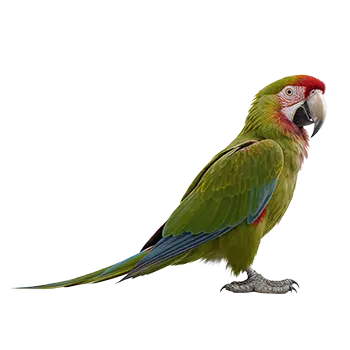

The Red-Fronted Macaw is an intelligent, curiosity-driven species that requires daily mental stimulation to maintain psychological health in captivity. In the wild, these birds spend the majority of their waking hours engaged in complex behaviors: navigating rocky cliff environments, searching for seasonal food sources across semi-arid terrain, socializing within flock groups, and manipulating natural objects with their beaks and feet. Captive life eliminates most of these natural outlets, and without deliberate enrichment, the resulting boredom and frustration manifest as feather-destructive behavior, excessive vocalization, stereotypic movements, and withdrawal from social interaction.
Enrichment for this species should target multiple sensory and cognitive channels simultaneously. Visual novelty, tactile engagement, auditory feedback, problem-solving challenges, and physical exertion each address a different dimension of the bird's behavioral repertoire. A toy program that relies exclusively on one category, such as offering only chew toys, satisfies the beak-work drive but leaves problem-solving, motor coordination, and exploratory instincts unaddressed. The most effective enrichment strategies rotate through all these categories systematically, ensuring that the bird encounters a changing landscape of challenges and rewards.
The intensity of the Red-Fronted Macaw's beak strength must be factored into every toy selection. This is a medium macaw with jaw musculature capable of exerting significant crushing force, and toys designed for cockatiels, conures, or similarly sized birds will be demolished in minutes rather than providing sustained engagement. Conversely, indestructible toys made from solid stainless steel or acrylic offer no chewing satisfaction and may frustrate a bird that is driven to manipulate and disassemble objects. The ideal toy occupies a middle ground where the bird can make meaningful progress toward destruction without finishing the job too quickly.
Social enrichment is as important as physical toys for this highly social species. Red-Fronted Macaws that live as single birds in a household rely entirely on their human flock for social interaction, and toys should not be viewed as a substitute for that interaction. Interactive toys that the owner and bird can engage with together, such as training props, shared puzzle sessions, or supervised play with foot toys on a play stand, provide social enrichment that no toy can deliver independently. The best enrichment programs integrate solitary toy engagement for times when the owner is absent with interactive play sessions during the hours they are present.