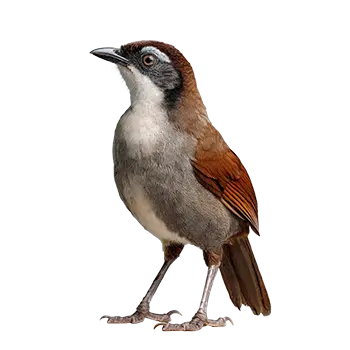

Enrichment Needs

Laughing Thrushes are among the most behaviorally complex softbill species kept in captivity, and their enrichment needs reflect an intelligence and curiosity that demands active engagement rather than passive entertainment. In the wild, these birds spend the vast majority of their waking hours engaged in purposeful activity: foraging through leaf litter, investigating novel objects and surfaces, maintaining complex social relationships within their group, and responding to the constantly changing sensory landscape of the forest understory. A captive environment that does not provide outlets for these behavioral drives produces birds that redirect their energy into repetitive behaviors, excessive vocalization, feather damage, or aggression.

The enrichment profile of a Laughing Thrush differs fundamentally from that of parrots, which dominate the commercial bird toy market. Parrots are arboreal manipulators that interact with objects primarily using their beaks and feet, grasping, pulling, shredding, and solving puzzles through direct physical manipulation. Laughing Thrushes are terrestrial foragers that interact with their environment primarily through ground-level investigation, using their beaks to flip, probe, and scatter substrate in search of hidden food items. Enrichment strategies and products designed for parrots often miss the mark entirely for softbill species because they assume a style of interaction that Laughing Thrushes do not naturally exhibit.

Effective enrichment for this species operates across multiple sensory channels simultaneously. Visual novelty, auditory stimulation, tactile exploration through substrate interaction, and the olfactory and gustatory rewards of discovering hidden food items all contribute to a rich behavioral experience. The best enrichment programs vary stimulation across all of these channels rather than relying on a single type of activity, no matter how well-designed. A Laughing Thrush that receives only foraging enrichment is better off than one that receives none, but it still lacks the sensory breadth that a wild bird experiences daily.

Social enrichment should not be overlooked as a component of the overall enrichment strategy. Laughing Thrushes are gregarious birds whose social interactions, including mutual preening, coordinated calling, play chasing, and collaborative foraging, constitute some of their most complex and engaging behaviors. For pair-housed or group-housed birds, enrichment items that promote social interaction, such as shared foraging opportunities or novel objects that attract group investigation, deliver behavioral benefits beyond what any solitary activity can achieve.

What to Look For

Safety is the non-negotiable starting point for evaluating any enrichment item. Laughing Thrushes interact with objects primarily through their beaks, and any item introduced into the enclosure must withstand being pecked, probed, and tossed without producing sharp edges, small detachable parts, or toxic residues. Avoid toys with zinc-plated hardware, lead-based paints, or small metal clips that could be ingested. Natural materials are generally safer than synthetic ones, though not all natural materials are appropriate, and any item should be inspected for mold, insect infestation, or chemical treatment before introduction.

Scale and design should match Laughing Thrush behavior rather than parrot behavior. Many bird toys on the market are designed for hook-billed species that grasp and manipulate objects with their feet, featuring rings, chains, and hanging elements that assume the bird will climb to and hang from the toy. Laughing Thrushes do not interact with enrichment this way. Items should be ground-level or low-mounted, lightweight enough for the birds to move and flip with their beaks, and designed to reward investigation through discovery rather than through mechanical manipulation.

Durability relative to cost determines the practical sustainability of an enrichment program. Some enrichment items are meant to be destroyed in the process of use, and that destructibility is the entire point. Leaf litter, paper-wrapped food parcels, and other consumable enrichment items should be inexpensive and easy to replace. Other items, such as foraging trays, puzzle feeders, and bathing fixtures, are meant to be permanent components of the environment and should be built to withstand daily use, regular cleaning, and the corrosive effects of moisture and organic waste.

Novelty value is the hidden variable in enrichment effectiveness. Even the most engaging enrichment item loses its behavioral impact when it becomes a permanent, unchanging fixture of the environment. The neurological response to novelty, a measurable spike in attention, investigation, and exploratory behavior, diminishes with familiarity. An item that produced twenty minutes of intense investigation on its first introduction may be ignored entirely after a week of constant presence, then re-engage the birds fully when reintroduced after a period of absence. This principle makes rotation the most important management strategy in any enrichment program.

Foraging Toys and Puzzle Feeders

Foraging enrichment is the most directly relevant category for Laughing Thrushes, because it taps into the behavioral drive that occupies the largest share of their natural activity budget. The simplest and most effective foraging enrichment involves hiding food items within or beneath substrate material, forcing the birds to search, scratch, and investigate to locate their reward. A shallow tray filled with clean leaf litter, shredded paper, or coconut coir with mealworms, crickets, or fruit pieces scattered throughout transforms a routine feeding into a sustained foraging session that can occupy a pair of Laughing Thrushes for thirty minutes or more.

Commercial foraging toys designed for parrots can be adapted for Laughing Thrush use with some modification. Acrylic puzzle feeders that require lifting or sliding a cover to access a food chamber work well when mounted horizontally at ground level rather than hung vertically as intended. The key adaptation is always to bring the toy to the bird's natural activity zone rather than expecting the bird to adopt an unnatural posture to interact with it. Foraging wheels and tumbler-style toys that release food when rolled or nudged are excellent options because they reward the pecking and pushing behavior that Laughing Thrushes naturally perform.

Escalating difficulty is an important principle in foraging enrichment design. Birds that are new to foraging enrichment or new to the collection should start with simple, transparent challenges where the food reward is visible and the barrier to access is minimal. A clear container with an open top, food visible inside, and a light covering of paper strips is an appropriate starting point. As the birds become proficient, the difficulty can increase incrementally: deeper substrate layers, opaque containers, lids that require specific manipulation to open, and food items wrapped in paper or tucked into crevices of natural materials. The progression should be gradual enough that the birds experience consistent success, since repeated failure leads to disengagement rather than persistence.

Social foraging opportunities add a dimension that solitary foraging cannot replicate. Scattering food items across a broad area of the enclosure floor rather than concentrating them in a single foraging station encourages the birds to spread out and forage simultaneously, producing the kind of parallel activity that characterizes wild flock behavior. Competitive foraging, where a limited number of high-value food items like waxworms are placed among lower-value items, stimulates increased foraging intensity and social negotiation as birds discover and respond to each other's finds.

Natural Material Toys

Natural materials provide enrichment that resonates with the sensory world Laughing Thrushes evolved to navigate. Cork bark sections, available from reptile supply retailers, are among the most versatile natural enrichment items for softbill species. Flat pieces of cork bark placed on the enclosure floor create a surface the birds will flip, peck at, and investigate for insects or food items hidden beneath. Curved sections can be positioned as tunnels or shelters that the birds explore and use as retreats. Cork is lightweight, non-toxic, resistant to mold, and inexpensive enough to replace regularly, making it a staple of softbill enrichment programs worldwide.

Pinecones offer another natural enrichment option with multiple applications. Large pinecones with open scales can be smeared with a thin layer of softbill food paste or peanut butter and rolled in dried insect fragments, creating a foraging challenge that requires the bird to extract food from between the scales. Pinecones can also be placed in the enclosure without food as novel objects that the birds investigate, roll, and toss. Collect pinecones from areas that have not been treated with pesticides, bake them at a low temperature to kill any insects or mold spores, and replace them when they become soiled or compressed.

Bundles of safe, leafy branches bring the forest into the enclosure in a form that engages multiple senses. Fresh-cut branches from willow, apple, birch, or hazel trees provide visual complexity, novel scents, tactile variety, and the opportunity to strip bark and leaves. The branches also attract small insects when used in outdoor aviaries, adding a live foraging element. Replace branch bundles regularly as they dry out and lose their appeal, and rotate between different tree species to maintain novelty. Avoid branches from trees that have been sprayed with pesticides, herbicides, or fungicides, and research the toxicity of any unfamiliar tree species before introduction.

Dried leaves, seed pods, and other botanical materials collected from safe sources can be scattered across the enclosure floor as disposable enrichment. Dried palm fronds, lotus pods, and coconut shell halves are commonly available from craft suppliers and provide interesting textures and shapes for investigation. The appeal of these items lies in their impermanence and variety. A handful of dried leaves or seed pods costs nothing but time to collect and introduces a sensory change to the environment that the birds notice and respond to each time it occurs.

Bathing and Water Play

Bathing is one of the most enthusiastically performed behaviors in the Laughing Thrush repertoire, and providing ample bathing opportunities serves both hygiene and enrichment functions simultaneously. These birds do not simply dip and shake like many species. Laughing Thrushes are vigorous, exuberant bathers that plunge into water, splash with abandon, and repeat the process multiple times in a single session. The bathing event is often a social activity, with multiple birds bathing in sequence or simultaneously while others watch and vocalize from nearby perches.

The bathing vessel itself can function as an enrichment variable. Rather than providing the same dish in the same location every day, rotating between different containers and placement options keeps the bathing experience novel. A shallow terracotta saucer one day, a deeper ceramic bowl another, a flat stone basin on the enclosure floor midweek, each variation presents a slightly different physical experience that the birds respond to with renewed interest. The water depth should be shallow enough for the birds to stand in comfortably, generally one to two inches, as Laughing Thrushes bathe by wading and crouching rather than swimming.

Moving water adds a dimension of enrichment that still water cannot match. A small recirculating pump creating gentle ripples in a shallow pool, a slow drip from an elevated container onto a flat stone, or a misting system that produces a fine spray all stimulate bathing behavior and attract sustained attention. Many Laughing Thrushes are particularly drawn to the sound and visual movement of dripping water and will bathe under a drip source for extended periods. The investment in a small water feature pays behavioral dividends that far exceed its modest cost.

Seasonal and weather-responsive bathing management adds variety to the routine. In warm weather, slightly cool water invigorates the birds and supports thermoregulation. In cooler conditions, tepid water encourages bathing when birds might otherwise avoid cold water. Outdoor aviaries can incorporate shallow ground-level pools fed by rainwater collection, creating a naturalistic bathing environment that changes with the weather. Regardless of the format, bathing water must be changed at minimum daily, and more frequently in warm conditions or after heavy use, as Laughing Thrushes will drink from their bathing water and contaminated water is a disease transmission pathway.

Auditory and Visual Enrichment

Laughing Thrushes are highly vocal species whose calls are among the most complex and varied in the passerine world, and auditory enrichment taps into this defining behavioral trait. Playing recorded birdsong at moderate volume introduces auditory stimulation that elicits vocal responses, head-tilting investigation, and active listening behavior. Recordings of wild Laughing Thrush calls from the same or related species produce the strongest responses, but recordings of other forest birds, flowing water, and even certain styles of music can engage the birds' attention and stimulate vocal activity.

The key to effective auditory enrichment is moderation and variety. Continuous background noise loses its enrichment value rapidly and can become a stressor rather than a stimulant if the birds cannot escape it. Short listening sessions of fifteen to thirty minutes, offered at varying times of day and featuring different recordings, maintain the novelty that makes auditory stimulation engaging. The volume should be moderate enough that the birds can hear and respond without being overwhelmed, roughly equivalent to the volume of a conversational voice in the same room.

Visual enrichment operates on the principle that novel visual stimuli provoke investigative behavior in intelligent, visually oriented species. For Laughing Thrushes, visual novelty can be as simple as rearranging the interior furnishings of the enclosure, introducing a new branch or piece of cork bark, or changing the color or pattern of the substrate. More deliberate visual enrichment might include placing a mirror in the enclosure temporarily, which many Laughing Thrush species respond to with vocal and display behaviors directed at their reflection, or positioning the enclosure where the birds can observe outdoor activity such as wild birds at a feeder, moving foliage, or pedestrian traffic.

Television and video screens are sometimes used as visual enrichment for captive birds, and Laughing Thrushes do attend to moving images on screens, particularly footage featuring other birds or natural environments. The behavioral response varies between individuals, with some birds showing sustained interest and others ignoring the screen after initial investigation. If screen-based enrichment is used, keep sessions short and ensure the birds can move away from the screen to areas where it is not visible, allowing them to self-regulate their exposure. Flickering screens in dark rooms can cause stress, so screen enrichment should be offered during daylight hours with ambient lighting that does not make the screen the dominant light source.

Rotation Strategies and DIY Enrichment

Enrichment rotation is the single most important management principle for maintaining long-term behavioral engagement. No enrichment item, regardless of its quality or ingenuity, retains its full behavioral impact when it becomes a permanent fixture of the environment. A practical rotation system divides the available enrichment inventory into three to four sets that are swapped on a weekly or biweekly basis, each containing a mix of foraging, tactile, and visual elements. The sets should not be thematically identical: one might emphasize foraging trays with deep substrate and hidden insects, while the next focuses on natural materials and novel objects, and the third introduces water play elements and auditory components.

Seasonal enrichment takes advantage of naturally available materials and changing environmental conditions to provide variety that artificial enrichment cannot replicate. Spring and summer offer fresh branches with leaves and blossoms, seasonal berries and fruits, and an abundance of live insects for foraging enrichment. Autumn provides fallen leaves, seed pods, dried grasses, and other botanical materials that can be collected in quantity and introduced to the enclosure. Winter, when natural materials are scarce, is the season to rely more heavily on commercial enrichment items, puzzle feeders, and indoor environmental modifications.

Some of the most effective Laughing Thrush enrichment costs nothing beyond time and creativity. Paper bags filled with leaf litter and a few mealworms, then loosely closed at the top, create a foraging puzzle that the birds must tear open and rummage through to find the reward. Ice enrichment works exceptionally well during warm weather: freezing small fruits, mealworms, or edible flowers into blocks of water creates a time-release foraging challenge that changes state as the ice melts, progressively revealing and releasing the food items within. Digging boxes filled with chemical-free topsoil or a mix of coir and sand with live mealworms buried throughout create an irresistible foraging station that Laughing Thrushes will excavate with sustained enthusiasm.

Documenting enrichment activities and their outcomes transforms enrichment from an ad hoc effort into a data-driven program. A simple log recording what was offered, when, and how the birds responded allows the keeper to identify which items and activities produce the strongest behavioral engagement and which fall flat. Over time, this record reveals individual preferences, seasonal patterns, and the optimal rotation interval for each category of enrichment. The log does not need to be elaborate: a notebook or spreadsheet with date, item, and a brief observation is sufficient to build a useful behavioral database for the collection.

Always consult a qualified professional before making any health-related decisions. This content is provided for informational reference only and should not replace professional guidance specific to your animal.