Laughing Thrush Species Guide - Furry Critter Network

Laughing Thrush

Quick Facts

🔬 Scientific Name
Garrulax spp.
📊 Care Level
Intermediate
😊 Temperament
Feisty
📏 Adult Size
9-14 inches (species dependent)
⏱️ Lifespan
10-15 years
🔊 Noise Level
Loud
🗣️ Talking Ability
None
🍽️ Diet Type
Omnivore
🌍 Origin
South and Southeast Asia, China
🏠 Min Cage Size
6x3x4 feet aviary
📐 Size
Medium

Laughing Thrush - Names & Recognition

The name Laughing Thrush refers to a large and taxonomically complex group of Asian passerine birds traditionally placed in the genus Garrulax, family Leiothrichidae (formerly Timaliidae, the Old World babblers). The common name is a direct reference to the birds' most famous characteristic — their extraordinarily loud, cascading, laughing or chuckling vocalizations that sound unmistakably like spontaneous human laughter echoing through forest undergrowth.

The genus Garrulax is itself derived from the Latin garrulus, meaning talkative or chattering, a thoroughly appropriate description. Recent molecular taxonomic revisions have resulted in significant reshuffling of species within and around this genus, with many species moved to related genera including Pterorhinus, Ianthocincla, and Trochalopteron. For avicultural purposes, the traditional Garrulax grouping remains widely used and understood.

The group contains over 50 species and the diversity of common names reflects the range of plumage and behavioral characteristics across species. Well-known avicultural species include the White-crested Laughing Thrush (Garrulax leucolophus), recognized by its bold white head and black mask; the Greater Necklaced Laughing Thrush (Garrulax pectoralis), named for its distinctive dark chest band; the Black-throated Laughing Thrush (Garrulax chinensis); and the Hwamei or Melodious Laughing Thrush (Garrulax canorus), considered by many to be the finest songbird in Chinese aviculture.

Regional naming conventions vary considerably. In China, several species are collectively referred to as huamei (painted eyebrow birds) in reference to their distinctive facial markings. In colonial-era avicultural literature, the group was sometimes called Jay Thrushes. In modern European and American aviculture, Laughing Thrush remains the universally understood common name.

Prospective keepers should be aware that CITES listings and national import/export regulations vary by species, and that several Garrulax species are subject to international trade restrictions. Verifying the legal status of any specific species in one's country before acquisition is strongly advised.

Laughing Thrush Physical Description

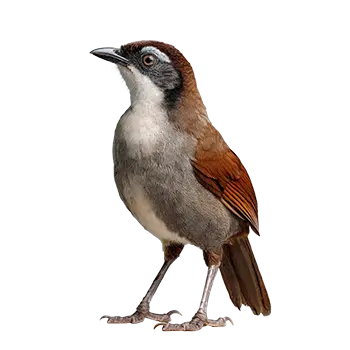
Laughing Thrushes are medium-sized passerine birds ranging from approximately 9 to 14 inches in total length depending on species, with most commonly kept avicultural species falling in the 10 to 12 inch range. Body weight typically ranges from 2 to 4 ounces. They are stocky, well-proportioned birds with rounded wings, a medium-length graduated tail, strong legs adapted for hopping and ground movement, and a robust, slightly curved bill suited to an omnivorous diet.

Plumage varies considerably between species but is generally composed of earthy browns, greys, blacks, and whites, often with boldly contrasting facial patterns. The White-crested Laughing Thrush is arguably the most striking, with a pure white head, neck, and breast contrasting sharply against dark brown upperparts and a prominent black mask through the eye. The Greater Necklaced Laughing Thrush is brown above with white underparts marked by a bold black breast band and fine black streaking. The Hwamei has warm brown plumage with intricate dark streaking and a distinctive white eye-ring and post-ocular stripe that gives the appearance of a painted eyebrow.

Sexual dimorphism is minimal across the group. Males and females are near-identical in plumage, making visual sexing unreliable. Behavioral cues during the breeding season — particularly male song intensity and display posturing — can assist in sexing, but DNA testing remains the most reliable method for pairs intended for breeding programs.

The bill is dark grey to black in most species, moderately strong, and suited to crushing small invertebrates, probing soft substrate, and manipulating fruit. The legs are strong, pinkish-grey to brown, and the feet are equipped with well-developed claws for gripping branches and scratching through leaf litter. The eyes are typically dark brown to reddish-brown, often set within distinctive facial patterning that enhances their visual expressiveness.

Overall, Laughing Thrushes present as alert, purposeful, physically robust birds whose plumage rewards close observation despite initial impressions of subdued coloration.

Affection Level
Laughing Thrushes are not affectionate birds in the conventional pet sense. They rarely seek physical contact with keepers and are best appreciated as aviary birds rather than hands-on companions. Some individuals become tolerant of their keeper's presence over time but seldom develop strong bonds with humans.
Sociability
Highly social within their own species, Laughing Thrushes thrive when kept in pairs or small compatible groups in sufficiently large aviaries. They engage constantly with companions through vocalizations and foraging, and single birds can become stressed and withdrawn without adequate social stimulation.
Vocalization
Vocalization is the defining characteristic of the group. Laughing Thrushes produce loud, complex, and extraordinarily varied songs including rich whistles, cascading laughing calls, and duets between paired birds. Their volume and frequency make them wholly unsuitable for indoor keeping in most residential settings.
Intelligence
Laughing Thrushes demonstrate solid avian intelligence adapted to foraging and social interaction. They quickly learn keeper schedules, investigate new enrichment items energetically, and problem-solve around food sources. They do not reach the cognitive complexity of corvids or large parrots but are bright, curious birds.
Exercise Needs
These active, energetic birds require a large planted aviary that allows extensive movement, hopping, and low-level flight throughout the day. They spend most daylight hours in constant motion foraging, exploring, and vocalizing. Cramped conditions lead rapidly to stress, feather condition decline, and behavioral problems.
Maintenance Level
Daily care involves offering fresh live food, fruit, and softfood alongside regular cage cleaning, as Laughing Thrushes are active feeders that create moderate mess. Aviary plantings require maintenance and substrate must be kept clean. Their dietary variety demands more daily preparation than seed-based species.
Trainability
Laughing Thrushes do not respond well to conventional training methods and are not suitable for free-flight recall or trick training. With patience, some birds can be conditioned to accept keeper presence calmly and to approach feeding stations on cue, but directed command training is not a realistic goal.
Independence
Laughing Thrushes are highly self-sufficient aviary birds that entertain themselves through foraging, singing, and social interaction with companions. They do not pine for human attention and are well-suited to keepers who provide excellent husbandry but appreciate rather than handle their birds.

Natural Habitat & Range

Laughing Thrushes of the genus Garrulax are distributed across a vast range spanning South Asia, Southeast Asia, and East Asia, with the highest species diversity concentrated in the Himalayan foothills, southern China, and the islands of Southeast Asia. Individual species occupy highly specific ecological niches within this broad range, from the subtropical forests of the eastern Himalayas to the montane forests of Borneo and the lowland jungles of Indochina.

As a group, Laughing Thrushes are predominantly forest birds with a preference for dense undergrowth, forest edges, bamboo thickets, and secondary growth vegetation. They are primarily terrestrial in foraging behavior, spending much of their time hopping through leaf litter and low shrub layers in search of invertebrates and fallen fruit. Most species are birds of mid-elevation forest zones, though some occupy lowland forest and others range into high-altitude habitats above the treeline.

The White-crested Laughing Thrush ranges from the foothills of the Himalayas through Myanmar, Thailand, and the Malay Peninsula into Sumatra and Borneo. The Hwamei is native to eastern and southern China, Taiwan, and parts of northern Indochina, and has been introduced to Hawaii and other Pacific islands through the cage bird trade. The Greater Necklaced Laughing Thrush is found across a broad arc from Nepal through southern China and mainland Southeast Asia.

In the wild, most Laughing Thrush species are non-migratory residents that maintain year-round territories in suitable forest habitat. Habitat loss through deforestation and agricultural expansion, combined with trapping pressure for the cage bird trade, has reduced populations of several species across their native ranges.

Temperament

Laughing Thrushes are bold, confident, and energetic birds with a personality that is decidedly more assertive than their softbill classification might suggest. Within their aviary, they are active and inquisitive throughout the day, moving constantly between foraging on the ground, hopping through planted shrubs, and calling from elevated perches. They are not flighty or easily startled in a well-managed environment, but they are also not placid or sedentary — these are birds that demand and create energy in their surroundings.

Toward their keeper, Laughing Thrushes maintain a characteristic wariness that never entirely disappears, even in birds that have been aviary-bred and raised in proximity to humans. They do not develop the humanized bonding behaviors of parrots and should not be expected to become handleable pets. Their relationship with the keeper is fundamentally one of familiarity and trust within boundaries — the bird is aware of and tolerant of the keeper's presence, particularly at feeding time, but prefers to maintain personal space.

Socially within their own species, Laughing Thrushes are highly engaged and communicative. Bonded pairs engage in remarkable vocal duetting, with both birds contributing to complex interwoven calls that serve as territory proclamation, pair bonding reinforcement, and social cohesion. Observing a well-bonded pair in full song is one of the most rewarding experiences in softbill aviculture.

Compatibility with other species in a mixed aviary requires careful consideration. Laughing Thrushes can be aggressive toward smaller species, particularly during feeding or breeding. They are best housed either as a single pair or with larger, similarly bold species in aviaries large enough to allow genuine territorial separation. Introducing new birds to an established aviary should always be done carefully and with close monitoring.

Breeding season brings heightened territorial behavior and increased vocalization. Males may become more assertive and should not be housed with other males of the same or similar species during this period. Nesting pairs require dense planted cover and a sense of aviary privacy to breed successfully.

Care Requirements

Laughing Thrushes are aviary birds and must be housed in an appropriately sized planted aviary rather than a conventional bird cage. A minimum aviary size for a single pair is approximately 6 feet long by 3 feet wide by 4 feet tall, but larger is strongly preferred. In a small aviary, the birds' energy and activity level will be constrained in a way that leads to stress and health decline. An aviary of 10 feet or more in length with 6-foot height allows for naturalistic movement and genuine territory establishment.

The ideal aviary for Laughing Thrushes incorporates both an enclosed sheltered indoor section and a secure outdoor planted flight. The indoor area provides protection from cold temperatures — most species should not be exposed to sustained temperatures below 45–50°F (7–10°C), and some tropical species require warmer minimums of 55–60°F. A frost-free shelter is essential for all but the hardiest montane species in temperate climates.

Planting is strongly recommended and significantly improves bird welfare. Dense shrubs, small trees, and ground-covering plants give the birds natural foraging substrate, visual cover, and nesting sites. All plants must be verified non-toxic. Suitable options include bamboo, willows, elder, hawthorn, and various non-toxic ornamental shrubs. The ground substrate should be natural — packed earth, leaf litter, or bark mulch — allowing for the ground-level foraging that these birds perform throughout the day.

Perches should be provided at varied heights using natural branches of appropriate diameter. Laughing Thrushes frequently use mid-height perches as singing posts and should have clear, elevated positions from which to vocalize. Nest boxes or dense natural shrub cover should be available if breeding is intended.

As with all avian species, Teflon and PTFE-coated cookware and appliances must never be used in or near the bird-keeping area, as PTFE fumes are immediately lethal to birds. The aviary must be fully predator-proofed with sturdy mesh and secure door systems.

Feeding & Nutrition

Laughing Thrushes are omnivores with a diet in the wild comprising invertebrates, small vertebrates, fruit, berries, and some seeds. Replicating this dietary breadth in captivity is essential for long-term health and vitality. A diet based solely on fruit or solely on seeds is wholly inadequate and will lead to nutritional deficiencies and shortened lifespan.

Live food is arguably the most critical dietary component and should be offered daily. Mealworms are the most practical and widely accepted live food and should form a consistent part of the daily ration. Waxworms can be offered as a higher-fat supplementary treat. Crickets, fruit flies, and other invertebrates add dietary variety and stimulate natural hunting behavior. The quantity of live food should be calibrated to the bird's condition — birds in breeding condition require substantially more protein than birds in maintenance.

A high-quality softbill pellet or insectivorous softfood should form a nutritional base alongside live food. Commercial insectivore mixes — dry or moistened — provide a convenient and nutritionally balanced foundation. These should be offered fresh daily and removed before they spoil, as Laughing Thrushes are particularly susceptible to bacterial infections from stale food in warm conditions.

Fresh fruit should be offered daily. Suitable fruits include apple, pear, banana, mango, papaya, berries, grapes, and figs. Stone fruits can be offered with the pit removed. Avoid avocado and other known toxic fruits. Grated carrot, sweet potato, and cooked egg can be offered as nutritional additions.

Fresh clean water must be available at all times for both drinking and bathing. Laughing Thrushes bathe regularly and a shallow bathing dish should be provided daily or kept as a permanent aviary fixture. Bathing supports feather condition and behavioral wellbeing. Water dishes should be cleaned daily.

Calcium supplementation via cuttlebone or a mineral block is beneficial, particularly during the breeding season. Avoid iron-rich supplementation as softbills can be susceptible to iron storage disease, though this is a lesser concern in Laughing Thrushes than in fruit-specialist species like toucans or birds of paradise.

Laughing Thrush Health & Lifespan

Laughing Thrushes are generally hardy birds when provided appropriate housing, diet, and temperature management, with lifespans of 10 to 15 years achievable in well-maintained aviaries. The most common health problems in the group arise from husbandry failures rather than inherent fragility — inadequate live food, damp or cold housing, and poor aviary hygiene account for the majority of disease presentations. Regular health monitoring by an avian veterinarian familiar with passerine softbills is strongly recommended, as annual wellness exams with fecal screening can detect parasitic and bacterial burdens before clinical signs appear.

With proper omnivore nutrition, a clean naturalistic aviary, appropriate temperature management, and regular avian veterinary oversight, Laughing Thrushes can live a full and healthy 10 to 15 years in captivity. Any bird displaying fluffed feathers, reduced appetite, abnormal droppings, or respiratory signs should be assessed by a veterinarian without delay, as passerine softbills can decline rapidly once illness becomes clinically apparent. Proactive husbandry is far more effective than reactive treatment for this group.

Common Health Issues

  • Coccidiosis is a common intestinal parasitic infection in aviary softbills - Transmitted through contaminated droppings in the substrate and causing diarrhea, weight loss, lethargy, and fluffed posture. Regular fecal screening and substrate hygiene are essential preventive measures.
  • Respiratory infections including bacterial pneumonia and air sac infection can develop in birds housed in cold - Damp, or poorly ventilated conditions, presenting as labored breathing, open-mouth breathing, tail bobbing, and nasal discharge requiring prompt veterinary treatment.
  • Trichomoniasis, a protozoan infection affecting the upper digestive tract - Can occur in softbill species sharing water sources with infected doves or pigeons, causing lesions in the mouth and crop that impair swallowing. Treatment with antiprotozoal medication is effective when diagnosed early.
  • Feather condition decline including dull - Brittle, or stress-marked feathers commonly results from nutritional deficiencies, overcrowding, insufficient bathing access, or chronic low-level stress. Addressing the underlying husbandry cause is essential alongside any supportive treatment.
  • Aspergillosis, a fungal respiratory infection caused by Aspergillus spores in damp organic substrate - Can develop in birds housed in poorly maintained aviaries with wet leaf litter or moldy food. Prevention through substrate hygiene and good ventilation is far more effective than treatment.
  • Bacterial enteritis from spoiled food - Contaminated water, or dirty feeding dishes is a frequent cause of acute illness in insectivore and omnivore species whose moist diets spoil rapidly. Symptoms include loose droppings, lethargy, and reduced appetite requiring veterinary diagnosis and antibiotic treatment.

Preventive Care & Health Monitoring

  • Schedule annual wellness examinations with an avian veterinarian experienced in passerine softbills - Including fecal parasitology screening, physical assessment, and weight monitoring to detect subclinical disease before clinical signs appear.
  • Offer fresh live food - Moistened insectivore mix, and fresh fruit daily while removing all uneaten moist food within a few hours to prevent bacterial growth, and clean food and water dishes thoroughly each day.
  • Maintain aviary substrate cleanliness with daily removal of droppings from high-traffic areas - Regular replacement of ground substrate, and monitoring for damp patches or mold growth that create conditions for aspergillosis and parasitic coccidiosis.
  • Ensure the aviary maintains appropriate temperature minimums - Provides a daily fresh bathing dish, includes sufficient planting and perch variety for natural behavior, and protects birds from stressors such as predator presence that contribute to chronic immune suppression.

Training & Vocalization

Training Laughing Thrushes in the conventional sense is not a realistic goal, and keepers who approach this group expecting the interactive trainability of parrots will be disappointed. These are aviary birds whose behavioral rewards are observational — the pleasure of watching natural foraging behavior, social interaction between paired birds, and above all, the extraordinary vocalization that defines the group.

The most meaningful conditioning that can be achieved is habituation — gradually reducing the bird's wariness threshold so that it behaves naturally in the keeper's presence rather than retreating or alarm calling. This is achieved simply through consistent, calm, unhurried presence near the aviary during feeding, moving slowly and predictably, and avoiding direct eye contact during the early stages of habituation. Birds that are fed by the same keeper daily over weeks and months develop a functional recognition of and tolerance for that individual.

For birds that will need to be caught for veterinary examination or transport, conditioning to enter a transport crate voluntarily for food rewards is valuable and achievable with patience. Target training using a dowel and food reward is possible with some individuals and can assist in guiding birds to specific locations within the aviary without physical handling.

Vocalization is where Laughing Thrushes are truly remarkable and the primary reason they have been prized in aviculture for hundreds of years. Different species have markedly different vocal characters. The Hwamei (Garrulax canorus) is regarded as one of the finest songbirds in Asian aviculture, producing extraordinarily complex, fluid, melodic songs that male birds develop and elaborate over years. In traditional Chinese bird culture, experienced male Hwamei with exceptional song repertoires have been valued as highly as prize animals in other traditions.

The White-crested Laughing Thrush produces the classic explosive laughing chorus most associated with the common name — a cascading, infectious call that once heard is impossible to forget. Pairs frequently engage in antiphonal duetting, with each bird producing complementary phrases that interlock into a combined call far louder than either individual voice.

Vocalization occurs throughout the day with peaks at dawn and dusk, and males in particular sing most intensively during the breeding season. The volume level is genuinely loud by any standard — these birds are not suitable for indoor keeping in most residential environments, and aviary placement must take neighbor proximity into account. In a garden aviary setting, the daily chorus is a major attraction for many keepers and a defining feature of the softbill aviary experience.

Children & Other Pets

Laughing Thrushes are not recommended as birds for households seeking a hands-on pet experience or for families with young children who expect direct interaction. These are observational aviary birds that require a calm environment and should not be handled by children. Their tendency toward alarm responses when approached suddenly and their vocal assertiveness make them a poor fit for chaotic or busy household environments.

Older children who can learn to move slowly and quietly around bird aviaries and who have a genuine interest in natural behavior and bird song can develop a meaningful appreciation for Laughing Thrushes. Observing the birds' foraging behavior, listening to their vocalizations, and understanding their natural history can provide an educational experience for engaged young people, but the observation must remain passive and respectful.

In a mixed-species aviary, Laughing Thrushes require careful species pairing. They are assertive feeders and can be aggressive toward smaller softbill species, particularly around food stations or during the breeding season. They are generally not compatible with small finches or canaries in shared accommodation. Larger, similarly bold softbills of comparable size — certain thrushes, Shamas, or other medium softbills — may coexist successfully in large, well-planted aviaries with multiple feeding stations, but introductions should always be monitored closely.

Multiple males of the same or closely related species should not be housed together, as territorial conflict between males is intense and persistent, particularly during breeding season. A single proven pair per aviary is the standard recommendation for successful management.

Cats, dogs, and other predatory pets must be completely excluded from access to the aviary. Beyond the direct physical threat, the chronic stress of repeated predator presence at the aviary mesh suppresses immune function and breeding behavior over time. Aviary design must physically prevent all predator contact with the mesh or structure. A double-door entry system prevents escape during keeper entry and exit.