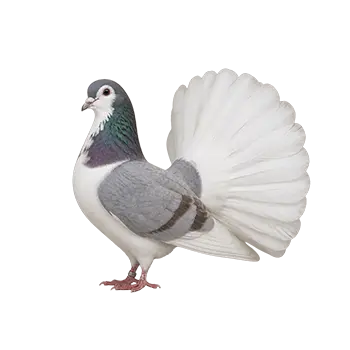

Fantail Pigeons require housing that accounts for their distinctive physical characteristics and their limited flight ability. The breed's elaborate fan-shaped tail, which can carry thirty to forty feathers spread in a broad arc behind the body, makes them significantly less agile in the air than common pigeons or performance breeds. Most Fantails can manage only short, awkward flights and are vulnerable to predators when outside a secure enclosure. This reduced mobility means their housing must provide everything they need within a protected space rather than relying on free flight for exercise and foraging.
Space requirements for Fantails are generous compared to many pigeon breeds. Each bird should have a minimum of four square feet of floor space in the loft or enclosure, with additional room for nesting pairs. Overcrowding leads to stress, feather damage, territorial aggression, and increased disease transmission. Because Fantails spend most of their time walking rather than flying, floor space is more important than vertical height, though perches at varying low heights allow the birds to roost comfortably and exercise their limited flight capability.
Ventilation is one of the most critical and frequently underestimated aspects of pigeon housing design. Pigeons produce significant amounts of feather dust and dander, and their droppings release ammonia as they decompose. Without adequate airflow, these airborne irritants accumulate rapidly and cause respiratory disease, which is one of the leading health problems in captive pigeons. Effective ventilation provides a steady exchange of fresh air without creating drafts at perch level, typically achieved through high ventilation openings near the roofline combined with lower intake vents positioned away from roosting areas.
Protection from predators is non-negotiable for Fantail housing. Because Fantails cannot fly well enough to escape danger, they are easy targets for cats, raccoons, raptors, rats, and snakes. Housing must be constructed with sturdy materials and secured with hardware cloth rather than standard chicken wire, which many predators can tear or squeeze through. All openings, including ventilation points, must be covered with mesh no larger than half an inch. Doors and access panels should latch securely, and the floor of the enclosure should prevent digging predators from tunneling underneath.