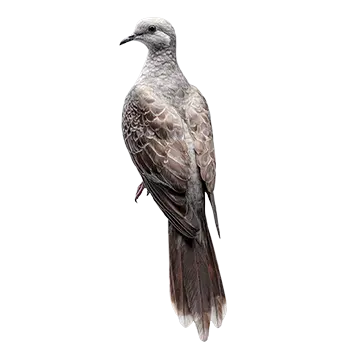

Enrichment for Cape Doves must be understood through the lens of this species' natural behavior rather than through the parrot-centric framework that dominates the pet bird market. Cape Doves are not manipulators, chewers, or puzzle solvers in the way that hookbills are. They do not hold objects in their feet, disassemble hardware, or derive satisfaction from destroying wooden blocks. The vast majority of commercially available bird toys are designed for parrots and are functionally irrelevant to doves. Applying parrot enrichment strategies to a Cape Dove is not merely unhelpful; it can clutter the enclosure with unused objects that reduce flight space and create obstacles.
The behavioral drives that enrichment should target in Cape Doves are foraging, locomotion, bathing, sunbathing, and social interaction. In the wild, Cape Doves spend a substantial portion of their waking hours walking across open ground, picking up tiny seeds one at a time. This is a slow, repetitive, detail-oriented activity that occupies the bird both physically and cognitively. Replicating this experience in captivity is the single most effective enrichment strategy available, and it requires surprisingly little in the way of purchased products.
Social enrichment deserves equal emphasis. Cape Doves are pair-bonding species that derive significant behavioral satisfaction from the company of a conspecific. A lone Cape Dove, no matter how well its physical environment is designed, will lack a critical dimension of stimulation that no toy or foraging device can replace. For keepers who maintain a single bird, regular visual and auditory contact with the household becomes the primary form of social enrichment, though it is a distant substitute for a compatible companion of the same species.
Environmental novelty, offered at a gentle pace, rounds out the enrichment picture. Cape Doves are cautious birds that can be overwhelmed by sudden changes to their environment. New items introduced to the enclosure should be placed outside the cage first, within the bird's line of sight, for a day or two before being moved inside. This gradual introduction respects the species' neophobic tendencies while still providing the cognitive stimulation that comes from encountering and evaluating new objects.