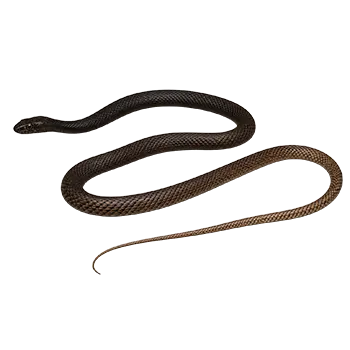

The juvenile phase of the Coachwhip (Masticophis flagellum) spans roughly from the end of the hatchling period at around three to four months of age through the attainment of sexual maturity at approximately two to three years. During this interval, the snake undergoes dramatic physical transformation, growing from a slender neonate of twelve to sixteen inches to a lean, muscular adolescent that may exceed three and a half feet. Growth is most rapid during the first eighteen months, when consistent feeding and proper thermal conditions can produce gains of two to four inches per month. This pace is among the faster growth trajectories in North American colubrids and places high nutritional and metabolic demands on the developing animal.
The juvenile Coachwhip's body proportions shift noticeably during this phase. Hatchlings are proportionally large-headed and thin-bodied, but as the snake grows, the body fills out and the head becomes more proportionate relative to the neck and trunk. The dorsal coloration undergoes a gradual but striking transition as well. The bold crossbanded pattern of the hatchling fades progressively, replaced by the species' characteristic adult coloration, which varies by geographic origin. Eastern populations trend toward a dark brown or black anterior that lightens to tan or beige posteriorly, while western populations, sometimes called red racers, develop shades of pink, salmon, or russet along much of the body. This ontogenetic color change is one of the more dramatic in North American snakes and can be tracked visually through successive sheds.
Skeletal and muscular development during the juvenile period supports the Coachwhip's identity as one of the most athletic snake species on the continent. The long, whip-like tail, which gives the species its common name, becomes increasingly prominent as the snake lengthens. The musculature along the dorsal and lateral body walls thickens, enabling the rapid terrestrial locomotion for which the species is renowned. Juvenile Coachwhips are capable of surprisingly fast movement even before reaching full adult proportions, and keepers will notice that the snake's speed and agility increase markedly between six and twelve months of age.
Weekly or biweekly weight tracking remains an important practice throughout the juvenile phase. Plotting weights over time on a simple chart reveals the growth trajectory and highlights any plateaus or declines that may indicate illness, parasitic burden, or inadequate nutrition. A healthy juvenile Coachwhip should show consistent upward weight trend between shed cycles. Brief stagnation around shedding events is normal, but extended plateaus lasting more than three to four weeks warrant a review of feeding frequency, prey size, and environmental conditions.