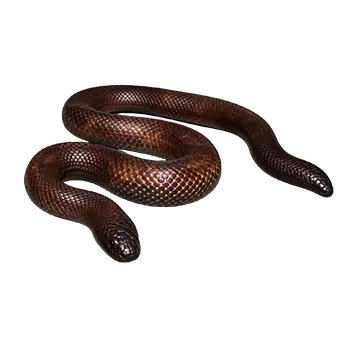

The adult Calabar Python (Calabaria reinhardtii) reaches full physical maturity between three and five years of age, though growth in length continues at a nearly imperceptible rate for several additional years. A fully grown adult typically measures between twenty-four and thirty-six inches in total length, with females occasionally reaching the upper end of this range and males tending toward the lower. Adult body weight generally falls between 200 and 500 grams depending on length, sex, and body condition. The species' distinctive cylindrical body shape, nearly uniform in diameter from behind the head to the vent, gives the adult Calabar Python a visual density that belies its modest length, and well-conditioned adults feel remarkably solid and muscular when handled.
Assessing body condition in a fossorial species that is rarely seen above substrate requires periodic physical examination. A healthy adult should feel firm and well-muscled without visible backbone or rib ridges along the dorsal surface, and without prominent fat rolls or lateral bulging that suggests obesity. When viewed in cross-section, the body should be smoothly cylindrical. The ventral surface should be flat or very slightly rounded when the snake is at rest. Emaciation manifests as a triangular cross-section with the spine forming the apex, while obesity produces a noticeably flattened ventral surface with soft, doughy lateral folds when the snake is held vertically.
Adult coloration in the Calabar Python is typically a rich dark brown to near-black ground color marked with irregular patches, spots, or blotches of orange, rust, reddish-brown, or occasionally pale cream. Pattern intensity varies among individuals, with some specimens showing bold, well-defined markings and others displaying a more uniformly dark appearance. The ventral surface is usually lighter, ranging from cream to pale gray with variable darker spotting. Coloration can serve as a rough health indicator: adults in optimal condition display deep, saturated colors, while stress, dehydration, or illness often causes the overall appearance to become dull and washed out, particularly noticeable in the days following a substandard shed.
The head remains characteristically small and blunt throughout adulthood, barely wider than the neck, with smooth, symmetrical scales and small, dark eyes positioned laterally. The tail retains its rounded, head-like tip and may show slightly brighter or more contrasting coloration than the body in some individuals. Adults continue to employ the tail-mimicry defensive posture throughout their lives, though well-socialized individuals in calm environments may use it less frequently than wild or recently acquired specimens.