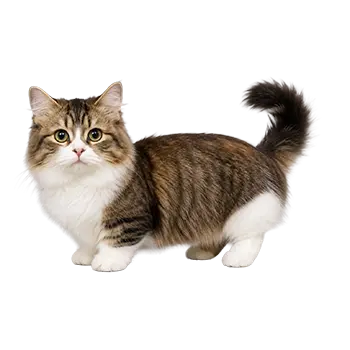

The juvenile stage for a Kinkalow cat typically spans from around two months to roughly one year of age, though some individuals may continue filling out until eighteen months. During this period, the Kinkalow's distinctive physical features become fully established. The short legs inherited from the Munchkin parent will be clearly proportioned relative to the body, and any ear curl from the American Curl lineage will have reached its final degree of curvature. Growth rates will be slower than in standard-sized breeds, and owners should not be concerned if their Kinkalow appears smaller than other cats of similar age.
Weight gain during this period should be steady but gradual. Most Kinkalow kittens will reach their adult weight of three to seven pounds by around twelve months, though males tend to be slightly larger than females. Regular weigh-ins every two weeks can help track progress and identify any growth stalls that might indicate nutritional deficiencies or underlying health issues. Keep a simple log so you can share trends with your veterinarian at checkup visits.
Physically, the Kinkalow's body will transition from the rounded, soft kitten form to a more defined and muscular shape. Despite their short legs, healthy Kinkalows develop strong, compact bodies with good muscle tone. Their coat will undergo a transition during this period as well, shedding the fine kitten fur and growing in the denser, plush adult coat. You may notice changes in coat texture and even slight shifts in color or pattern intensity as the adult coat comes in.
Monitor leg and spinal development carefully during the growth phase. While the shortened leg structure is a normal breed characteristic, any signs of difficulty walking, reluctance to jump at appropriate heights, or an unusual gait should be evaluated by a veterinarian. The vast majority of Kinkalows move freely and comfortably, but early detection of any skeletal irregularities ensures the best possible outcome.