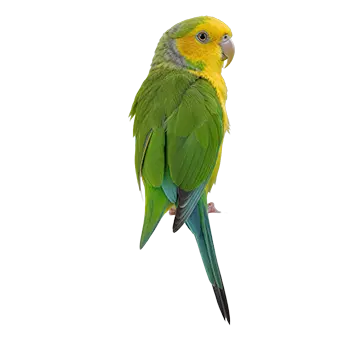

The Yellow-Faced Parrotlet reaches full physical maturity between eight and twelve months of age, marking its transition into the adult stage that will span the majority of its 15- to 20-year lifespan. At maturity, this species is the largest member of the Forpus genus, typically measuring 5.5 to 6 inches from the tip of the beak to the end of the tail and weighing between 28 and 40 grams. The robust, stocky build that characterizes parrotlets is particularly pronounced in this species, giving the bird a compact, powerful appearance that belies its small stature.
Adult plumage in the Yellow-Faced Parrotlet is distinctive and makes the species immediately recognizable among parrotlet enthusiasts. The face, forehead, and crown display the bright yellow coloring from which the species takes its common name. This yellow extends variably across the chest and underparts depending on the individual and, in some cases, regional variation within the species' native range in the Maranon Valley of northern Peru. Males are distinguished from females by the presence of cobalt blue markings on the rump, lower back, and secondary wing coverts. Females typically display a greener tone in these same areas with little to no blue.
The beak in adult Yellow-Faced Parrotlets is horn-colored and notably strong for the bird's size. Parrotlets in general possess powerful beaks relative to their body dimensions, and the Yellow-Faced Parrotlet is no exception. This beak strength has practical implications for cage construction, toy selection, and handling. Lightweight plastic toys designed for budgies or finches will be demolished quickly and may pose ingestion risks. Cage bars must be spaced closely enough, no more than half an inch apart, to prevent the bird from squeezing through or becoming trapped.
Maintaining the bird's adult weight within a healthy range requires ongoing attention to diet and exercise. An adult Yellow-Faced Parrotlet that consistently weighs above or below its established healthy baseline, as determined by regular weigh-ins and veterinary assessment, may be experiencing a nutritional imbalance, hormonal shift, or early-stage illness. Establishing a weight baseline during the prime years creates a critical reference point for detecting changes as the bird ages.