
Fledging & First Flights

The transition from nest-bound chick to fledgling is one of the most dramatic and consequential periods in a White-crested Laughingthrush's life. Fledging typically occurs between 15 and 20 days of age, though the exact timing varies depending on clutch size, nutritional history, and individual developmental pace. The fledgling emerges from the nest with functional but not yet fully developed flight feathers, capable of short, clumsy flights and controlled descents but far from the agile flier it will become over the following weeks.

In an aviary setting, prepare the environment before fledging begins. Remove or cover any hazards that a poorly coordinated young bird might collide with, including exposed glass panels, open water containers deep enough to pose a drowning risk, and narrow gaps between structures where a fledgling could become trapped. Position low perches and dense foliage at various heights to give the newly fledged bird safe landing options as it practices flight. Padding the aviary floor with a thick layer of clean leaf litter or soft substrate can cushion the inevitable crash landings that occur during early attempts.

The first few days after fledging are characterized by rapid improvement in flight coordination and landing accuracy. The juvenile laughingthrush will make increasingly confident flights between perches, though it may still misjudge distances and struggle with sharp turns. Both parents typically continue to feed the fledgling during this period, often following it around the aviary and delivering food to wherever it has landed. This parental provisioning is critical, as the energy demands of learning to fly are substantial and the young bird cannot yet forage efficiently on its own.

Hand-reared fledglings face a unique set of challenges during this stage. Without parental role models to follow, they may be slower to develop confidence in flight and may exhibit more hesitation about leaving the security of their brooder or rearing enclosure. Provide a flight-safe room or enclosed space where the hand-reared bird can practice without risk of escape or injury. Encourage flight with gentle tossing onto soft surfaces from progressively greater heights, and reward successful flights with immediate food delivery to reinforce the behavior.

Weaning & Dietary Transition

Weaning represents the gradual shift from dependence on parental feeding or hand-feeding to independent consumption of solid foods. In White-crested Laughingthrushes, this process typically begins shortly after fledging and continues over a period of two to four weeks, during which the juvenile bird learns to recognize, manipulate, and consume a range of food items on its own. Rushing the weaning process can lead to malnutrition and psychological stress, while delaying it unnecessarily can create dependence issues that complicate the bird's long-term management.

For parent-raised juveniles, weaning occurs naturally as the parents gradually reduce the frequency and quantity of direct feedings. The adults begin placing food near the fledgling rather than delivering it directly to the beak, encouraging the young bird to pick up items independently. This natural weaning timeline should be respected and not artificially accelerated. Ensure that a diverse array of appropriate foods is available within easy reach of the fledgling, including small live insects, finely chopped fruits, soaked softbill pellets, and moistened egg food.

Hand-reared birds require a more structured approach to weaning. Begin by placing shallow dishes of easily accessible food items in the rearing enclosure while continuing regular hand-feedings. Mealworms, waxworms, small pieces of ripe banana, papaya, and blueberries are all appealing starter foods that a young laughingthrush will readily explore. As the juvenile begins consuming measurable quantities of solid food, reduce hand-feedings by one session at a time, starting with midday feedings and retaining the morning and evening sessions longest.

Monitor weight carefully throughout the weaning period. A slight weight plateau is normal as the bird transitions between food sources, but sustained weight loss indicates that the juvenile is not consuming enough solid food to meet its caloric needs and that hand-feeding reductions should be slowed or temporarily reversed. The weaning process is complete when the juvenile consistently maintains or gains weight while feeding entirely on its own, shows no begging behavior directed at caregivers or parents, and actively forages throughout the day.

The post-weaning diet should reflect the omnivorous nature of the species. Offer a base of high-quality insectivore pellets supplemented with a rotating selection of live insects, chopped fruits, berries, and occasional mealworms. Calcium supplementation through cuttlebone or calcium-dusted insects supports ongoing skeletal development. Fresh water must always be available in a shallow, stable container that the juvenile cannot tip or fall into.

Plumage Development & Molt

Juvenile White-crested Laughingthrushes undergo significant plumage changes during their first several months of life as they transition from their initial fledgling feathers to the definitive adult plumage that characterizes the species. Understanding the normal progression of feather development helps caregivers assess overall health, since plumage quality is one of the most visible indicators of nutritional status and general well-being.

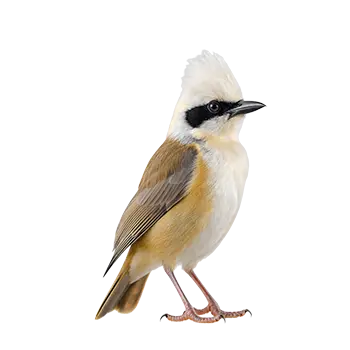
At fledging, the juvenile's plumage is generally similar to the adult pattern but may appear softer, less sharply defined, and slightly duller in coloration. The distinctive white crest that gives the species its common name is present but often shorter and less fully developed than in mature birds. The brown body feathers, black facial mask, and white throat and breast markings are all visible but may lack the crisp contrast seen in adults. Over the ensuing weeks, as the juvenile feathers continue to grow in fully and the keratin sheaths are preened away, the plumage becomes more refined.

The first complete molt, known as the post-juvenile or pre-basic molt, typically begins at approximately two to three months of age and extends over several weeks. During this molt, the juvenile replaces its initial feather coat with a fresh set of feathers that more closely resembles the definitive adult plumage. Molting is an energetically demanding process, and the juvenile's dietary needs increase during this period. Increase protein availability through live food offerings and ensure that adequate vitamins and minerals, particularly vitamin A, biotin, and amino acids containing sulfur, are present in the diet to support healthy feather synthesis.

During the molt, observe the bird for signs of abnormal feather development. Stress bars, which appear as thin horizontal lines of weakness across the feather vanes, indicate that the bird experienced nutritional deficiency or physiological stress at the time those feather sections were growing. Retained feather sheaths that the bird cannot remove through normal preening may indicate low humidity, a lack of bathing opportunities, or underlying health issues. Provide daily access to shallow bathing water or a fine mist spray to help the juvenile manage feather maintenance during this transition.

Social Development & Flock Integration

The juvenile period is when White-crested Laughingthrushes develop the complex social skills they will rely on throughout their lives. In the wild, these birds live in cohesive flocks of five to fifteen or more individuals, communicating through an elaborate vocal repertoire and maintaining group cohesion through constant contact calls, mutual preening, and cooperative behaviors. Captive juveniles need opportunities to develop these same social competencies, whether among conspecifics, with other compatible species, or through structured interaction with human caregivers.

Parent-raised juveniles that remain within a flock environment have the richest opportunities for social learning. They observe and imitate the foraging strategies, predator awareness behaviors, and vocal patterns of the adults around them. The characteristic laughing calls of the species begin to emerge during the juvenile period, starting as rough, imprecise vocalizations that gradually become clearer and more structured through practice and imitation. Young birds can often be heard rehearsing call patterns, sometimes in coordinated bouts with siblings or other juveniles in the group.

Introducing a juvenile to an established flock of unrelated adults requires careful management. White-crested Laughingthrushes can be territorial and may initially react aggressively toward an unfamiliar young bird. Use a gradual introduction process, beginning with visual and auditory contact through an adjacent enclosure before allowing physical access to the shared space. Monitor the first direct interactions closely for signs of aggression, including sustained chasing, pinning, or feather pulling. Most well-socialized flocks will accept a new juvenile within a few days to a week, but persistent aggression may require separation and a slower reintroduction timeline.

Hand-reared juveniles present particular social challenges. Birds raised without conspecific contact may not recognize or respond appropriately to the social signals of their own species. They may display misdirected bonding behaviors toward humans, show excessive fearfulness around other birds, or lack the vocal repertoire necessary for flock communication. Whenever possible, expose hand-reared juveniles to adult laughingthrushes during the fledgling and weaning period so they can begin absorbing species-appropriate behaviors. Even visual and auditory exposure through adjacent housing is preferable to complete isolation from conspecifics.

Enrichment activities during the juvenile period should emphasize social engagement and cognitive stimulation. Provide foraging opportunities that encourage problem-solving, such as insects hidden in leaf litter, food items tucked into crevices in branches, or small puzzle feeders designed for passerines. These activities satisfy the juvenile's natural curiosity, build foraging competence, and reduce the likelihood of stereotypic behaviors developing from boredom or under-stimulation.

Housing & Enclosure Requirements

As the White-crested Laughingthrush transitions from the nest to the juvenile stage, its housing requirements change substantially. The confined warmth of the brooder or nest box gives way to a need for space, complexity, and environmental stimulation. Proper housing during the juvenile period supports physical development, encourages natural behaviors, and provides the young bird with the exercise and mental engagement it needs to mature into a healthy, well-adjusted adult.

A juvenile laughingthrush should be housed in an enclosure that allows sustained flight. These are active, energetic birds, and adequate flight space is essential for the development of strong flight muscles, cardiovascular fitness, and coordination. For a single juvenile or a small group, a planted aviary with a minimum length of six to eight feet is recommended. The enclosure should include perches of varying diameters and materials positioned at different heights to encourage movement and strengthen the feet and legs. Natural branches with bark are preferable to smooth dowel perches, as they provide textural variety and better grip.

Planting the aviary with non-toxic, dense shrubs and ground cover transforms the enclosure from a bare cage into a naturalistic habitat that supports the laughingthrush's ground-foraging instincts. These birds spend considerable time on the ground in the wild, turning over leaf litter and probing soil for invertebrates. A deep layer of clean leaf litter on the aviary floor gives the juvenile an outlet for this natural behavior and provides foraging enrichment when live insects or food items are scattered within it.

Climate management within the enclosure is important, particularly for juveniles that are still completing their first molt and may be less resilient to temperature extremes than fully feathered adults. In temperate climates, White-crested Laughingthrushes can tolerate a range of outdoor temperatures, but juveniles should have access to a sheltered, draft-free area where they can retreat during cold or wet weather. Heated indoor sections connected to outdoor flights are ideal for year-round housing in regions with significant seasonal temperature variation.

Cleanliness and hygiene standards remain high during the juvenile period. Clean food and water stations daily, remove uneaten perishable foods within a few hours to prevent bacterial growth, and maintain the aviary substrate in a condition that does not promote mold or parasite development. Regular replacement or refreshment of the leaf litter layer keeps the foraging substrate hygienic while maintaining its enrichment value.

Juvenile Health Concerns

The juvenile period introduces a new set of health considerations as the White-crested Laughingthrush becomes more active, explores its environment, and interacts with a broader range of stimuli. While the acute fragility of the neonatal stage has passed, juveniles remain more susceptible to certain illnesses and injuries than fully mature adults, and vigilant health monitoring should continue throughout this developmental phase.

Respiratory infections remain a significant concern during the juvenile period. Aspergillosis, caused by the fungus Aspergillus, is one of the most serious respiratory diseases affecting passerines in captivity. Juvenile birds are particularly vulnerable because their immune systems are still maturing and they may encounter fungal spores in substrate, nesting material, or poorly ventilated enclosures. Maintain excellent air quality and ventilation in the housing area, avoid moldy or damp substrates, and ensure that food items are fresh and free of fungal contamination. Symptoms of aspergillosis include labored breathing, tail bobbing, decreased activity, and voice changes, and the disease often requires aggressive antifungal treatment if caught early enough to be treatable.

Gastrointestinal parasites are another common health issue in juvenile laughingthrushes, especially those housed in outdoor aviaries with soil or natural substrates. Roundworms, capillaria, and coccidia are among the most frequently encountered parasites in captive passerines. Routine fecal examinations performed by an avian veterinarian every three to six months allow early detection and treatment before parasite burdens become heavy enough to cause clinical illness. Signs of parasitic infection include weight loss, poor feather condition, diarrhea, and decreased appetite.

Traumatic injuries are more common during the juvenile period than at any other life stage, a direct consequence of the young bird's inexperience with flight and its tendency to explore aggressively. Collisions with aviary walls, windows, or hard objects can cause concussions, wing injuries, or leg fractures. Night frights, episodes of panicked flight triggered by disturbances after dark, pose a particular risk and can be mitigated by providing a dim night light in the enclosure, avoiding sudden loud noises near the aviary after dusk, and covering exposed glass or wire panels that the bird might fly into during disorientation.

Schedule a comprehensive veterinary examination for the juvenile at approximately three months of age, even if the bird appears healthy. This visit should include a thorough physical examination, fecal parasite screening, and a discussion of the bird's diet, housing, and behavioral development. Establishing a veterinary baseline during the juvenile period makes it much easier to detect subtle changes later in life.

Building Independence & Confidence

The overarching goal of the juvenile period is to produce a self-sufficient, confident, and behaviorally well-rounded young bird that is prepared for the transition to adulthood. White-crested Laughingthrushes are intelligent and emotionally complex, and the experiences they accumulate during their juvenile months shape their temperament, their ability to cope with environmental changes, and their capacity for social relationships for years to come.

Encourage independent foraging by gradually reducing the ease of food access. Instead of placing food in a single, obvious dish, scatter portions of the daily diet throughout the enclosure so the juvenile must search for them. Hide insects in leaf litter, tuck fruit pieces into branch forks, and rotate the locations of food stations regularly. This approach mirrors the foraging challenges the bird would face in the wild and builds the exploratory drive and problem-solving skills that keep a captive laughingthrush mentally engaged and behaviorally healthy.

Exposure to environmental novelty is another key component of confidence building. Introduce new objects, perches, and enrichment items into the enclosure on a regular basis. Rotate items in and out rather than adding clutter, so each change presents a fresh stimulus for the bird to investigate. Young laughingthrushes are naturally curious and will typically approach novel objects with interest after a brief period of cautious observation. If a juvenile shows excessive or prolonged fearfulness toward a new item, do not force interaction. Remove the item and reintroduce it at a later date, perhaps paired with a food reward to create a positive association.

For hand-reared birds destined to remain as companion animals rather than aviary birds, the juvenile period is the time to establish the routines and boundaries that will govern the human-bird relationship going forward. Teach the bird to step up onto the hand on cue, to return to its enclosure willingly, and to accept basic handling for health checks. Use positive reinforcement, primarily food rewards and verbal praise, to shape desired behaviors. Avoid punitive responses to unwanted behaviors, as laughingthrushes are sensitive birds that respond poorly to negative interactions and may develop fear-based aggression or avoidance if subjected to them.

Finally, assess the juvenile's readiness for the adult stage by evaluating several benchmarks. The bird should be fully weaned and maintaining a stable weight on an independent diet. Its plumage should be complete or nearly complete, with the first molt well underway or finished. Socially, it should be engaging appropriately with conspecifics or caregivers, displaying species-typical vocalizations, and showing no signs of chronic stress such as feather plucking, excessive screaming, or repetitive stereotypic movements. A juvenile that meets these criteria is well prepared for the freedoms and responsibilities of adult life.

Always consult a qualified professional before making any health-related decisions. This content is provided for informational reference only and should not replace professional guidance specific to your animal.