
The Weaning Transition

Weaning is one of the most consequential phases in a young Swainson's Toucan's development, and it demands considerably more patience and attention than many keepers anticipate. Unlike psittacines, which may take months to fully wean, ramphastid chicks transition to independent feeding relatively quickly, often completing the process between seven and ten weeks of age. However, the speed of the transition does not reduce its complexity. A poorly managed weaning can result in nutritional deficits, stress-related behavioral problems, and a lasting mistrust of solid foods that complicates dietary management for years.

The weaning process should be led by the chick rather than imposed by a schedule. The first sign that a Swainson's Toucan chick is ready to begin weaning is a consistent decline in its enthusiasm for hand-feeding, often accompanied by increased interest in objects around it, including food dishes, fruit pieces, and even the caregiver's fingers. At this point, begin placing small pieces of soft, ripe fruit such as papaya, banana, blueberries, and steamed sweet potato in a shallow dish within the chick's enclosure. Do not reduce hand-feeding volumes preemptively. Instead, allow the chick to increase its solid food intake at its own pace while formula feedings are gradually decreased in response to reduced demand.

The transition period is physiologically demanding. The chick's digestive system must adapt from processing a uniform, pre-digested formula to handling whole fruit with varying fiber, sugar, and moisture content. Monitor droppings closely during this period, as temporary changes in consistency and color are normal, but persistent diarrhea, undigested food particles, or a return to watery droppings after a period of normal output may indicate that the gut is struggling. Weight should continue to increase, though the rate of gain will naturally slow compared to the rapid growth phase of the first few weeks.

Some chicks regress during weaning, returning to loud begging and refusing solid food after having shown initial interest. This is normal and should not be met with forced deprivation of hand-feeding formula. A chick that is truly hungry must be fed. Forced weaning, where formula is withheld to compel the chick to eat solids, is stressful, can cause dangerous weight loss, and frequently backfires by creating anxiety around food. Patience and consistent availability of appealing solid options will bring even reluctant chicks through the transition safely.

Flight Development & Physical Growth

A juvenile Swainson's Toucan's first flight is a pivotal event that marks its transition from a dependent nestling to an increasingly autonomous young bird. Fledging typically occurs around six to eight weeks of age, though individual variation is common. In the days leading up to the first flight, the chick will exercise its wings with increasing vigor, flapping energetically while perched and sometimes lifting itself a few inches off the surface. The flight feathers should be fully emerged from their sheaths and appear intact and symmetrical. Any broken, bent, or missing flight feathers at this stage should be evaluated, as they can impair the chick's ability to fly safely.

The environment in which first flights occur must be carefully managed. A room with hard walls, ceiling fans, open windows, large mirrors, or exposed water surfaces presents serious hazards to a fledgling whose flight control is still rudimentary. Ideally, the chick's first flights should take place in a small, enclosed room with padded or curtained walls, no overhead hazards, and soft landing surfaces. Close all doors and windows, cover mirrors and glass, and remain present to supervise. Early flights are often short, clumsy, and end with crash landings, which is entirely normal. The chick will gain altitude control, turning ability, and landing precision over the course of several days to two weeks of practice.

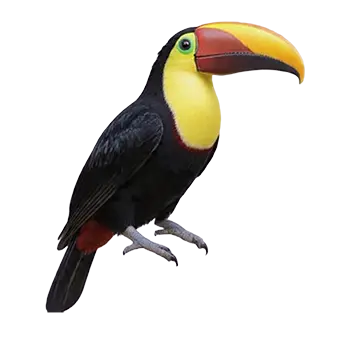
Physical growth during the juvenile period extends well beyond plumage. The bill, which at fledging is still considerably smaller and softer than an adult's, continues to elongate and harden over the following three to four months. The iconic bicolored pattern of the Swainson's Toucan bill, with its chestnut-brown mandible and bright yellow maxilla accented by a maroon band, becomes progressively more vivid as the bird matures. Body mass stabilizes during this period, with the bird reaching approximately 85 to 95 percent of its adult weight by three months of age. Muscle tone, particularly in the pectoral and leg muscles, continues to develop through active flight and perching.

Provide the juvenile with an enclosure or flight space that encourages physical activity without risking injury. Multiple perches of varying diameters and textures promote healthy foot development and prevent the pressure sores that can result from standing on a single uniform surface. Natural wood branches with bark intact are ideal, as they offer grip variation and allow the bird to exercise its beak by stripping and chewing bark. Swings, ropes, and gently swaying perches add complexity and encourage balance and coordination. The juvenile period is when the bird's musculoskeletal system is most responsive to environmental enrichment, and investments made now pay dividends in lifelong physical health.

Diet & Nutrition for the Growing Juvenile

Establishing a complete and appropriate diet during the juvenile period is essential for a Swainson's Toucan's long-term health, and it requires a fundamentally different approach than feeding a parrot. Toucans are frugivores with a specialized digestive tract that processes food rapidly, often passing a meal in as little as 30 to 45 minutes. This rapid transit time means that nutrient density and bioavailability matter enormously, and it also means that dietary errors, particularly excess iron, accumulate consequences faster than they would in a species with a longer gut retention time.

The foundation of a juvenile Swainson's Toucan's diet should be a variety of fresh, low-iron fruits. Papaya, banana, blueberries, grapes, melon, and fig are all excellent staples. Citrus fruits can be offered in moderation, as the vitamin C they contain enhances iron absorption and should not be provided in excess. Fruits high in iron, such as raisins and dried figs, must be avoided entirely. Alongside fruit, a high-quality, low-iron softbill pellet should constitute approximately 30 to 40 percent of the daily diet. These pellets are formulated to provide the protein, calcium, and micronutrients that fruit alone cannot supply in adequate quantities.

Animal protein is a natural and necessary component of a toucan's diet, particularly during the juvenile growth phase when the demands on the musculoskeletal system are highest. Offer small quantities of gut-loaded insects such as crickets, mealworms, and waxworms several times per week. Pinky mice, small pieces of cooked egg, and occasional low-iron cat kibble can also serve as protein sources. The protein component should represent no more than 10 to 15 percent of the total diet by volume, and all animal protein sources should be checked to confirm they are low in iron before inclusion.

Feeding presentation matters for a juvenile toucan. These birds eat by tossing food to the back of their throat with a quick upward flick of the head, and they are naturally drawn to brightly colored, bite-sized pieces. Cut fruit into pieces small enough for the bird to pick up and swallow in one or two tosses. Provide food in shallow, wide dishes placed at perch height rather than on the floor, where droppings can contaminate it. Fresh water must be available at all times, and many toucans enjoy bathing in their water dish, so expect to change it multiple times per day. The juvenile period is the ideal time to establish the dietary habits that will protect the bird from iron storage disease and nutritional deficiency throughout its life.

Behavioral Development & Training

The juvenile period is the most formative window for shaping a Swainson's Toucan's behavior and establishing the routines that will define the human-bird relationship for decades. Toucans are not parrots, and approaching their training with psittacine assumptions is a common and costly mistake. They do not learn to speak, they are generally less interested in puzzle toys and foraging devices, and their motivation structure is centered almost entirely on food rewards and social interaction rather than the complex problem-solving drive that characterizes cockatoos or macaws. What toucans do possess is an intense curiosity, a strong desire for social engagement, and a remarkable capacity for learning through positive reinforcement when the trainer understands their temperament.

Begin structured training sessions as soon as the juvenile is comfortably weaned and settled into its enclosure. The first and most important behavior to train is the step-up, where the bird voluntarily steps onto your hand or a handheld perch on cue. Use a small, high-value food reward such as a blueberry or a piece of papaya, offered immediately after the desired behavior, to build the association. Sessions should be short, no more than five to ten minutes, and should always end on a positive note. If the bird becomes distracted, agitated, or disinterested, stop the session rather than pushing for compliance. Toucans that are pressured during training quickly develop avoidance behaviors that are difficult to extinguish.

Biting is a normal part of juvenile toucan behavior but must be managed carefully to prevent it from becoming an entrenched habit. Juvenile toucans explore their world with their bills, and a nip during handling is often exploratory rather than aggressive. However, any response that reinforces the behavior, including dramatic reactions, pulling away quickly, or putting the bird back in its enclosure as a perceived reward, will increase its frequency. The most effective response to a bite is a calm, neutral redirection. Gently guide the bird's bill away from your skin and offer an appropriate object to chew, then reward the bird when it engages with the substitute.

Socialization with multiple people should continue and deepen during the juvenile period. A toucan that bonds exclusively to a single person may become aggressive or fearful toward everyone else in the household, creating management difficulties that escalate as the bird reaches adulthood. Encourage all family members to participate in feeding and training sessions. Supervised exposure to visitors, new environments, and novel objects also builds the broad social confidence that makes a toucan a genuinely enjoyable companion. The juvenile period closes the socialization window that opened during the neonatal stage, and the habits established now will be the ones the bird carries into its adult life.

Housing & Enclosure Requirements

A juvenile Swainson's Toucan's housing needs differ significantly from those of parrots of comparable size, and an inadequate enclosure is one of the most common sources of behavioral and health problems in captive ramphastids. Toucans are active, flight-oriented birds that use horizontal space more than vertical space. The minimum enclosure for a single juvenile Swainson's Toucan should be approximately four feet wide, three feet deep, and four feet tall, but larger is always better, and a small flight cage or dedicated bird room is the ideal arrangement during this high-energy developmental stage.

Bar spacing is an important consideration. Toucans have relatively weak bite pressure compared to parrots, so they are unlikely to damage cage bars, but their bills are long enough to reach through widely spaced bars and potentially injure themselves or grab objects outside the cage. A bar spacing of three-quarters of an inch to one inch is appropriate for a juvenile Swainson's Toucan. The cage material should be powder-coated steel or stainless steel, as toucans are enthusiastic bathers and their enclosures are exposed to significant moisture. Rust-prone materials degrade quickly and can introduce heavy metals into the bird's environment.

Perch layout within the enclosure deserves careful planning. Arrange perches at varying heights and orientations to encourage hopping and short flights between them. Avoid placing perches directly above food or water dishes, as toucans produce voluminous, loose droppings that will quickly contaminate anything below. Natural wood branches of varying diameter, between three-quarters of an inch and one and a half inches, exercise the feet and prevent the pressure-point problems that develop on uniform dowel perches. Replace branches regularly as they become soiled or stripped of bark.

Environmental enrichment is critical for preventing the boredom and stress behaviors, such as feather damage, repetitive bill rubbing, and excessive vocalization, that can develop in under-stimulated juvenile toucans. Rotate toys and novel objects through the enclosure on a regular schedule. Toucans are particularly attracted to brightly colored items, small balls they can pick up and toss, and items with interesting textures. Shallow bathing dishes should be available daily, as Swainson's Toucans are avid bathers who use water not only for hygiene but as a form of play and thermoregulation. The enclosure should be positioned in a room where the bird can observe household activity and interact with its family, but away from direct sunlight, kitchen fumes, and drafts.

Juvenile Health Monitoring

Ongoing health surveillance during the juvenile period builds on the foundation established during the neonatal phase and addresses a new set of age-specific concerns. The juvenile Swainson's Toucan is no longer the fragile hatchling that required round-the-clock brooder management, but it is not yet the robust adult whose immune system and physiology have fully matured. This transitional status means that vigilance must remain high even as the bird appears increasingly independent and vigorous.

Schedule a comprehensive veterinary examination at approximately three months of age, and another at six months. These visits should include a full physical examination, a complete blood count, a blood chemistry panel with specific attention to serum iron and ferritin levels, and fecal analysis. The blood chemistry results at this age establish the individual bird's baseline values, which become the reference point for all future health assessments. Any deviation from baseline in later years is far more meaningful than comparison to generic species reference ranges, making these juvenile blood panels one of the most valuable diagnostic tools the bird's veterinarian will ever have.

Iron storage disease remains the overriding health concern and must be monitored proactively during the juvenile period even though clinical symptoms rarely appear this early. Elevated serum iron or ferritin levels in a juvenile bird indicate that dietary iron intake is too high or that the bird has an individual predisposition to excessive absorption. If levels are elevated, the veterinarian and caregiver should conduct a thorough review of every dietary component, including pellets, treats, supplements, and even the mineral content of the bird's drinking water, to identify and eliminate sources of excess iron.

Beyond iron management, juvenile toucans are susceptible to several conditions that warrant awareness. Aspergillosis, a fungal respiratory infection caused by Aspergillus spores, is a risk in environments with poor ventilation or damp conditions. Candidiasis can recur if the bird's diet includes too much sugar or if the immune system is stressed. Gout, while more commonly associated with older birds, can develop in juveniles fed excessive protein or housed in conditions that promote dehydration. Observe the bird daily for any changes in appetite, droppings, breathing, posture, or activity level. A juvenile that suddenly becomes lethargic, fluffed, or reluctant to fly after a period of normal activity should be examined promptly. Early intervention consistently produces better outcomes than reactive treatment in ramphastid species.

Always consult a qualified professional before making any health-related decisions. This content is provided for informational reference only and should not replace professional guidance specific to your animal.