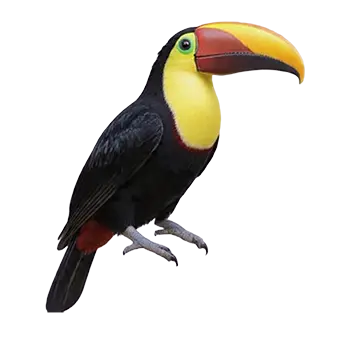

Adult Diet & Iron Management

The dietary management of an adult Swainson's Toucan is defined by a single overriding imperative: preventing iron storage disease. Hemochromatosis is the leading cause of premature death in captive ramphastids worldwide, and it develops silently over months or years as excess dietary iron accumulates in the liver, heart, and other organs. By the time clinical signs appear, often as sudden lethargy, labored breathing, or abdominal distension, the organ damage is frequently advanced and irreversible. Every dietary decision made during the adult years must be filtered through the lens of iron control.

The daily diet should consist of approximately 50 to 60 percent fresh, low-iron fruits and 30 to 40 percent low-iron softbill pellets. Suitable fruits include papaya, banana, blueberries, grapes, melon, mango, and fresh figs. Avoid dried fruits, raisins, and any fruit preserved with iron-containing additives. Citrus should be offered sparingly, as the ascorbic acid it contains dramatically increases iron absorption from other foods consumed at the same meal. Pellets must be specifically formulated for softbills or toucans with a guaranteed iron content below 100 parts per million. Standard parrot pellets, mynah bird pellets, and dog or cat food are all dangerously high in iron and must never be offered.

Animal protein continues to play a role in the adult diet, albeit a smaller one than during the juvenile growth phase. Offer gut-loaded insects, a small piece of cooked egg, or an occasional pinky mouse two to three times per week. These protein sources support feather condition, muscle maintenance, and reproductive health without overloading the bird with iron, provided they are selected carefully. Some commercial insectivore diets contain added iron; read labels meticulously and consult your avian veterinarian if the iron content is not clearly stated.

Feeding routine matters as much as food selection. Toucans have a rapid gastrointestinal transit time that typically clears the digestive tract in under an hour. This means they eat frequently throughout the day rather than consuming large meals at set intervals. Offer fresh food in the morning, replenish it at midday, and remove uneaten food in the evening to prevent fermentation and bacterial growth. Fresh water should be available continuously, and dishes should be washed and refilled at least twice daily. The consistency and discipline of the adult feeding routine directly determines the bird's long-term health trajectory.

Behavioral Enrichment & Mental Health

An adult Swainson's Toucan that lacks adequate mental stimulation will inevitably develop behavioral problems. Toucans are intelligent, socially motivated birds that require daily engagement to remain psychologically healthy, and the consequences of boredom in ramphastids are both distinctive and serious. Unlike parrots, which commonly manifest stress through feather plucking, toucans tend to express frustration and under-stimulation through excessive vocalization, repetitive bill rubbing against cage bars, aggression during handling, and stereotypic pacing or hopping patterns. These behaviors, once established, are difficult to reverse.

Daily out-of-cage time is not a luxury but a necessity for a well-adjusted adult toucan. The bird should spend a minimum of two to three hours per day outside its enclosure, interacting with its human family in a supervised, bird-safe environment. Toucans are naturally playful and will invent their own games if provided with appropriate materials. Small, lightweight balls that can be picked up and tossed with the bill are perennial favorites. Soft items that can be carried and dropped, containers that can be explored, and novel objects introduced on a rotating basis all contribute to a stimulating daily experience.

Social interaction is the most potent form of enrichment for a Swainson's Toucan. These birds thrive on attention and will actively seek out their preferred humans for engagement. Structured interaction, such as brief training sessions reinforcing learned behaviors or introducing new ones, provides both mental exercise and relationship maintenance. Even simple activities like sitting with the bird while it perches on your arm, narrating household tasks in a conversational tone, or gently tossing blueberries for the bird to catch all serve the purpose of keeping the toucan's social needs met.

For households where the bird must spend extended periods alone, environmental enrichment within the enclosure becomes critical. A foraging approach, where food is scattered, hidden in paper cups, or placed inside simple containers the bird must manipulate, encourages natural problem-solving behavior. Audio enrichment, such as leaving a radio or nature sounds playing at low volume, can reduce the isolation stress that some toucans experience. If extended solitary periods are a regular part of the household routine, strongly consider adding a second toucan as a companion, as the social buffering provided by a conspecific is something no amount of toys or background noise can replicate.

Adult Housing & Flight Space

The enclosure requirements for an adult Swainson's Toucan reflect the bird's need for flight, its sensitivity to environmental conditions, and the practical realities of managing a species that produces copious, liquid droppings. The minimum recommended enclosure for a single adult is six feet long, three feet wide, and four feet tall, though a full flight cage or dedicated bird room remains the gold standard. Toucans are horizontal flyers that cross distances in level flight rather than climbing vertically, so length is more important than height when space is limited.

Cage construction should prioritize durability, corrosion resistance, and ease of cleaning. Stainless steel is the superior material, though powder-coated steel is acceptable provided the coating is maintained and any chipping or rust is addressed immediately. Bar spacing of three-quarters of an inch to one inch prevents the bird from wedging its bill or head between bars while still allowing adequate visibility and airflow. The cage bottom should feature a pull-out tray with a grate that keeps the bird separated from its droppings, and the tray should be lined with newspaper or disposable liners that can be changed daily.

Perching arrangement within the enclosure serves both functional and health purposes. Provide a minimum of four to five perches positioned at varying heights and distances to encourage flight and hopping. Natural hardwood branches remain the best option, as they provide variable diameter gripping surfaces that exercise the feet and prevent bumblefoot, a painful inflammatory condition that develops when birds stand for prolonged periods on smooth, uniform perches. Replace soiled or stripped branches regularly and rotate new species of wood into the enclosure to maintain the bird's interest.

Environmental conditions within the enclosure room should approximate the bird's native tropical habitat as closely as practically possible. A temperature range of 68 to 80 degrees Fahrenheit is comfortable for an adult Swainson's Toucan. Humidity should be maintained above 50 percent, with 60 to 70 percent being ideal. Full-spectrum lighting with a UVB component supports vitamin D synthesis and natural circadian rhythm regulation. Provide 12 to 14 hours of light and 10 to 12 hours of uninterrupted darkness each day. The enclosure should be positioned away from kitchens, where cooking fumes and non-stick cookware emissions can be lethal to birds, and away from windows where direct sunlight could overheat the bird or drafts could cause chilling.

Routine Health Maintenance

Proactive veterinary care during the adult years is the single most effective strategy for extending a Swainson's Toucan's lifespan and quality of life. The annual wellness examination should be treated as a non-negotiable commitment, not an optional expense. Each visit provides an opportunity to detect subclinical disease, adjust dietary management, and address emerging issues before they become crises. The consequences of skipping annual examinations are particularly severe in ramphastids, because the species' most serious health threat, iron storage disease, progresses silently and is far more manageable when caught early.

The annual examination should include a comprehensive physical assessment, a complete blood count, a serum chemistry panel with iron and ferritin levels, and a fecal gram stain and wet mount. The physical examination evaluates body condition, keel prominence, feather quality, bill integrity, foot pad health, and respiratory clarity. Blood chemistry results should be compared against the individual bird's established baseline rather than generic species ranges, as normal values can vary significantly between individuals. A consistent upward trend in serum iron or ferritin, even if values remain within the published reference range, is a warning sign that demands dietary intervention.

Between veterinary visits, the caregiver's daily observations form the front line of health monitoring. Weigh the bird weekly on a gram-accurate scale and record the results. Adult Swainson's Toucans maintain a relatively stable body weight when healthy, and a loss of more than five percent of body weight over a period of weeks should trigger a veterinary consultation. Monitor droppings daily for changes in volume, consistency, color, and odor. Healthy adult toucan droppings are semisolid with a green-brown fecal component, a white urate component, and a moderate amount of liquid urine. Significant changes in any of these parameters can indicate gastrointestinal disease, hepatic compromise, or infection.

Bill and foot care are aspects of maintenance that are specific to toucans and unfamiliar to many bird owners. The bill grows continuously and can develop overgrowth, cracks, or peeling if the bird lacks appropriate chewing substrates or if nutritional deficiencies affect keratin quality. Provide hardwood branches and natural bark for the bird to work its bill against. The feet should be inspected regularly for calluses, pressure sores, and early signs of bumblefoot. Perch variety and cleanliness are the primary preventive measures. Any swelling, redness, or favoring of one foot warrants a veterinary visit, as foot infections in birds can become systemic if left untreated.

Seasonal Changes & Molting

Adult Swainson's Toucans undergo a complete annual molt that replaces all of their feathers over a period of several weeks to a few months. The molt is a metabolically demanding event that places significant strain on the bird's nutritional reserves, energy levels, and immune system. Understanding the normal molt cycle and supporting the bird through it with appropriate husbandry adjustments is an important aspect of adult toucan care that distinguishes experienced keepers from novices.

The molt typically occurs once per year and may be loosely triggered by photoperiod changes, even in indoor birds exposed to artificial lighting. Some individuals molt predictably at the same time each year, while others follow a less regular pattern. The process usually begins with the flight feathers and tail feathers, which are replaced sequentially rather than simultaneously to preserve the bird's ability to fly throughout the molt. Body contour feathers are shed and replaced more diffusely, and the bird may appear temporarily patchy or disheveled during peak molting. This is normal and does not indicate illness, provided the bird remains active and its appetite is maintained.

Nutritional support during the molt should include a modest increase in protein to supply the amino acids required for new feather synthesis. Offer additional insects, cooked egg, and ensure the softbill pellet component of the diet is consistently available. Some keepers supplement with a small amount of biotin or a poultry-grade feather conditioner, though evidence for the efficacy of supplementation in toucans is limited and any supplement must be confirmed low in iron before use. Hydration is particularly important during the molt, as dehydrated birds may produce feathers with stress bars, lines of structural weakness that make the feathers prone to breakage.

Behavioral changes during the molt are common and should be anticipated. Many toucans become somewhat irritable or withdrawn during heavy feather replacement, preferring to rest rather than engage in play or social interaction. This is a physiological response to the energy demands of the molt and should be respected. Reduce handling to essential interactions, maintain a quiet environment, and allow the bird extra rest by extending the dark period slightly. Bathing opportunities should be increased during the molt, as moisture helps soften the keratin sheaths encasing new pin feathers and provides the bird with a natural form of comfort and skin care. Once the molt is complete, the bird will emerge with a fresh, vivid plumage that reflects its underlying health and the quality of care it received during the process.

Long-Term Companionship & Household Integration

Living with an adult Swainson's Toucan is a fundamentally different experience from keeping a parrot, and the keepers who find the most success and satisfaction are those who embrace the toucan on its own terms rather than expecting it to behave like a feathered version of a cockatoo or Amazon. Toucans are affectionate, playful, and genuinely interactive companions, but their social style is distinct. They are less inclined to cuddling and more inclined to active play. They do not speak or mimic, and their vocalizations, while characterful, can be startlingly loud. They are enthusiastic bathers who spray water across surprising distances, and their fast-transit digestive systems produce frequent droppings that are difficult to contain outside an enclosure.

Successful household integration requires thoughtful planning around the toucan's daily needs and natural behaviors. Establish consistent routines for feeding, out-of-cage time, bathing, and sleep. Toucans are creatures of habit that thrive on predictability, and a stable routine reduces the stress that can trigger behavioral problems. Designate a bird-safe area of the home for out-of-cage time, ideally a room with washable surfaces, no fragile objects within reach, and good visibility so the bird can observe and participate in family life.

Interactions with other household pets require careful management. Toucans are prey animals and can be seriously injured or killed by dogs, cats, or ferrets in a matter of seconds. Even a well-intentioned pet can inflict fatal wounds through play or predatory reflex. Supervised, separated exposure may be possible with calm, well-trained household pets, but unsupervised contact should never be permitted. Other birds in the household present a different dynamic. Toucans can coexist peacefully with other ramphastids of compatible temperament, but they should never be housed with smaller birds that they might injure or with aggressive parrot species that could damage the toucan's comparatively delicate bill.

The emotional bond between a Swainson's Toucan and its primary caregiver can be deep and rewarding, but it must be balanced against the needs of the rest of the household and the bird's own need for social breadth. An overly exclusive bond leads to jealousy-driven aggression toward other family members, screaming when the preferred person is out of sight, and extreme distress during unavoidable separations such as travel or hospitalization. Mitigate this by ensuring multiple family members participate in the bird's daily care and enrichment. A toucan that has strong, positive relationships with several people is more emotionally resilient and easier to manage across the long arc of a potential two-decade companionship.

Always consult a qualified professional before making any health-related decisions. This content is provided for informational reference only and should not replace professional guidance specific to your animal.